EN
EN

Courchevel and Megève sit at the top of French skiing, and most comparisons stop at that. In practice they give you two very different weeks. Courchevel is a high, purpose-built resort in the Tarentaise, at the eastern end of the Three Valleys - the largest lift-linked ski area in the world. Megève is a Savoyard village at 1,113 m in Haute-Savoie, facing Mont Blanc, at the centre of the Evasion Mont-Blanc domain. One thing to settle before anything else: the two are not linked, share no lift pass, and sit around two hours apart by road. So this is not a question of which side of a shared area to sleep on. It is a choice between altitude and scale on one hand, and village life and a short transfer on the other.
Choose Courchevel for: high, north-facing terrain that holds snow into April, one pass covering 600 km of linked pistes, four villages sitting at four different altitudes, and ski-in/ski-out chalets a few metres from the snow.
Choose Megève for: a village with a life that predates skiing, tree-lined runs that still work when the light goes flat, the shortest transfer from Geneva of any major French resort, and a week that suits families who want more than lifts and lift queues.


| Feature | Courchevel | Megève |
|---|---|---|
| Country | France | France |
| Ski area | Three Valleys - 600 km, all lift-linked | Evasion Mont-Blanc - around 400 km across seven resorts |
| Local sector | Courchevel - around 150 km | Megève's own sectors - around 100 km; roughly 265 km lift-linked with Saint-Gervais |
| Village altitude | 1,300 m (Le Praz) to 1,850 m (Courchevel) | 1,113 m |
| Highest lift | 2,738 m (La Saulire) | Around 2,350 m (Mont Joly, on the Saint-Gervais side) |
| Season | Roughly early December to late April | Roughly mid-December to mid-April |
| Best for | Altitude, scale, doorstep skiing | Village life, dining, non-skiers |
| Village character | Purpose-built, spread across four altitudes | Savoyard village, remodelled from the 1920s |
| Nearest airport | Chambéry (~1 hr 30 min); Geneva (~2 hr 30 min) | Geneva (~1 hr 15 min) |
The headline numbers are the most misleading part of this comparison, so it is worth unpicking them. Courchevel's own sector covers around 150 km, and every metre of it feeds by lift and piste into the 600 km Three Valleys. Megève's pass quotes a figure closer to 400 km, but that total spans seven resorts and only around 265 km of it is joined up by lifts - Les Contamines, the largest chunk of the remainder, needs a bus or a car. On the ground, Courchevel gives you more skiing without taking your skis off. Its terrain climbs from wooded runs above Le Praz and La Tania through the sunny blues at Moriond to the Saulire ridge, where the couloirs start. Megève splits into Rochebrune, Mont d'Arbois, Le Jaillet and Côte 2000, not all of them linked by piste, and the skiing is gentler throughout - long, tree-lined blues and reds with Mont Blanc across the valley.
Who it suits: for a week of mileage on a single pass, Courchevel; for relaxed cruising through the trees with the best view in the Alps, Megève.
Altitude is where the two separate most sharply. Most of Courchevel's ski area sits above 1,800 m, the Saulire side faces north, and snowmaking covers the runs home, so the pistes hold their base into late April in a normal winter. Le Praz at 1,300 m is the exception and its ski-back is the first thing in the valley to go thin. Megève starts at 1,113 m and its own sectors top out around 2,000 m; the domain's high point, Mont Joly at roughly 2,350 m, sits on the Saint-Gervais side and takes a few lifts to reach. Megève answers with heavy snowmaking and with trees - wooded pistes keep their cover better than open slopes at the same height, and they stay skiable when flat light shuts the high bowls elsewhere. Even so, early December and April are a gamble there in a way they are not in Courchevel.
Who it suits: for a trip at either end of the season, or in a lean winter, Courchevel is the safer base by a clear margin.
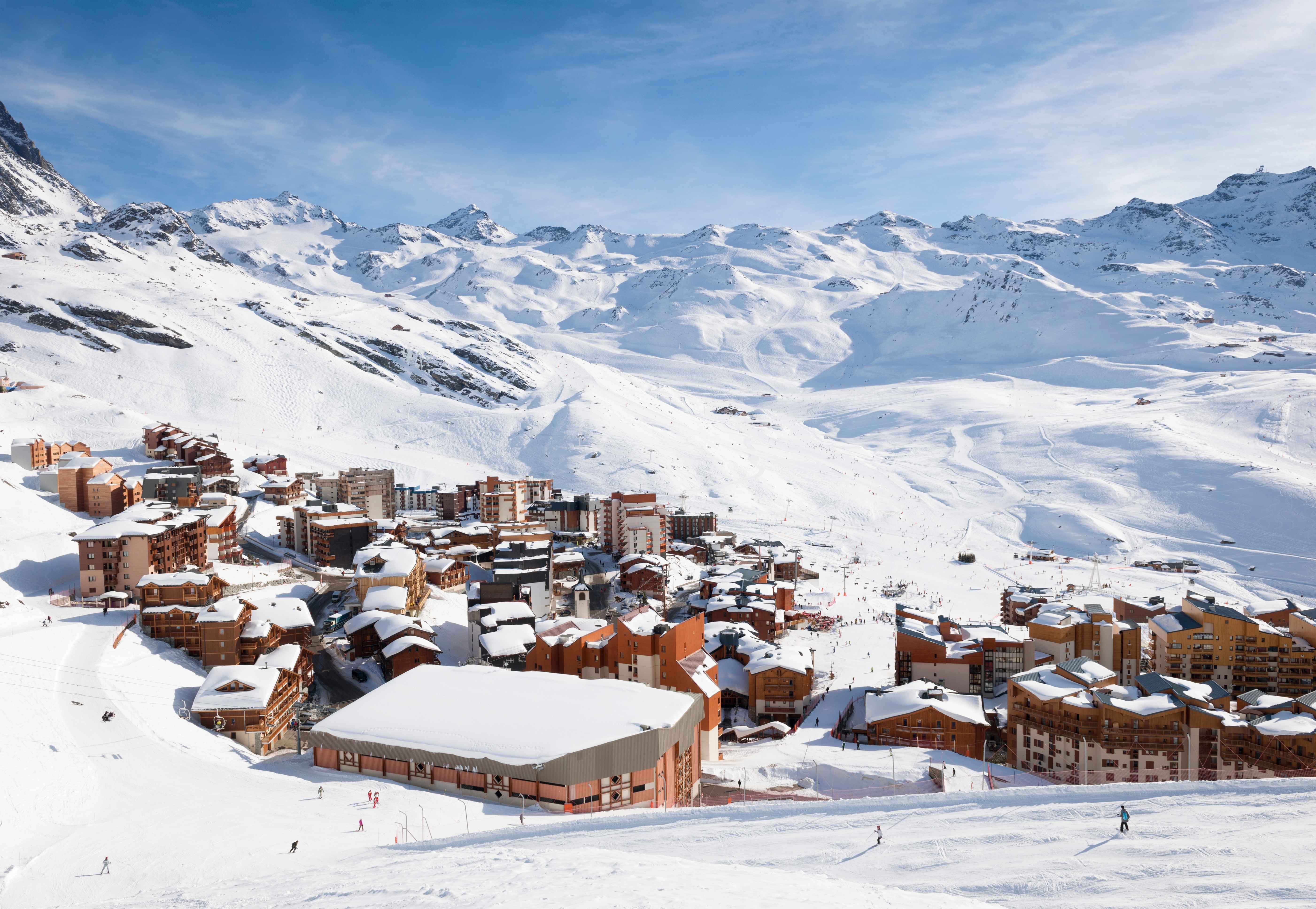
Courchevel is not one place, and picking the right one matters more than picking the resort. Le Praz sits at 1,300 m among the trees and still feels like the hamlet it was. Courchevel Village at 1,550 m is quiet with fast lift access. Moriond at 1,650 m gets the sun and works well for families. Courchevel 1850 is the one people picture - designer windows, palace hotels, piste-side chalets and prices to match. Self-catered apartments in the lower villages give you the same ski area for a very different week. Megève has one centre and no such decision to make: a pedestrianised core of independent shops and restaurants, horse-drawn sleighs on the square, and boutique hotels rather than lift-side blocks. The trade-off is that almost nothing in Megève is ski-in/ski-out - the Rochebrune cable car and the Mont d'Arbois gondola are a walk or a free bus from most beds.
Who it suits: for stepping out of the door onto snow, Courchevel; for a village you would still enjoy without skis, Megève.
Both eat extremely well, in different registers. Courchevel holds one of the densest concentrations of Michelin-starred kitchens in the Alps, with the mountain restaurants above 1850 running to the same standard as the village ones, and La Folie Douce setting the afternoon tempo on the Saulire side. Evenings in 1850 run late and the bars are polished; Moriond and Le Praz are calmer and cheaper by some distance. Megève does its eating at a slower pace. Flocons de Sel is the name everyone knows, but the character of the place is in the bistros and mountain farms, the long lunch on a sunny terrace, and a jazz scene that has been part of the village for decades. The Folie Douce at Mont Joux covers the loud end of the afternoon if you want it.
Who it suits: for a night that starts on the mountain and finishes in a bar, Courchevel; for a long dinner and a walk home through the village, Megève.
Courchevel is one of the better beginner resorts in the Alps and does not always get credit for it. Wide nursery areas sit at the base of 1850 and Moriond, several beginner lifts are free, and the dedicated novice zones spread across all four villages. Once children can link turns, the long greens and blues above Moriond give them somewhere to go. Megève's learning terrain is just as gentle but less convenient, since the main nursery areas sit up at Mont d'Arbois and La Princesse - a gondola ride at each end of the day. What Megève adds is everything around the skiing: a walkable centre, a skating rink, sleigh rides and an afternoon that does not need ski boots. Both hold the Famille Plus label, and both have strong English-speaking ski schools for beginners.
Who it suits: for the smoothest ski-school logistics, Courchevel; for a family week where the village does half the work, Megève.
Courchevel wins this one and it is not close. The Grand Couloir off La Saulire is one of the better-known lift-served descents in France, the Creux Noirs bumps up properly, and the Chapelets area skis like backcountry without being it. Add the reach into Méribel and the Belleville valley and a strong skier can spend a week without repeating much. Megève does not set out to be that resort. Its steepest pistes are the Épaule descents under Mont Joly and the Côte 2000 sector, which has hosted World Cup downhill racing, and there is off-piste under the Tête de Bonjournal for anyone who goes looking with a guide. The volume is simply smaller and the top of the mountain is lower.
Who it suits: for a week built around steep terrain, Courchevel; Megève works for a strong skier travelling with people who are not, less so for a group of them.
This is Megève's strongest card and the reason people return to it for decades. The centre is compact and pedestrianised, with galleries, a weekly market, independent shops and spa hotels, and the ski lifts are on the edge of it rather than through the middle. Someone who does not ski can have a full day there and still feel they are on holiday, which is rarely true in a purpose-built resort. Courchevel counters with Aquamotion, one of the largest aquatic centres in the Alps, along with the boutiques and restaurants of 1850. What it cannot do is walkability: the four villages are strung along a mountain road, so a day without skis means the free bus between them.
Who it suits: if someone in the group is not skiing, or you want a couple of days off the snow, Megève by a wide margin.
Megève is among the quickest major resorts in France to reach, at roughly an hour and a quarter from Geneva with motorway most of the way and only a short climb at the end. That is what makes it work for a long weekend. Courchevel takes longer from anywhere: around an hour and a half from Chambéry, two and a half from Geneva or Lyon, and the last stretch is a climb of some twenty hairpins up from Moûtiers. The rail option is better than most, though - Moûtiers is on the TGV and Eurostar ski-train network and sits about twenty-five minutes below the villages, while Megève's nearest station is at Sallanches, a short drive away. Worth repeating, since it catches people out: the two resorts are about two hours apart, so seeing both in one trip costs you a day of skiing, not a lift ride.
Who it suits: for a short break or a weekend, Megève; over a full week the transfer matters less, and Courchevel's train access is the better of the two.
WeSki insider tip: if Megève's village feel is what draws you but you cannot give up the altitude, book Courchevel Le Praz. It is the oldest of the four villages, sits in the trees at 1,300 m, and the gondola from the centre puts you on the Saulire side in well under fifteen minutes - low-village character with the whole Three Valleys above it. The trade-off is the run home, which is the first in the valley to go thin.
If you are still weighing the two, three questions settle it faster than more comparing will.
When are you going? This does most of the work on this pairing. Early December, or anything after the first week of April, leans hard towards Courchevel - it holds cover at altitude while Megève's lower slopes are leaning on snowmaking. Between January and March the gap narrows enough that the next two questions matter more.
Is anyone not skiing? Or does anyone want a day off mid-week? Megève's pedestrian centre gives them somewhere to be. Courchevel's four villages, strung along a mountain road, do not.
How many nights? On a long weekend, an extra hour and a quarter each way is a real share of the holiday, and Megève is about the easiest major French resort to reach from Geneva. Over a full week it is one morning out of eight and stops mattering.
Answer those three and one name usually stands out. If they leave you level, that is because both would give you a good week - so book on the evenings, since the days will look after themselves.
No, and it is worth knowing before you book. Unlike most head-to-head ski resort pairings, these two are not linked by lift or piste and share no lift pass. Courchevel sits in the Tarentaise valley in the Three Valleys; Megève is in Haute-Savoie, about two hours away by road, at the centre of the Evasion Mont-Blanc domain. You can visit both in one trip, but it costs a travel day rather than a gondola ride, so most people pick one and stay put.
Courchevel, comfortably. Most of its ski area sits above 1,800 m with north-facing slopes off La Saulire and snowmaking on the runs home, so it holds a base well into April. Megève's village sits at 1,113 m and its own sectors top out around 2,000 m, which makes early December and late spring far less dependable. Megève's tree-lined pistes do hold cover better than open terrain at the same altitude, and the snowmaking is extensive, but altitude is altitude.
Courchevel has the edge, mostly on convenience. Its nursery areas sit at the base of 1850 and Moriond, several of the beginner lifts are free, and there are novice zones in all four villages, so a first-timer walks to their lesson. Megève's main learning areas are up at Mont d'Arbois and La Princesse, which means a gondola at each end of the day. The terrain itself is gentle in both, and both have well-regarded English-speaking ski schools.
Courchevel 1850 sits at the top of the French market, so if that is the comparison then yes. The fuller answer is that Courchevel is four villages, not one. Le Praz, Courchevel Village and Moriond have plenty of self-catered apartments and mid-range hotels on the same ski area, which changes the picture a great deal. Megève is more consistent across the board - boutique hotels and chalets rather than palaces - so the gap depends almost entirely on which Courchevel you mean.
It depends on what makes your week easier. Courchevel wins on logistics: ski-in/ski-out accommodation, free beginner lifts, wide nursery slopes and the Aquamotion centre for a day off. Megève wins on everything around the skiing - a walkable pedestrian centre, a skating rink, sleigh rides and a village that keeps children busy without ski boots. Families skiing hard every day tend to lean Courchevel; those who want a gentler rhythm lean Megève.
Megève, and by some distance. Its centre is compact, pedestrianised and full of shops, galleries, spas and restaurants, with the lifts sitting on the edge rather than running through the middle. A non-skier can fill a week there without feeling they are waiting for everyone else. Courchevel has Aquamotion and the boutiques of 1850, but the four villages are spread along a mountain road, so getting around without skis means the free bus.