EN
EN
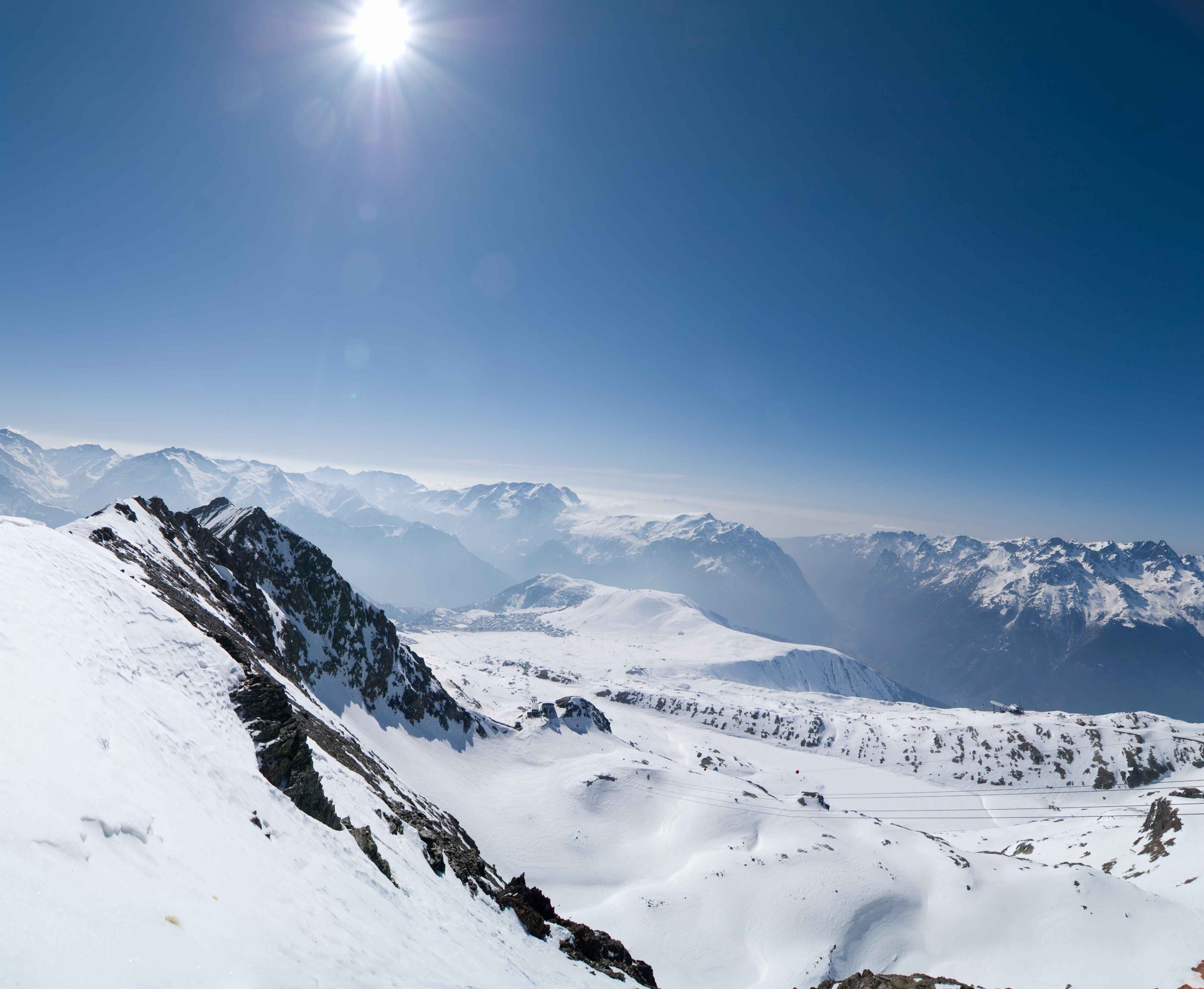
Vaujany and Alpe d'Huez sit at opposite ends of the same mountain. One pass covers the whole 250 km of the Alpe d'Huez Grand Domaine from either village, so unlike most head-to-heads this one is not a choice about terrain - you ski the same area whichever you book. What changes is the village you come back to, and how you get back to it. Alpe d'Huez is a large resort spread across a sunny plateau at 1,860 m, with the beginner slopes, the bars and the lifts all on its doorstep. Vaujany is a working village of a few hundred residents at 1,250 m, joined to the mountain by a cable car that takes 160 skiers at a time. This guide compares them on terrain, snow, passes, villages, families, experts and transfers.
Choose Vaujany for: a small village with a pool, an ice rink and covered lifts between its streets, paid for by the hydroelectric scheme in the valley below, the only properly tree-lined runs in the ski area for days when the light goes flat, and a road in that avoids the 21 hairpin bends - which matters to families with anyone who travels badly.
Choose Alpe d'Huez for: one of the largest beginner areas in the Alps, sitting at village level with free lifts and greens that lead back to the same spot, which is why it works for first-timers, plus around 300 days of sunshine a year, the 16 km Sarenne, the couloirs off Pic Blanc and the busiest evenings in the Oisans.


| Feature | Vaujany | Alpe d'Huez |
|---|---|---|
| Country | France | France |
| Shared ski area | Alpe d'Huez Grand Domaine - around 250 km across five linked villages | Alpe d'Huez Grand Domaine - around 250 km across five linked villages |
| Village altitude | 1,250 m | 1,860 m |
| Highest lift | 3,330 m (Pic Blanc, shared) | 3,330 m (Pic Blanc) |
| Slope aspect | Mostly north and north-west, with trees on the lower runs | Mostly south and west, above the treeline |
| Season | Roughly early December to late April | Roughly early December to late April |
| Lift pass | Alpe d'Huez Grand Domaine - the same pass from either village | Alpe d'Huez Grand Domaine - the same pass from either village |
| Best for | Quiet evenings, tree runs, short easy transfer | Beginners, sunshine, long descents, après |
| Village character | Working mountain village of a few hundred residents | Large resort spread across an open plateau |
| Nearest airport | Grenoble (~1 hr 30 min); Lyon (~2 hr) | Grenoble (~1 hr 45 min); Lyon (~2 hr 15 min) |
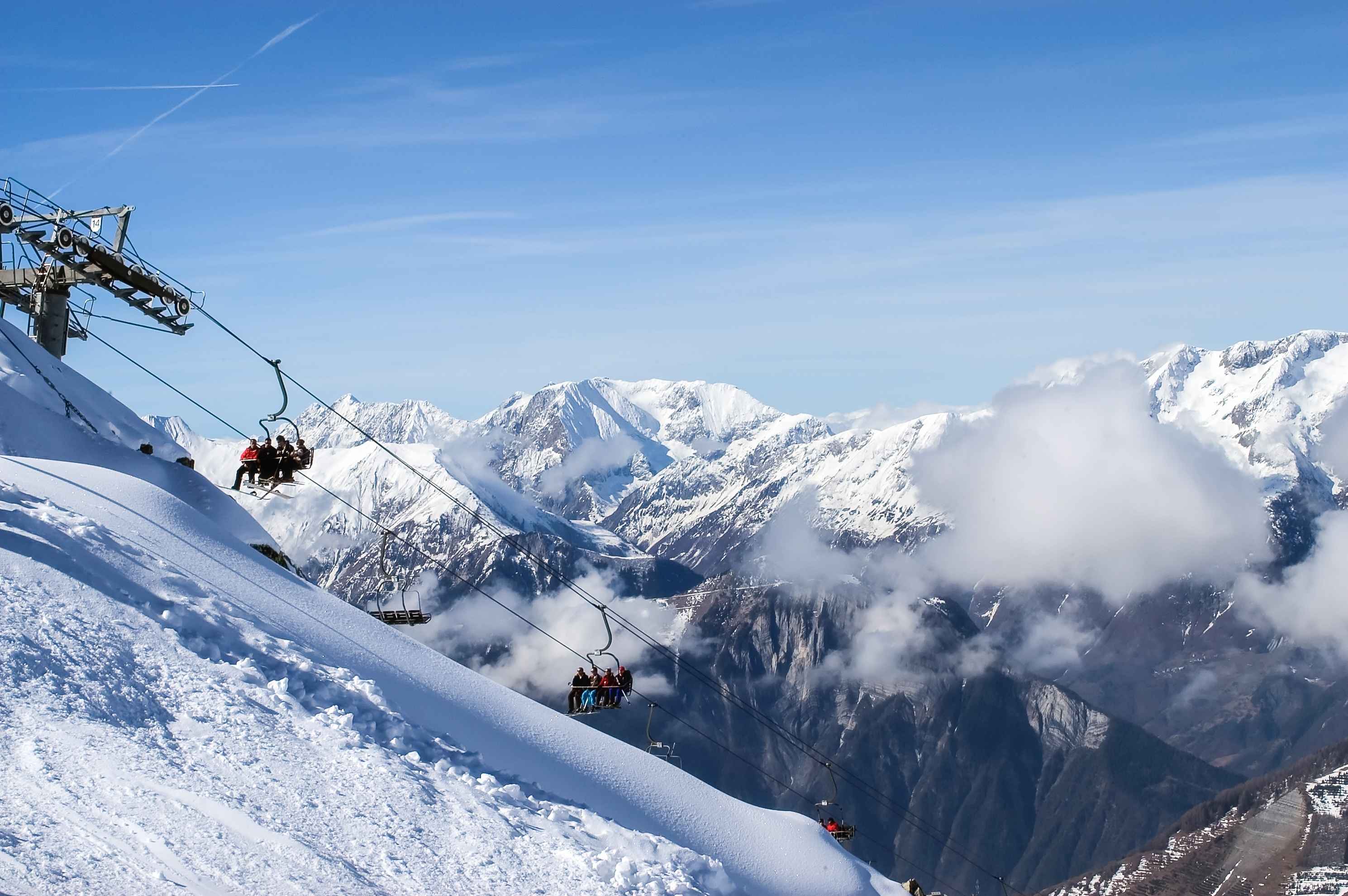
Both villages ski the same 250 km, so the useful question is what sits at the bottom of your first lift. Vaujany's own sector is Montfrais, reached by gondola from the village: wide sheltered blues, a nursery area well away from through traffic, and the only stretch of tree-lined piste in the area. The 160-person cable car climbs the other way, lifting you to the Dôme des Rousses at 2,800 m in under ten minutes and putting you on the ridge that runs across to everything else. Alpe d'Huez starts you in the middle of it all instead: the Signal side above the village, the Marmottes lifts feeding Pic Blanc at 3,330 m, and the whole fan of pistes spreading out from the plateau. The area's real distinction is vertical rather than distance - several descents drop more than 2,000 m from the top to the valley floor at Vaujany, La Villette and l'Enversin.
Who it suits: for a quiet corner with trees and a nursery slope of its own, Vaujany; for starting each day in the centre of the area, Alpe d'Huez.
The altitude gap between the two villages looks decisive and mostly is not, because both ride lifts onto the same high ground. Pic Blanc at 3,330 m and the glacier beneath it hold a base as well as anywhere in the region, and over a thousand snow guns cover the pistes from the top of the area down to the valley floor. Where altitude does bite is the last few hundred metres of the day. Alpe d'Huez's runs end at 1,860 m, high enough that skiing into the village works through most of the season, though its slopes face largely south and the lower ones soften quickly once the spring sun gets strong. Vaujany's runs end around 1,150 m, the lowest point in the area, so they are the first to close in a thin winter - but they face north and north-west and keep cold snow far longer than the numbers suggest once they are open.
Who it suits: for a late-season trip where you want to ski to the door, Alpe d'Huez; for cold, shaded snow on the runs below you through midwinter, Vaujany.
This is the part that takes the pressure off the decision. The Alpe d'Huez Grand Domaine pass covers all five linked villages and costs the same wherever you sleep, so nobody gets a smaller mountain for staying in the smaller village. The area also sells cut-down passes covering a single village's own slopes, which is worth knowing if someone in the group will spend the week on Montfrais and never needs the rest of it. Passes of six days or longer add the Grande Galaxie agreement on top: free days at Les Deux Alpes across the valley, Serre Chevalier, Montgenèvre, Puy Saint Vincent and Sestriere over in the Milky Way. None of them is lift-linked, so you drive, and passes bought online usually need activating at the resort that sold them before the partner days work.
Who it suits: identical either way, so let the pass settle nothing - book six days or more if you want the partner resorts, and choose the village on everything else.
Vaujany is the more unusual of the two, and the reason is in the valley below it. In the 1980s EDF built France's largest hydroelectric scheme on the Eau d'Olle, and the commune has drawn a rent from it ever since. That income built the cable car, a leisure centre with a pool and a gym, an ice rink, and the escalators and covered lifts that carry people between the village's upper and lower levels instead of up a steep street in ski boots. What you get is a few hundred residents with the facilities of somewhere many times the size, and a place that still functions as a village rather than a resort. Most of what you can book there is chalets and apartments. Alpe d'Huez runs the other way: a large station laid out in districts across the plateau - Les Bergers, the Rond-Point des Pistes, the older Vieil Alpe - with the widest choice of hotels, shops and restaurants in the Oisans. It is big enough that where you stay inside it matters nearly as much as which resort you pick.
Who it suits: for a village you can cross in ten minutes and still swim in the evening, Vaujany; for choice in accommodation and somewhere to walk to after dinner, Alpe d'Huez.
Competitors tend to describe both villages as having direct access to the ski area, which is true and skips the part you notice daily. Alpe d'Huez's pistes finish in the resort itself. Vaujany's finish below it: the two runs down the Vaujany side, including the La Fare black, carry on past the village to the valley floor, and a short lift brings you back up the last stretch. It is quick and it works, but it is a lift rather than a doorstep. The return journey is the bigger consideration. Vaujany sits at the far northern end of the area, so a day over on the Pic Blanc side means a chain of lifts to get back, and the closing time of the last one sets your afternoon curfew - worth checking on the first morning rather than the first time you cut it fine. The same applies in reverse from Alpe d'Huez, where Montfrais is the furthest corner of the map.
Who it suits: for skiing to your accommodation without watching the clock, Alpe d'Huez; for a short lift home and an emptier mountain to ski it from, Vaujany.
Alpe d'Huez has the bigger afternoon by a wide margin. La Folie Douce above the Marmottes lifts starts things in mid-afternoon, the district bars carry it on, and the spread of restaurants is broad enough that a group with different tastes will find somewhere everyone is happy with. It also hosts a large electronic music festival for a week each March, which is either the reason to book that week or the reason to avoid it - check the dates either way. Vaujany does none of this and does not pretend otherwise. A handful of bars fill up when the lifts stop and empty again by mid-evening, the eating leans towards small mountain restaurants and chalet tables, and for many people staying there the pool and the ice rink do more for the evening than a bar would.
Who it suits: for a slopeside afternoon that runs into a night out, Alpe d'Huez; for an early start the next morning, Vaujany.
Alpe d'Huez has the stronger beginner set-up in pure terms. Its beginner area is among the largest in the Alps, sits along the top of the village with free lifts, and the green runs above it return to the same place, so someone on day one skis back rather than riding down. Vaujany's answer is Montfrais, a sector of its own reached by gondola: gentler, sheltered by trees, and quiet because most of the area's traffic is somewhere else entirely. Add the escalators through the village, the pool, the ice rink and the bowling for a day off the snow, and the logistics of a week with small children are easier than the altitude suggests. The trade-off is that a beginner in Vaujany takes a gondola up and down each day instead of walking to the slope.
Who it suits: for an absolute first-timer who wants to ski home from day one, Alpe d'Huez; for quiet nursery slopes and short walks in the village, Vaujany.
Alpe d'Huez keeps its hardest skiing close to the top. The Tunnel drops off Pic Blanc through a passage cut under the ridge onto one of the steepest pitches in French skiing, the couloirs sit either side of it, and the Sarenne runs 16 km off the summit, though only its first section earns the black grading and the rest is a long cruise a confident intermediate will enjoy. The off-piste around the glacier is extensive and repays a guide. Vaujany's case rests on one run and the ground around it: La Fare drops the full Vaujany side in a single black, part of a descent of more than 2,000 m from the top of the area to the valley, on a face that sees little sun and holds its snow. It is one of the biggest continuous verticals you can ski in the Alps, and it starts from the same lifts.
Who it suits: for couloirs and moguls straight off a lift, plus two parks, Alpe d'Huez; for long shaded descents and quiet snow after a storm, the Vaujany side.
Grenoble is the nearest airport to both, at around an hour and a half to Vaujany and a little under two hours to Alpe d'Huez. Lyon adds roughly half an hour to each, and Geneva is around two and a half hours to Vaujany and three to Alpe d'Huez. The gap is small but it comes from the one part of the journey worth knowing about. Alpe d'Huez sits at the top of the 21 hairpin bends out of Bourg d'Oisans, the climb the Tour de France made famous, which is fine in a car and less fine for anyone in the back who travels badly, and it is the section that needs chains or gets held up in heavy snow. Traffic for Vaujany turns off earlier, at Rochetaillée, and follows a valley road up the Eau d'Olle instead, missing the bends entirely. Neither village has a railway station; the nearest is Grenoble, then a bus.
Who it suits: for the widest choice of flights and a short hop from Grenoble, either works; for the gentler final climb, Vaujany.
WeSki insider tip: treat the two ends of the area as separate days rather than crossing back and forth. From Vaujany, take the cable car on the first lift and be on the Pic Blanc side by mid-morning, then start working back by mid-afternoon. From Alpe d'Huez, go the other way after lunch - the Vaujany runs and Montfrais empty out once the day's visitors turn for home, and the tree-lined lower section is the place to be when the light goes flat up top.
The skiing is the same from both, so three other questions tend to settle it.
Is anyone in the group on their first skis? Alpe d'Huez, on the beginner area alone - village level, free lifts, and greens that come back to where you started. Vaujany's Montfrais is gentler and much quieter, but it is a gondola ride from the village at each end of the day, which is a lot to ask of someone learning.
How is the group travelling, and with whom? Vaujany's road in skips the 21 hairpins, which is worth a great deal with young children or anyone prone to car sickness, and the transfer is shorter from every airport. If nobody minds the climb, this one cancels out.
What do you want the evening to look like? Alpe d'Huez has the range - bars, restaurants, a festival week in March. Vaujany has a pool, an ice rink and a quiet street. Since the mountain cannot break the tie here, this is usually what does.
Yes, easily and in both directions. Vaujany's cable car climbs to the Dôme des Rousses at 2,800 m, which puts you on the ridge linking into the main Alpe d'Huez sectors, and the pistes run back the other way through Montfrais and l'Alpette. Most people staying in either village ski both ends of the area during a week. The only thing to plan around is the last lift back, since Vaujany sits at the far end of the map and the return takes a chain of lifts rather than one run.
It is, and the reverse is true too. Vaujany is one of the five villages that make up the Alpe d'Huez Grand Domaine, so a single pass covers around 250 km of pistes across all of them, bought at the same price wherever you are staying. Smaller passes covering one village's own slopes are sold as well, which can suit a beginner sticking to Montfrais. Six days or longer also brings in Grande Galaxie days at Les Deux Alpes, Serre Chevalier, Montgenèvre, Puy Saint Vincent and Sestriere.
Alpe d'Huez has the edge for a first week. Its beginner area is one of the biggest in the Alps, runs along the top of the village with free lifts, and the greens above it feed back to the same spot, so a first-timer skis home rather than riding a lift down. Vaujany's Montfrais sector is gentler and far quieter, with sheltered tree-lined runs, but it sits above the village rather than beside it, so every day starts and ends with a gondola.
For the skiing itself they are level, because both use the same high ground up to Pic Blanc at 3,330 m. The difference is at village level. Alpe d'Huez sits at 1,860 m and holds its runs home for most of the season, although its slopes face largely south and soften under strong spring sun. Vaujany's runs finish around 1,150 m, the lowest point in the area, so they close earliest in a lean winter - but they face north and keep cold snow well when they are open.
Almost, and the distinction is worth knowing before you book. The two runs down the Vaujany side, including the La Fare black, carry on below the village to the valley floor, and a short lift takes you back up the last section into the village itself. It is a couple of minutes rather than a trek, and the covered lifts and escalators handle the rest once you are there. Alpe d'Huez, by contrast, has pistes that finish in the resort, so you step off your skis where you are staying.
The lift pass is the same, since both sit inside the Grand Domaine, so any difference shows up in the style of the stay rather than on the mountain. Vaujany is mostly chalets and apartments with a handful of restaurants, and much of what fills an evening there - the pool, the ice rink, the skating - belongs to the village. Alpe d'Huez carries the range you would expect of a large station, from apartments to smart hotels, with a much broader dining and après scene attached. It comes down to which sort of week you want.