EN
EN
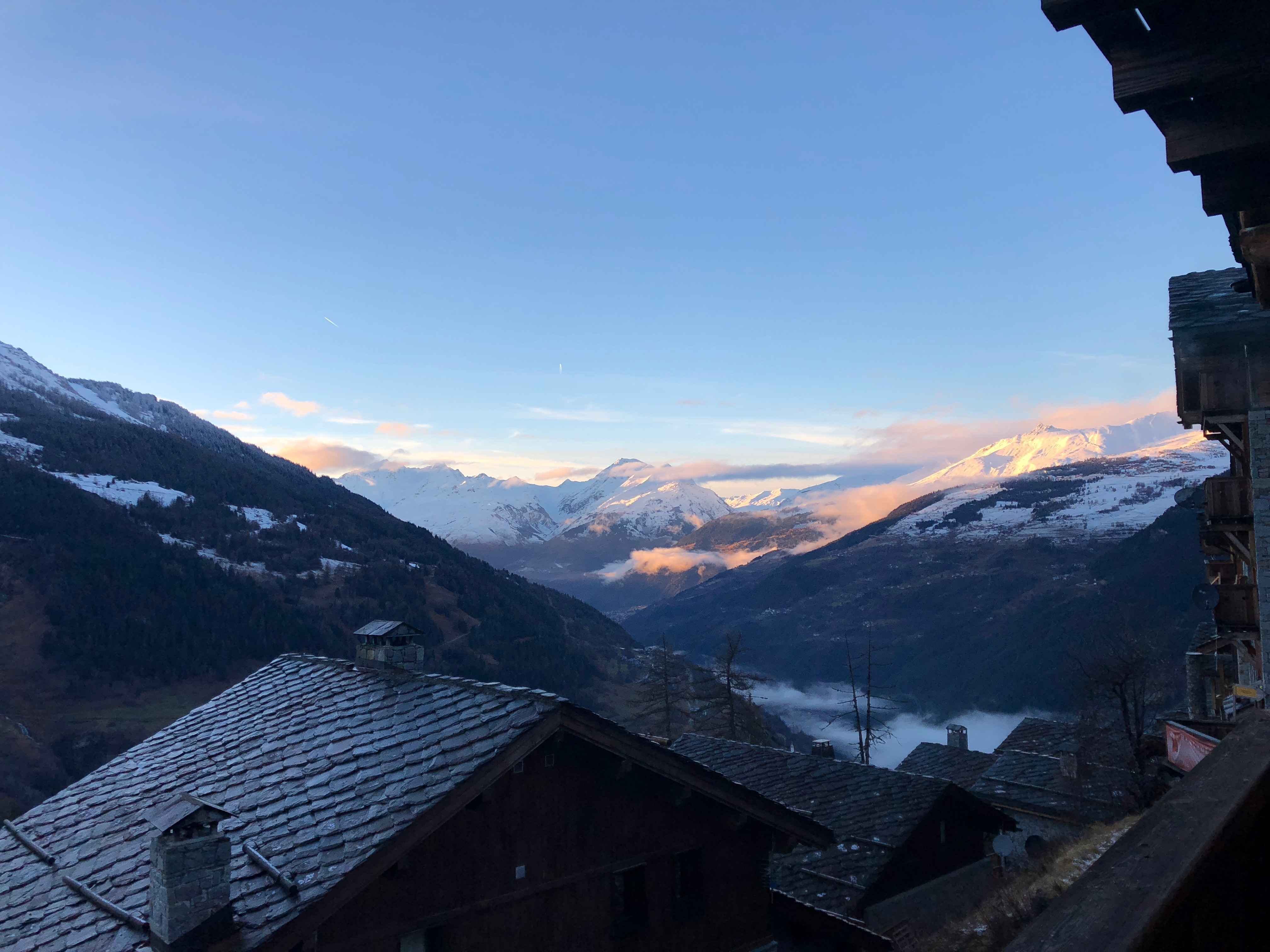
Sainte Foy in the French Tarentaise and La Thuile in the Italian Aosta valley sit a short distance apart across the Col du Petit Saint-Bernard, and for most of the winter the road between them is shut. They share no lift pass and no lift link. Sainte Foy is a six-lift area of around 40 km; La Thuile skis the Italian half of the Espace San Bernardo, roughly 150 km spread across two countries. What they do have in common is a role: each is the quiet, north-facing, tree-heavy option sitting next to far busier neighbours, and each attracts skiers who rate snow quality above piste mileage. This guide compares them on terrain, snow, what each lift pass actually covers, villages, families, experts and getting there.
Choose Sainte Foy for: lift-served off-piste that stays skiable for days after a storm, larch-forest tree runs for flat-light mornings, pistes that stay quiet through half term, and a position within half an hour of three of the largest ski areas in France if you have a car.
Choose La Thuile for: around 150 km on a single pass spanning two countries, a sustained 1,200 m of vertical back to the village, the Franco Berthod World Cup black, unhurried Italian lunches, and heli-skiing on the Ruitor glacier.


| Feature | Sainte Foy | La Thuile |
|---|---|---|
| Country | France | Italy |
| Ski area | Sainte Foy - around 40 km of pistes, six lifts | Espace San Bernardo, shared with La Rosière - around 150 km of pistes |
| Village altitude | 1,550 m (Sainte Foy Station) | 1,441 m |
| Highest lift | 2,620 m (Col de l'Aiguille) | 2,641 m (Belvedere) |
| Slope aspect | Mainly north-west, much of it through larch forest | Mainly north, much of it in trees |
| Lift pass | Local area only; longer passes usually carry a reduced day rate at Tarentaise neighbours | Espace San Bernardo covers France and Italy; an Aosta Valley pass covers the wider region |
| Season | Roughly mid-December to mid-April | Roughly early December to late April |
| Best for | Off-piste, tree skiing, quiet pistes, touring the Tarentaise | Mileage, long vertical, mountain lunches, freeride |
| Village character | Small modern station built in Savoyard style | Former mining village on the valley floor |
| Nearest airport | Chambéry (~1 hr 30 min); Geneva (~2 hr 30 min) | Turin (~1 hr 45 min); Geneva (~3 hr) |
The gap in size is the first thing to weigh, and it is wider than the map suggests. Sainte Foy runs two chairs out of the village and two above them, climbing from 1,550 m to the Col de l'Aiguille at 2,620 m over around 40 km of piste. Almost all of it faces north-west, the lower half cutting through larch forest and the upper half opening into wide bowls, and the marked runs lean towards easy reds and long blues rather than anything severe. La Thuile has more than three times the mileage, because its pass reaches over the col into France. From Belvedere at 2,641 m the runs drop through high open ground to Les Suches at 2,200 m and then into forest all the way to the village, a sustained 1,200 m in one go. Strong intermediates who want to ski top to bottom without stopping will find more of that in Italy.
Who it suits: for a small area skied properly, Sainte Foy; for mileage and long descents, La Thuile.
Neither is high by Tarentaise standards, and both get away with it for the same reason: aspect. Sainte Foy has a local reputation as a snow pocket, and its north-west exposure plus forest cover means fresh snow sits untracked for days rather than hours, helped by the lack of crowds. Snowmaking covers the lower runs home. La Thuile faces north and keeps much of its terrain under trees, which holds a firmer surface through sunny spells and into spring, and the area's season tends to run a little longer at both ends. The honest summary is that these two are closer on snow than on anything else. Where they part company is what happens in a lean winter: Sainte Foy's smaller area gives you fewer places to go when cover is thin, while La Thuile can send you over to the sunnier French side and back.
Who it suits: for untracked snow days after a storm, Sainte Foy; for a longer season and somewhere to move to when conditions turn, La Thuile.
This is the section that decides most weeks here, and it is the one competitors skip. Sainte Foy sells a pass for its own area and nothing else - there is no link to a neighbour and nothing included beyond the six lifts. What longer passes have carried instead is a reduced day rate at nearby resorts, usually on passes of six days or more bought at the public rate: Val d'Isère, Tignes, Les Arcs, La Plagne, Valmorel and La Rosière. The terms are set each season, so check at the ticket office rather than assuming, but the shape of it is stable: Sainte Foy works as a base for the valley as much as a resort in its own right, and that only pays off with a car.
La Thuile starts from the opposite position. Anything beyond a day pass covers the whole Espace San Bernardo, so France is already paid for. Above that sits the Aosta Valley pass, a regional multi-day ticket valid across the region's resorts - Courmayeur is under half an hour down the road, with Pila, Cervinia and the Monterosa resorts around Champoluc further east. One detail catches people out: the link between the two resorts on this page runs one way. From Sainte Foy you can drive to La Rosière in about half an hour and ski over the col to La Thuile for the day. From La Thuile you cannot do the reverse, because the col road is closed through the winter and the way round goes through the Mont Blanc tunnel.
Who it suits: for a base to explore the Tarentaise by car, Sainte Foy; for a week where everything is on one ticket, La Thuile.
Sainte Foy Station is a small, recent build in old Savoyard materials, four kilometres above the valley village it takes its name from and well off the through road to Val d'Isère. Everything is within a few minutes on foot, the chairs leave from the middle of it, and most of what you can book sits on or beside the snow - catered chalets and recent apartment residences rather than large hotels. La Thuile is older and lower: a former mining village on the valley floor with a stone quarter, a river through the middle and the large Planibel complex next to the gondola. Accommodation runs from family-run hotels to apartments, and much less of it is on the snow, so most mornings start with a gondola ride up and end with one down.
Who it suits: for stepping out of the door onto a piste, Sainte Foy; for a village with some history and more to walk around, La Thuile.
Neither resort is a late-night proposition, so the difference shows at lunchtime. La Thuile has the stronger mountain eating by a clear margin - Aosta valley cooking, table service and afternoons that run long, and it is the reason plenty of skiers staying in France cross the col at midday. Lo Riondet is the name most often repeated. Sainte Foy keeps a handful of bars around the base and a short list of restaurants in the village, with La Maison à Colonnes doing the traditional Savoyard end of it, and the evening tends to finish early. Anyone wanting volume and noise is better served up the valley in Val d'Isère, which is part of why Sainte Foy stays as quiet as it does.
Who it suits: for long lunches and Italian cooking, La Thuile; for a quiet evening and an early start, Sainte Foy.
Sainte Foy makes the simpler week with young children, and the reason is geography rather than teaching. The nursery ground sits at village level with magic carpets on it, the greens and blues above come back to the same place, and nothing involves a gondola or a bus at either end of the day. Add uncrowded pistes and short lift queues and a first week is about as low-friction as French skiing gets, which is why family bookings hold up here despite the small area. La Thuile puts its learning terrain up at Les Suches rather than in the village, so each morning starts with kit, children and a lift ride, though the plateau up there is wide and quiet once you arrive. Older children who already link turns will get more out of the Italian side; a first-timer will not notice the missing kilometres at either.
Who it suits: for a first week or young children, Sainte Foy; for families already skiing blues and reds, La Thuile.
Sainte Foy's reputation with strong skiers rests on what sits just outside the piste markers. The Aiguille chair opens onto broad north-west faces, the Pointe de Foglietta and the route down past the old hamlet of Le Monal are the two descents people come back for, and the resort marks several ungroomed but patrolled runs for anyone wanting to try the surface before committing to a guided day. Tracked-out powder is rarer here than in resorts ten times the size. La Thuile answers with more inside the ropes: the Franco Berthod is a World Cup downhill that drops through forest at a pitch few Italian resorts match, the Fourclaz chair serves the best of the local off-piste, and the Ruitor glacier above the village is among the better heli-skiing grounds in the Alps. Heli-drops are banned in France, so that last one has no equivalent at Sainte Foy at all.
Who it suits: for quiet lift-served powder and tree skiing, Sainte Foy; for steep pistes and heli-skiing, La Thuile.
The two sit in different countries with no airport in common, so this is one of the comparisons where the travel day can decide it on its own. Sainte Foy is around an hour and a half from Chambéry and about two and a half hours from Geneva, with Lyon and Grenoble a similar distance. The detail that matters for anyone not flying is Bourg-Saint-Maurice, half an hour down the hill: it is a mainline terminus with direct trains from Paris and a seasonal service from London, which makes Sainte Foy one of the easier small resorts in the Alps to reach without a plane. La Thuile is roughly an hour and three-quarters from Turin and around two and a half from Milan, both of which are straightforward, but closer to three hours from Geneva because the route goes round through the Mont Blanc tunnel. There is no useful rail option on the Italian side.
Who it suits: Chambéry, Geneva or the train point to Sainte Foy; Turin and Milan point to La Thuile.
WeSki insider tip: if you are basing in Sainte Foy and want a day in Italy, drive to La Rosière first thing and check the col lifts are turning before you buy the day pass. The chain of drags over the Petit Saint-Bernard is the most wind-exposed part of the Espace San Bernardo and closes independently of everything below it. Go on the first still morning of the week rather than saving it for the Friday, and you keep a second attempt in hand.
No shared pass and no shared lifts, so this is a clean choice rather than a question of which village to sleep in. Three things usually settle it.
How many days are you skiing, and do you have a car? Around 40 km fills a long weekend comfortably and a full week only if you are hunting snow rather than covering ground. With a car, Sainte Foy turns into a base for the whole Haute Tarentaise. Without one, a week is a lot to ask of six lifts, and La Thuile's 150 km is the safer booking.
Is the trip about powder or about mileage? Sainte Foy is the stronger call if the group would rather find untracked snow on day three than tick off runs. La Thuile is the stronger call if the group wants to keep moving and finish somewhere different each afternoon.
Which airport are you flying into? Geneva and Chambéry point to Sainte Foy, and so does the train. Turin and Milan point to La Thuile. On a short break the gap is wide enough to decide the question on its own.
Not directly, no. There is no lift link between them and they are on separate passes, and although they sit close together on a map, the Col du Petit Saint-Bernard road between them is closed through the winter. What you can do from Sainte Foy is drive about half an hour to La Rosière and ski over the col into La Thuile for the day on an Espace San Bernardo pass. It does not work in reverse, because from the Italian side the only road back to France goes round through the Mont Blanc tunnel.
La Thuile, by a wide margin. Sainte Foy has around 40 km of piste served by six lifts, all of it within one compact area. La Thuile's pass covers the Espace San Bernardo, roughly 150 km shared with La Rosière across the French border, which is more than three times the terrain. The figures do not tell you everything, though: Sainte Foy's appeal rests on the off-piste and the absence of crowds rather than the length of the piste map.
They are closely matched, which is unusual for two resorts this different in size. Both sit lower than their famous neighbours and both get away with it through aspect: Sainte Foy faces north-west with forest on its lower half, La Thuile faces north with trees for most of its vertical. Sainte Foy holds untracked snow longer simply because fewer people are skiing it. La Thuile has the slightly longer season and, when cover is thin, somewhere else to send you.
Sainte Foy, fairly clearly. Its nursery area is at village level, the easy runs above it return to the same spot, and there is no lift ride at either end of the day with skis and children in tow. La Thuile's learning terrain is wide and quiet but sits above the village at Les Suches, which means a gondola each morning. Both have English-speaking ski schools, so this comes down to the shape of the mountain rather than the standard of teaching.
Both have a reputation for being easier on the wallet than their better-known neighbours, and for different reasons. Sainte Foy's stock is weighted towards self-catered apartments and catered chalets, with a short list of restaurants and a small local lift pass. La Thuile leans on family-run hotels and Italian mountain restaurants, with a pass covering two countries. What you spend depends far more on the style of week you book than on which side of the border you are on.
There is, and it catches people out when they set a sat nav. Sainte Foy's own commune contains a hamlet called La Thuile, a few kilometres from the ski station, which shares its name with the Italian resort an hour or so away by road in summer. If you are booking or driving, look for La Thuile in the Aosta valley, Italy, rather than La Thuile in Savoie. Both sit near the same mountain pass, which is where the shared name comes from in the first place.