EN
EN
 Stunning views
 Classic mountain charm
 Off-mountain activitiesStunning viewsClassic mountain charmOff-mountain activitiesStunning viewsClassic mountain charmOff-mountain activitiesStunning viewsClassic mountain charmOff-mountain activities
Moena is one of the prettiest towns in the Dolomites of northern Italy, tucked into the Val di Fassa, a valley high in the Trentino mountains. It's long been known as the fairy tale of the Dolomites, a nickname that stuck after a visiting painter described it that way over a century ago, and it's easy to see why, with pastel houses gathered below soaring pale-rock peaks. For all its charm, it's a proper working town rather than a purpose-built resort, with good restaurants, shops, a lively central piazza, and the nightly passeggiata, while still holding on to the Ladin language and mountain traditions that have shaped this valley for generations. The Alpe Lusia-Bellamonte ski area rises on the mountains just to the south.rentino Dolomites offer some of the most rewarding ski destinations in the Alps, and Moena is among the most complete.
The skiing itself has two contrasting sides. Above Bellamonte, the slopes are sunny, wide, and gentle, easy terrain for beginners to settle into, while the Moena side of the mountain faces north and skis steeper and more testing, with a run of reds and blacks for confident intermediates and strong skiers. In between there's plenty of long cruising, including a top-to-bottom descent of around 3km. Most of the area sits above the treeline, so you ski out in the open with huge Dolomite peaks on every side. It's a modern, gondola-served mountain, and a friendly size in its own right, though it also links over to the neighbouring San Pellegrino slopes and forms part of the vast Dolomiti Superski region. High altitude and plenty of snowmaking keep it well covered through a season that runs from early December into April.
There's a lot to enjoy here beyond the pistes. Moena is proud of its food, above all the Puzzone di Moena, a pungent, full-flavoured local cheese with Slow Food status that turns up all over the valley's Ladin cooking, alongside hearty mountain dishes and good Trentino wines. The valley is also one of Italy's great cross-country skiing centres, with kilometres of groomed trails through the woods and the famous Marcialonga, a 70km cross-country marathon that sets off from Moena each January. Away from the skiing you can head out snowshoeing, take the children sledging on the long Fraina run, or wander the old streets, visit the twelfth-century church, and settle in for an aperitivo in the piazza. Between the mountains, the food, and the town itself, Moena makes for a well-rounded Dolomites holiday.
Check out Moena - Alpe Lusia - Bellamonte ski deals to start planning your trip.
Moena is one of the prettiest towns in the Dolomites of northern Italy, tucked into the Val di Fassa, a valley high in the Trentino mountains. It's long been known as the fairy tale of the Dolomites, a nickname that stuck after a visiting painter described it that way over a century ago, and it's easy to see why, with pastel houses gathered below soaring pale-rock peaks. For all its charm, it's a proper working town rather than a purpose-built resort, with good restaurants, shops, a lively central piazza, and the nightly passeggiata, while still holding on to the Ladin language and mountain traditions that have shaped this valley for generations. The Alpe Lusia-Bellamonte ski area rises on the mountains just to the south.rentino Dolomites offer some of the most rewarding ski destinations in the Alps, and Moena is among the most complete.
The skiing itself has two contrasting sides. Above Bellamonte, the slopes are sunny, wide, and gentle, easy terrain for beginners to settle into, while the Moena side of the mountain faces north and skis steeper and more testing, with a run of reds and blacks for confident intermediates and strong skiers. In between there's plenty of long cruising, including a top-to-bottom descent of around 3km. Most of the area sits above the treeline, so you ski out in the open with huge Dolomite peaks on every side. It's a modern, gondola-served mountain, and a friendly size in its own right, though it also links over to the neighbouring San Pellegrino slopes and forms part of the vast Dolomiti Superski region. High altitude and plenty of snowmaking keep it well covered through a season that runs from early December into April.
There's a lot to enjoy here beyond the pistes. Moena is proud of its food, above all the Puzzone di Moena, a pungent, full-flavoured local cheese with Slow Food status that turns up all over the valley's Ladin cooking, alongside hearty mountain dishes and good Trentino wines. The valley is also one of Italy's great cross-country skiing centres, with kilometres of groomed trails through the woods and the famous Marcialonga, a 70km cross-country marathon that sets off from Moena each January. Away from the skiing you can head out snowshoeing, take the children sledging on the long Fraina run, or wander the old streets, visit the twelfth-century church, and settle in for an aperitivo in the piazza. Between the mountains, the food, and the town itself, Moena makes for a well-rounded Dolomites holiday.
Check out Moena - Alpe Lusia - Bellamonte ski deals to start planning your trip.
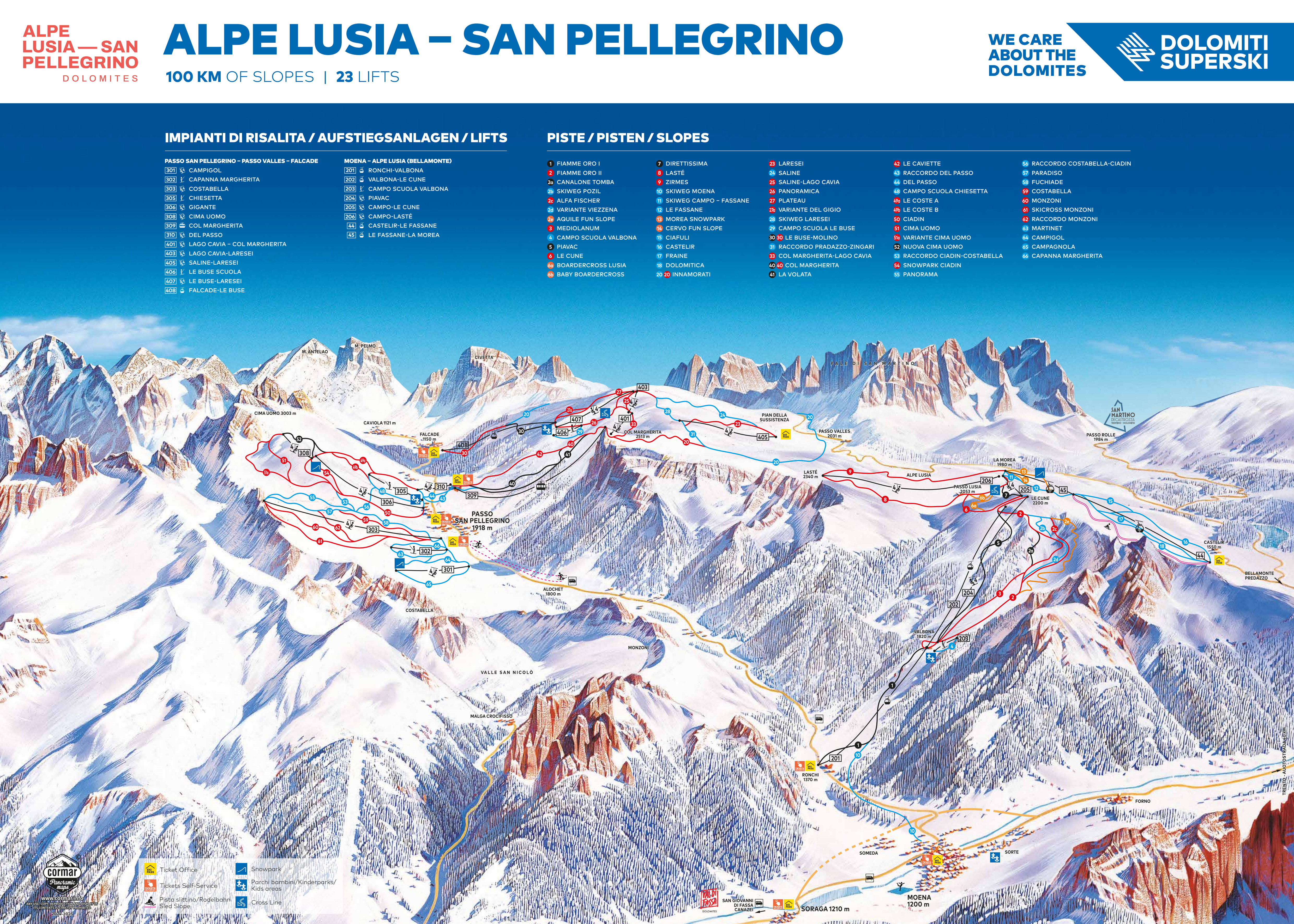
The Alpe Lusia ski area rises above the hamlet of Bellamonte, about five minutes from Moena by car or ski bus, onto a broad, sunny mountainside that opens into wide alpine meadows. Much of the appeal is in the setting. Up high the slopes are open and panoramic, full of space and light, with long views across to the Pale di San Martino and the Lagorai, while lower down the runs wind through larch and spruce forest with more shelter on a stormy day. It's a mountain that rewards every level. Beginners and cruising intermediates have the gentle, wide-open terrain up top and on the Bellamonte side, while the steeper, north-facing Moena side has reds and blacks, giving stronger skiers and boarders something to test themselves on. The runs are broad and well-spaced throughout, so there's room to make your own turns.
The lift system is modern and well thought out. Four gondolas and cableways, two rising from the Bellamonte side and two from Moena, carry you up to a network of fast, hooded chairlifts that serve the upper mountain and keep you comfortable even in cold or windy weather. The two sides of the mountain connect over the top, so you can ski the whole area on one circuit, and because it rarely gets busy, you spend your time skiing rather than queuing. Your lift pass covers the full Moena-Alpe Lusia-Bellamonte area and its 26km of runs, plenty to fill a holiday. If you want to range further, the same mountain is part of the huge Dolomiti Superski network, so a wider pass is there as an option, though most people find there's more than enough on the doorstep.
Important for international visitors: One thing worth knowing if you haven't skied in Italy before: runs here are graded blue, red, and black rather than the green, blue, and red you might be used to, with blue the easiest, red intermediate, and black the hardest.
The Bellamonte side of the mountain is a lovely place to learn. Italian resorts don't use a green grade, so the easiest runs here are gentle blues, and this sunny, south-facing side is full of them, with wide, well-groomed, and forgiving pistes. First-timers start at the Laricino Park down at the Castelir base, a fenced practice area with a moving carpet and soft obstacles to guide your turns, and the ski school runs beginner lessons here. It's a relaxed, unintimidating place to click into skis for the first time.
Once you're comfortable, the whole Bellamonte side opens up, since it stays gentle from top to bottom, which is a real bonus for a first-time skier. You can work your way up from the practice area onto the longer, wide blues higher up the mountain, building confidence over proper distances rather than being funnelled onto anything steep. The one thing to know is that the Moena side, over the top, is a different proposition, mostly reds and blacks, so while you're finding your rhythm it's best to keep to the Bellamonte side, where the easy runs are.
WeSki insider tip: Because the Bellamonte side is gentle all the way down, you can ride the lifts right up to the top at Lastè, at 2,340m, and ski a long, easy run of over 6km all the way back to the base at Castelir. It's a rare thing to ski from a Dolomite summit as a beginner, and a wonderful confidence-builder once you've got a few days under your belt.
Alpe Lusia is a rewarding mountain for intermediates, with a good spread of red runs to link together across both sides. A favourite is the Mediolanum, a scenic red that drops from the Le Cune terrace, high on the Moena side, down towards Ronchi, long and flowing with a nice mix of pitches. For a gentler cruise, the long run from the top down through the larch forest to Bellamonte covers the full height of the mountain in one satisfying descent, starting on open slopes up high and finishing among the trees.
When you're ready to push on, the Moena side is where to do it. Its north-facing reds are steep and hold their snow well, and they make natural stepping stones towards the blacks for anyone building up to more demanding terrain. You can link them into a long descent that runs right down the mountain, and at the end of the day you can even carry on all the way down to Moena itself on the valley run into town, a quiet, satisfying way to finish.
WeSki insider tip: On the Moena side there's a public race course where you can ski a red against the clock, with automatic timing, and it's free to use. It's a brilliant way to sharpen up your technique and add a bit of friendly competition to the day, and plenty of visitors ski straight past without realising it's there.
The Moena side of the mountain is where advanced skiers head, a north-facing wall of reds and blacks with real bite. The one everyone comes for is the Piavac, a proper black that drops off the Le Cune ridge down a series of steep pitches and gullies. Its opening wall is reckoned to be one of the steepest in the Dolomites, and being north-facing it often skis firm and icy, so it rewards sharp edges and full commitment.
There's more to test yourself on beyond the Piavac. Several of the reds here are steep and sustained enough to challenge strong skiers and the runs down through the forest towards the valley bump up into natural moguls and mixed snow as the day goes on, rewarding an active, engaged technique. It isn't a huge amount of expert terrain in the end, so if you're after big kilometres on steep runs, this is where the wider Dolomiti Superski network comes in, opening up the Sella group and the Marmolada glacier with a pass upgrade. But the local slopes have enough character to keep most advanced skiers happily occupied.
WeSki insider tip: After the Piavac, another black to seek out afterwards is the Canalone Tomba, a narrow gully run where you thread tight, rhythmic turns down a natural corridor in the mountain. It's quieter and more technical than its famous neighbour, and skiing it well is one of the real satisfactions of the mountain for a strong skier.
Alpe Lusia is a friendly, easy-going mountain for snowboarding. It isn't a hardcore scene, but it's set up in a way boarders appreciate. The lifts are almost all gondolas, cableways, and chairs rather than drags, so there's very little skating or awkward towing, and the pistes are wide and open, with room to lay out big carves. The open upper slopes are the best of it, dotted with natural rollers and banks to pop off, while the tree runs lower down are good fun after fresh snow. The one thing to watch is the flatter linking trail between the two sides, where it's worth carrying your speed so you don't have to unstrap. When you want to session features, head over to the Bellamonte side, where the Morea Snowpark has jumps and rails for all levels, alongside a boardercross course and a couple of fun slopes with banked turns and rollers to flow through.
Alpe Lusia is a groomed-piste resort at heart, so it isn't a big lift-served off-piste destination, but there's more here than first meets the eye. Off the top at Le Cune, the open, above-treeline terrain on both sides of the mountain holds good snow after a storm, and local mountain guides run freeride tours that link these open slopes with tree runs through the larch forest lower down, a fine way to find the best snow safely and see corners of the mountain you'd otherwise miss. The real prize for the adventurous, though, lies just beyond the ski area. The Lagorai range, rising to the south of Moena, is one of the wildest and least-developed corners of the Dolomites and a paradise for ski touring through silent, uncommercialised terrain far from any lift. It's serious mountain country, so whether you're exploring the side-country off the pistes or heading out into the Lagorai, go with a qualified guide and carry the right avalanche kit.
There are well-established ski schools in both Moena and Bellamonte, offering group and private lessons for all levels, with English-speaking instructors available. Beyond the standard lessons, they cover plenty of specialities you can pick up during a trip, from snowboarding, telemark, and carving to freeride and off-piste sessions with an instructor, or a first taste of ski touring. If you'd rather focus on technique, some schools run race-style coaching on the timed course, with video analysis to show you exactly what to work on, and you can also book a guide for a bespoke day exploring the mountain.
Freestyle riding centres on the Morea Snowpark, over on the Bellamonte side, a good-sized park that's shaped and maintained through the season. It has a spread of features to progress through, from small boxes and rails for getting started to bigger kickers, jumps, and wall rides for those with more airtime in them. Alongside it there's a boardercross course to race down and a couple of fun slopes strung with banked turns and rollers to flow through, which are a hit with children and adults alike. There are even regular freestyle days through the winter, with coaching on hand if you want to sharpen up.
Moena and Bellamonte make a lovely, easy base for a family ski holiday. Most families stay down in Moena, a warm, welcoming Italian town where the days end with a wander round the piazza, a hot chocolate, and an early pizza, and the skiing is a short hop away up at Bellamonte, five minutes by car or ski bus. It's all very manageable too. You can drop the children at ski school and be on the snow yourself within minutes, then meet up for lunch at a mountain hut without any fuss, which is exactly what makes it work so well for families.
On the mountain, the Bellamonte side is made for families. It's sunny and gentle, with wide, easy blues that the whole family can ski together, and a dedicated learning area, the Laricino Park, where beginners take their first turns with the help of moving carpets and friendly obstacle courses. For children too young to ski, or for days when they've had enough, there's proper childcare at the base in the Gnomes' Den kindergarten, so parents can head off for a few runs knowing the little ones are happily looked after. As children find their confidence, the same side of the mountain lets them stretch out onto longer, wider runs, and the more adventurous can head over with a parent to try the reds on the Moena side, so the family keeps skiing together as everyone's ability grows.
There's more to a family week here than downhill skiing. The valley is one of Italy's great cross-country areas, so it's easy to give the Nordic trails a go together, and the highlight for many children is the Fraina sledge run, a winding two-kilometre toboggan track down through the woods to Bellamonte. You can also head out snowshoeing or take a horse-drawn carriage ride into the Paneveggio forest. Down in Moena there's ice skating, a swimming pool, and bakeries turning out fresh strudel each morning, and in the evenings the family-friendly restaurants serve hearty Trentino and Ladin cooking that always goes down well after a day on the snow.
Beyond the skiing, a holiday here taps into two things Trentino does beautifully, the outdoors and the good life. There's plenty to fill the days off the pistes, from cross-country trails and snowshoe walks in the woods to sledging and horse-drawn carriage rides, and just as much to enjoy in the evenings, in Moena's warm, walkable old centre with its bakeries, restaurants, and Ladin traditions. Here are some of the best things to do around Moena and the Alpe Lusia area, on the snow and off.
Eating well is a big part of a holiday in Moena. For a town of its size it has a proper dining culture, from a Michelin-starred restaurant and characterful mountain rifugi to cosy osterie and family pizzerias, and the food itself is something special. The cooking here draws on three traditions at once, Italian, Austrian, and the valley's own Ladin heritage, which together give it a character you don't find elsewhere. Expect hearty mountain staples like canederli (bread dumplings), strangolapreti (spinach and bread gnocchi), polenta, game, wild mushrooms, and the local cheeses, washed down with good Trentino and Alto Adige wines. Whether you're after a long, refined dinner or a plate of dumplings at a hut with a view, here are some of the best places to eat.
WeSki insider tip: Don't leave without trying the Puzzone di Moena, the pungent washed-rind cheese made in just a handful of local dairies. The name means something like 'the big stinker of Moena', but don't let that put you off, it's rich, savoury, and quietly addictive. Have it melted over polenta at a mountain hut, or pick up a wedge from a local dairy to eat with honey or a spoonful of mustardy fruit chutney, the classic Trentino pairing.
Après-ski in Moena is a relaxed, Italian affair, built around the town's aperitivo culture. As the lifts close, the piazza comes to life with the evening passeggiata, and the bars fill up for a Spritz, a glass of Trentino wine, and a plate of nibbles before dinner. It's warm and sociable, with a good spread of places, from stylish piazza spots and cosy pubs to hotel lounges with live music, so there's somewhere to suit whatever mood you're in. Up at Bellamonte, you can start earlier with a drink on a sunny terrace as the day winds down.
Après-ski spots to know:
Most places to stay in Moena are hotels, and they have a particular character worth knowing about. This is Trentino, so the mainstay is the family-run three- and four-star hotel, warm, well-kept, and personal, often owned by the same family for generations. Many are quietly generous with their wellness facilities too, so it's common to find a sauna, a small pool, and a steam room to ease tired legs after a day on the snow, and a good number offer half-board, which is an easy, comforting way to eat well each evening. Alongside the hotels there are self-catering apartments, handy for families and groups who like their own space, and a handful of agriturismo farmhouses on the edge of town for something a little more rustic and rural.
Where you stay comes down to the kind of holiday you're after. Moena itself is compact and walkable, so wherever you are in town you're only a short stroll from the piazza, the shops, and the restaurants, and it's where the evenings are liveliest, which is why most people base themselves here, with the Bellamonte slopes a five-minute hop away by car or ski bus. If getting onto the snow quickly matters more than the town buzz, a few properties up near Bellamonte put you closer to the lifts, in a quieter, more peaceful mountain setting.
Your lift pass covers the whole local Moena-Alpe Lusia-Bellamonte area, its 8 lifts and around 26km of runs across both the sunny Bellamonte side and the steeper Moena side, plenty to fill a holiday. If you'd like to range wider, Alpe Lusia is one of the 12 areas of Dolomiti Superski, so a Dolomiti Superski pass opens up over 1,200km of linked skiing across the Dolomites. Alpe Lusia is also part of the Ikon Pass network through Dolomiti Superski, so WeSki can sort an Ikon pass too if that suits your trip better.
Check for multi-day pass options when booking your Moena - Alpe Lusia - Bellamonte ski holiday package through WeSki to find the best fit for your trip.
There are well-stocked rental shops in Moena and at the lift bases on both sides of the mountain, at Ronchi on the Moena side and Castelir on the Bellamonte side, so it's easy to pick up your gear right where you're skiing. They carry the full range, skis, snowboards, boots, and helmets, and many have a workshop on hand for tuning and repairs, plus ski rooms where you can leave your kit overnight rather than lugging it back to your accommodation. Given that this is one of Italy's great cross-country areas, it's also an easy place to hire Nordic gear and give the trails a try. It's worth booking ahead for the busier weeks, especially over the Italian school holidays.
WeSki partners with SkiSet shops in Moena, letting you add equipment to your package and collect it on arrival. Browse Moena - Alpe Lusia - Bellamonte ski deals to build your perfect trip.
Moena town is compact and walkable. Most hotels, shops, and restaurants sit within a few minutes' stroll of the central piazza, so once you've arrived you can leave the car behind and get around town on foot. A ski bus runs through the season, linking Moena with the Bellamonte gondola base (about 5 minutes) and Passo San Pellegrino (about 25 minutes), and public buses run along the wider Val di Fassa to Canazei, Pozza, and the other valley towns. Worth knowing: the ski bus now needs its own ticket or pass rather than coming free with the lift pass, though it's inexpensive and children travel free.
A hire car is handy if you plan to venture further afield, whether to the QC Terme spa or the wider Dolomiti Superski resorts, with parking in Moena and at the Bellamonte base. If you'd rather not drive, local taxis are easy to arrange for a day trip or an evening out. The roads through the Val di Fassa are well-kept and straightforward in winter, though bear in mind that Italian law requires winter tyres or snow chains through the colder months, so make sure any hire car is properly equipped.
Moena sits at the southern end of the Val di Fassa, in Italy's Trentino Dolomites. The handiest airports are Verona and Innsbruck (both around 180 to 190km, roughly two and a half hours by car) and Venice Marco Polo (a similar distance), with Bergamo a little further at around 280km. Each has a good spread of international flights. By train, the nearest stations are Trento and Bolzano on the main Brenner line, from where local buses run up the valley to Moena. The drive in is straightforward, following the A22 Brenner motorway before turning onto the valley roads that wind up through the Val di Fiemme and into the Val di Fassa.
WeSki has car rentals from the airport as well as private transfers to Moena. Add them to your Moena - Alpe Lusia - Bellamonte ski holiday package for seamless door-to-door travel.
The nickname goes back to the early 1900s, when a visiting Viennese painter described Moena as 'la fiaba delle Dolomiti', the fairy tale of the Dolomites, taken with its setting among the surrounding peaks. The name stuck, and it's easy to see why. The mix of Dolomite mountains, traditional painted houses, and old Ladin mountain culture gives the town a storybook feel, especially under winter snow.
Moena sits at a natural crossroads. Its home slopes at Alpe Lusia-Bellamonte are a few minutes away by ski bus or car, the neighbouring San Pellegrino-Falcade area is a short ski-bus ride over the Passo San Pellegrino, and the other Val di Fassa resorts up the valley, Pozza, Vigo, Campitello, and Canazei, are linked by regular valley buses. With a Dolomiti Superski pass, the whole 1,200km Dolomite network opens up from there.
Yes, though it helps to know where to go. Italian resorts don't use a green grade, so the gentlest runs are blues, and the sunny Bellamonte side of the mountain is full of them, wide, easy, and forgiving, with a dedicated nursery area (the Laricino Park) and childcare at the base. It's a good place to learn. The Moena side, by contrast, is steeper reds and blacks, so beginners are best keeping to the Bellamonte side, which also makes it a fine fit for mixed-ability groups, with beginners on the easy blues and stronger skiers heading over the top.
Puzzone di Moena is the valley's famous washed-rind cheese, pungent, savoury, and made in just a handful of local dairies. The name means something like 'the big stinker of Moena', but the flavour is rich and complex, and it's prized enough to be a Slow Food Presidium and a protected DOP product. Try it melted over polenta, paired with honey, or on its own, and you'll find it in local dairies and on menus all over the valley.
It's excellent, one of the real draws of a holiday here. The valley has around 88km of groomed Nordic trails, among the best in Trentino, winding along the valley floor and through the woods, with everything from gentle beginner loops to demanding race tracks. Moena is also the start of the Marcialonga, one of the great long-distance cross-country races, so you'll be skiing on serious Nordic ground.
They have quite different characters. Canazei, at the top of the valley, is the bigger, livelier resort town, with more extensive skiing and direct access to the famous Sella Ronda circuit. Moena is smaller, quieter, and more relaxed, with a strong cross-country scene and a lot of village charm. If your priority is racking up piste miles and linking the big Dolomite circuits, Canazei has the edge; if you want a characterful town, excellent Nordic skiing, and an easier pace, Moena is the one. They're about 20 minutes apart by car, so you can always sample both.
It depends on how you like to ski. If you're an intermediate or advanced skier who wants to roam and tick off the big-name areas, it's hard to beat, the Dolomiti Superski pass covers over 1,200km across the Dolomites, including the Sella Ronda, the Marmolada glacier, Val Gardena, Alta Badia, and Cortina, and several are doable as day trips from Moena. If you're happy on the home slopes, or skiing with beginners or young children, the local Alpe Lusia pass covers plenty and works out simpler. It's worth thinking about how far you actually want to travel each day before deciding.
 4.9/5
4.9/5I usually book flights, ground transportation, hotel, ski rental and lift tickets myself but this year used WeSki for a trip to Morzine. It was so much easier. Everything worked perfectly - ground transportation arrived on time and there was plenty of feedback throughout the whole process giving you confidence the vacation would go smoothly.

A really useful service that is so much easier to use than other 'all-inclusive' sites. It nicely bridges the gap between a travel agent and booking the trip yourself online. I'll use WeSki every time I go skiing from now on.
We booked a late minute skiing trip to Morzine through we ski. We looked at booking the trip ourselves but could get anywhere near the price quoted by we ski. The company was excellent and we had no problems at all from start to finish. I would definitely use them to book another weekend skiing trip.
Seamless experience from start to finish. I was spending ages trying to sort out a weekend break and managed to do it with we ski in minutes and for the same price as booking it all up yourself. Flight, transfers and accommodation was all as expected and faultless.