EN
EN
Dolomiti Superski isn't a single ski area but a single pass, covering 12 ski areas and around 1,200km of pistes across the Dolomites in northern Italy. The mountains themselves are a UNESCO World Heritage Site, famous for their pale, jagged limestone peaks. At the heart of the network is the Sella Ronda, a famous loop around the Sella massif that links four valleys, including Val Gardena and Alta Badia. Beyond it, areas such as Cortina d'Ampezzo and Kronplatz aren't linked by lifts but share the same pass, so you can base yourself in one valley and explore further afield.
Whether you ski or snowboard, the Dolomites have all the ingredients for a memorable holiday. The area is known for immaculate grooming, wide, sunny pistes, and extraordinary scenery, with rock towers rising straight out of the snow. Beginners have gentle learning terrain across the network, from the broad plateau of the Alpe di Siusi to the rolling slopes of Alta Badia. For intermediates, the Sella Ronda is a bucket-list day out, a loop of around 40km that circles the Sella massif through four valleys, and every valley has long, well-groomed blues and reds of its own. Advanced skiers can look forward to long, fast pistes and steep runs squeezed between rock walls, including World Cup courses such as Val Gardena's Saslong and the 12km descent from the Marmolada glacier.
Life off the slopes is just as much of a draw throughout the Dolomites. The region blends Italian, Austrian, and Ladin culture, which shows in everything from village architecture to the menus. Lunch is a highlight, with mountain huts, known as rifugi, serving homemade pasta, local wine, and South Tyrolean specialities on sunny terraces. Alta Badia is known for its Michelin-starred restaurants, while in the Val di Fassa, hearty Trentino dishes such as polenta and canederli, the region's bread dumplings, are on every menu. Après-ski is generally relaxed, centred on terrace drinks and long dinners, while Cortina d'Ampezzo is known to add a touch of glamour with boutiques and stylish bars.
With so much to explore, you'll never be short of things to do. You can dig into the region's history and culture, from Reinhold Messner's mountain museum on the summit of Kronplatz to the First World War trenches around Cortina d'Ampezzo. Snowy hiking trails link villages and mountain huts, and there's sledging, snowshoeing, and cross-country skiing in almost every valley.
| Country | Italy |
| Region | South Tyrol, Trentino, and Veneto |
| Total piste km | 1,200 km |
| Altitude | 1,000 m (valley floors) - 3,342 m (Marmolada glacier) |
| Linked resorts | 14 Cortina d'Ampezzo Val Gardena Alta Badia Arabba Kronplatz Campitello di Fassa Canazei Ortisei 3 Zinnen Dolomites Alpe di Siusi Carezza Civetta Val di Fiemme San Martino di Castrozza |
| Lifts | 450 |
| Runs | 1,200 km across 12 ski valleys |
| Season | Late November - mid-April (Marmolada glacier extends season) |
| Ski pass name | Dolomiti Superski pass |
| Nearest airports | Innsbruck (~1 hr 30 min to western resorts) Venice (~2 hr to eastern resorts) Verona (~2 hr 30 min) Bergamo (~3 hr) |
| Glacier skiing | Yes - Marmolada glacier (3,342 m), accessed from Arabba |
| WeSki services | Transfers: 12 of 14 resorts (see resort sections for details) Ski equipment hire: Arabba, Campitello di Fassa, Canazei, Cortina d'Ampezzo, Kronplatz, San Martino di Castrozza, Selva Gardena, and others No WeSki lessons currently available |
Dolomiti Superski is made up of separate ski areas that share a single pass. Four of them, Val Gardena, Alta Badia, Arabba, and the Val di Fassa, are linked around the Sella massif by the Sella Ronda, so you can ski from one valley to the next without taking off your skis. The Alpe di Siusi is connected too, by lift from Val Gardena. Staying in one of these areas puts the famous circuit right on your doorstep.
The other areas, from Cortina d'Ampezzo and Kronplatz to Val di Fiemme and San Martino di Castrozza, aren't linked by lifts, but they're covered by the same pass. Each has plenty of skiing of its own. Many visitors base themselves in one and take the odd day trip by car, bus, or train to explore another.
Val Gardena is a long, open valley beneath some of the most striking peaks in the Dolomites, with three villages along it: Ortisei, Santa Cristina, and Selva. The skiing is varied and beautifully groomed, from wide, sunny blues to long, fast reds and the valley's famous World Cup downhill course, which anyone can ski. One of its longest runs drops around 10km from high ridges with huge views across the Dolomites all the way back down to Ortisei. From the village, a lift also climbs to the Alpe di Siusi, a vast, gently rolling plateau that's ideal for beginners and relaxed cruising.
Ortisei is the valley's main village, with a pedestrian centre lined with shops, cafés, and workshops showcasing Val Gardena's long tradition of wood carving. Selva, higher up the valley, is the most convenient base for the Sella Ronda circuit, while a handful of hotels sit right on the Alpe di Siusi plateau for a peaceful stay among the snowfields. Accommodation across the area ranges from family-run hotels to apartments, many with spas. Food is a real highlight here, as Val Gardena sits where Italian, Austrian, and Ladin traditions meet. Menus mix South Tyrolean dumplings and speck with Italian pasta and Ladin specialities, from the village restaurants all the way up to the mountain huts.
Alta Badia sits in a wide, open valley ringed by dramatic rock walls, with a string of five villages, including Corvara and San Cassiano. It's one of the best areas in the Dolomites for beginners and intermediates, since most of its slopes are wide, gentle blues that are easy to link together. Advanced skiers will find steeper pitches on the reds and blacks higher up, and those who want a real test can head to the Gran Risa, a steep black that hosts the World Cup. Two of its villages sit right on the Sella Ronda, so the famous circuit is easy to reach, while Alta Badia also has a memorable run nearby: the Hidden Valley, a long descent beneath towering cliffs that ends with horses towing skiers across the valley floor.
What really sets Alta Badia apart is its food. The valley has several Michelin-starred restaurants, and its mountain huts serve far more than the usual ski lunch, with local ingredients, traditional Ladin recipes, and dishes created by top chefs for its gourmet skiing events. Alta Badia is also a heartland of Ladin culture, with its own language and traditions, and villages dotted with old farmhouses and chalet-style hotels. Après-ski is relaxed, with sunny terraces and long, lingering dinners setting the pace. Off the slopes, the valley's wide, open landscape is made for cross-country skiing, snowshoeing, and winter walks, and you can learn more about Ladin life at the local museum.
Arabba is a small village tucked beneath the Sella massif, with some of the steepest marked terrain in the Dolomites. It's considered the Sella Ronda's most demanding corner, with steep blacks that drop straight back down to the village and long, north-facing runs that hold their snow well. Intermediates have plenty of reds to enjoy too, and the high slopes tend to stay in good condition through the season. From nearby Malga Ciapela, a cable car climbs to Punta Rocca at 3,265m (the highest point you can reach by lift in the Dolomites), and you can ski all the way back down. The run, a 12km descent called La Bellunese, drops around 1,800m, making it the longest on the Dolomiti Superski pass, and it's within reach of confident intermediates as well as advanced skiers.
Village life in Arabba revolves around the slopes, with traditional chalets, hotels, and apartments gathered at the foot of the lifts, many just a few steps from the snow. That makes it a convenient base for keen skiers who want to make the most of their days on the Sella Ronda. It's also a good starting point for the Great War ski tour, a full-day circuit that follows the line of the First World War front through the mountains, passing old trenches and tunnels along the way. Evenings are relaxed, with a handful of restaurants serving hearty Ladin and Italian dishes and a few bars for a quiet drink after skiing.
In the Val di Fassa, the neighbouring villages of Canazei and Campitello di Fassa sit on the southern side of the Sella Ronda, with lifts climbing from each village straight up to the slopes. The terrain is high, sunny, and varied, with long blues and reds that wind beneath big rock walls and wide views of the Marmolada, the highest peak in the Dolomites. What really sets the valley apart is Sass Pordoi, a rocky plateau at nearly 3,000m known as the Terrace of the Dolomites. A cable car climbs to the top for some of the most spectacular views in the region, and with a guide, confident skiers can take off-piste routes down through steep, narrow gullies.
Canazei is the livelier of the two villages, with a busy centre of shops, bars, and restaurants, while Campitello di Fassa is smaller and quieter, a short distance down the valley. The Val di Fassa is part of Trentino, with a Ladin heritage of its own, and restaurants serve hearty mountain cooking, from polenta to canederli, the region's bread dumplings. After a long day on the Sella Ronda, the valley's thermal spa is the perfect place to unwind, with warm pools and views of the surrounding peaks, and there's snowshoeing and winter walks to enjoy too.
Cortina d'Ampezzo sits at the heart of the Ampezzo valley, surrounded by a ring of famous Dolomite peaks. Its 120km of pistes spread out across three ski areas on different sides of town. Tofana, the largest and most varied, has everything from gentle beginner slopes at its base to high, open runs and steep blacks that squeeze between rock bands, including the course where the world's best women raced at the 2026 Winter Olympics. Across the valley, Faloria and Cristallo look straight down on the town, with sunny, scenic runs that tend to hold their snow late into spring. Cinque Torri, the smallest of the three, has narrow, winding runs that weave beneath five towering rock pillars.
Known as the "Queen of the Dolomites", Cortina has an elegant, old-world feel, and life here centres on the Corso Italia, a pedestrian street of designer boutiques, cafés, and wine bars. As the lifts close, skiers drift into town for aperitivo in its stylish bars, and dinner can be anything from refined Italian cooking to a hearty meal in a traditional mountain hut. Accommodation is just as varied, from grand historic hotels to cosy chalets and apartments.
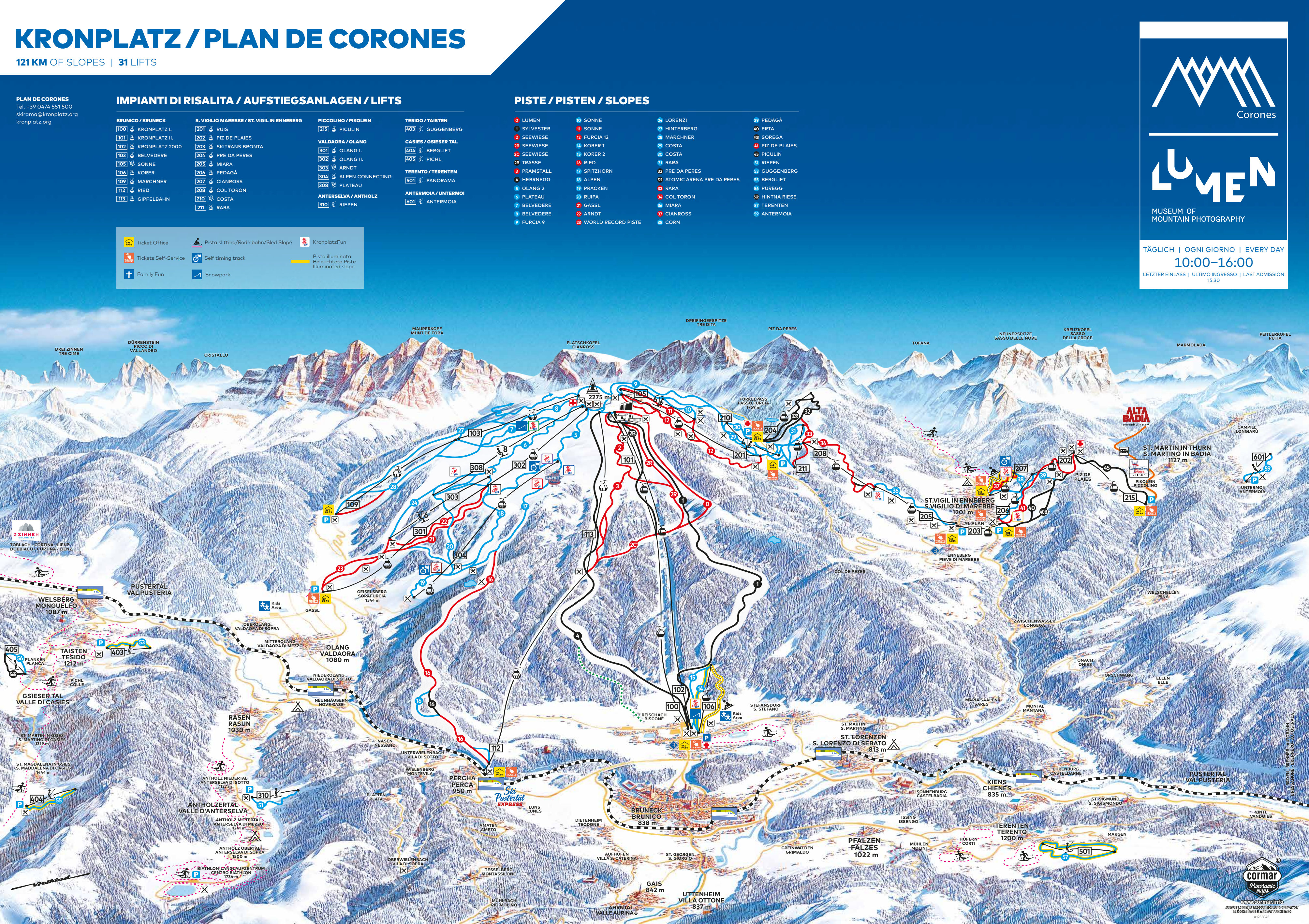
Kronplatz is a rounded, almost treeless summit at 2,275m, with more than 120km of pistes running down every side. Up top, the slopes are wide, smooth, and ideal for beginners and intermediates, while lower down, the runs wind through forest to the villages at the base. For strong skiers, the big draw is the "Black Five", a set of five steep blacks that includes the World Cup Erta and two long valley runs dropping all the way down the north side of the mountain.
At the summit, two museums add a cultural twist: the Messner Mountain Museum Corones, designed by Zaha Hadid, and LUMEN, a museum of mountain photography. Down below, each of Kronplatz's villages has its own feel. Riscone, just above the town of Brunico, has the liveliest après-ski, with bars at the foot of the lifts and live music. San Vigilio di Marebbe is a charming Ladin village with a pedestrian centre, spa hotels, and the Fanes-Sennes-Braies Nature Park on its doorstep. Off the slopes, there are sledging runs in both villages, snowshoe walks and ice skating, and around 160km of cross-country trails across the surrounding valley.
Straddling the border between Trentino and Veneto, Alpe Lusia – San Pellegrino has around 100km of pistes in two sectors connected by ski bus, all covered by a single local pass. Alpe Lusia rises above the town of Moena, with gentle blue runs on the Bellamonte side that suit beginners, and a mix of reds and a few blacks on the Moena side. The larger San Pellegrino sector spreads across a high mountain pass and down to the village of Falcade, with long, cruising runs through the forest. From the pass, a cable car climbs to Col Margherita at 2,513m. From the top, La Volata, a steep black, drops back to the pass, and a long descent leads all the way down towards Falcade.
The two main villages each have their own character. Moena, known as the Fairy of the Dolomites, is a lively town of pastel houses and a busy central piazza, and one of the main centres of Ladin culture. It’s also home to Puzzone di Moena, a strong local cheese that turns up all over the valley’s cooking. Falcade, in the Val del Biois, is quieter and more traditional. Many of its older houses are decorated with religious frescoes, some from the 17th century, alongside murals by contemporary artists. Up on Col Margherita, you can still see trenches from the First World War front. From Passo San Pellegrino, a winter trail leads to Fuciade, a cluster of old wooden haylofts with a well-known mountain hut.
Tucked into the far north-eastern corner of the Dolomites, close to the Austrian border, 3 Zinnen Dolomites has around 115km of pistes spread across two linked mountains. Most of the skiing is on wide, scenic blues and reds that wind down through the forest, with long, cruising descents and big views of jagged peaks along the way. Confident skiers have some properly steep blacks to try, and the whole area is relaxed enough to enjoy at your own pace.
What sets 3 Zinnen apart is its peaceful, unhurried feel. It's a lovely choice for families and for anyone looking for a calm, easy-going base, and the villages have a strong Tyrolean character. Days usually end with a long dinner in a cosy stube, with menus full of hearty dishes such as dumplings, speck, and Kaiserschmarrn, a fluffy shredded pancake served with fruit compote. Beyond skiing, there are cross-country trails and winter walks with views of the area's famous rock towers, and the Ski Pustertal Express train makes it easy to spend a day at Kronplatz.
Carezza sits at the foot of the Catinaccio and Latemar, two of the best-known rock massifs in the Dolomites, and its 40km of slopes are made for relaxed, scenic skiing. More than half of the runs are easy, which makes it a favourite with families and beginners, and the youngest skiers have three themed children's areas of their own. Intermediates have a good mix of reds that wind through forest and open clearings, while strong skiers will find steeper pitches near the top, where long runs drop from beneath the rock walls all the way down towards the village.
Visitors have been drawn here since the 19th century, and it still has a timeless, romantic feel. Local legend says the Catinaccio was once King Laurin's rose garden, which is why the rock glows pink at sunset, and the story runs through the ski area, from run names to the children's park. Off the slopes, a gentle winter walk leads to Lago di Carezza, a small mountain lake framed by snowy peaks, and there's a toboggan run, snowshoe trails, and cross-country tracks to explore. It's a quiet, easy-going base, with a small choice of hotels and restaurants close to the slopes.
The Civetta ski area links the villages of Alleghe, Selva di Cadore, and Val di Zoldo around the base of Monte Civetta. Its 72km of pistes are mostly long, rolling reds and blues that wind down through the forest, and skiing from one village to the next gives each day a sense of journey. Gran Zuita is Civetta’s signature run, which drops 7km from the top of the area all the way down to the lake at Alleghe. Each village has its own nursery area, and there's night skiing several evenings a week.
Alleghe sits on the lakeshore with Civetta's 1,000m north-west face, known as the "Wall of Walls", reflected in the water. The village is famous for ice hockey, and its lakeside arena, home to a successful local team, hosts public skating sessions, while in a cold winter, the lake itself freezes over for skating. Nearby, you can try ice climbing on the frozen waterfalls of the Serrai di Sottoguda gorge. Over in Val di Zoldo, the valley that gave the world many of its artisan gelato makers, the villages are small and welcoming, with a laid-back, traditional feel.
Val di Fiemme is a wide, forested valley in Trentino, with around 120km of pistes spread across a handful of ski areas connected by ski bus. The terrain is a mix of long forest runs and high, open slopes, with plenty for every level. Above the town of Cavalese, the Alpe Cermis ski area is known for its long, north-facing runs, including the Olimpia, a 7.5km descent that drops around 1,400m, with steep black pitches at the top and a long red to finish. The biggest area, the Ski Center Latemar, sits high above the treeline, with wide, sunny slopes, a snowpark, and an open-air art trail along one of its runs.
This is a valley with deep Nordic roots. It hosts the Marcialonga, one of the world's best-known cross-country races, and every winter, the world's top cross-country skiers finish the Tour de Ski by racing straight up the Olimpia. The surrounding Paneveggio forest is known as the Forest of Violins, where the Stradivari family once came for wood to craft their instruments. Back in the cobbled streets of Cavalese, its old centre is lined with shops and restaurants, where evenings revolve around good food and local wine. Off the slopes, there's an alpine coaster, sledging, and plenty of cross-country trails to explore.
San Martino di Castrozza is an elegant mountain village in eastern Trentino, surrounded by a protected nature park. Its 60km of pistes are spread across the mountainsides on either side of the village, with mostly blues and reds through the forest. The longest run here winds around 5km back towards the village. For something wilder, take the cable car up to the Pale, a vast, rocky plateau at around 2,600m where mountain guides lead off-piste routes. A short ski bus ride away, Passo Rolle adds wide, high-altitude slopes and its own snowpark.
Life here moves at a quieter, more refined pace. The compact village centre has elegant hotels, cafés, and restaurants, and up on the mountain, a handful of chalet restaurants serve gourmet cooking with big views. For a memorable outing, follow the winter trail from Passo Rolle up to the Baita Segantini hut, where the Pale peaks glow pink at sunset. There's also a cross-country centre at the edge of the village, and the historic villages of the Primiero valley are a short drive away.
The Dolomites are a welcoming place to learn. Grooming standards are famously high, the slopes are often wide and sunny, and every area has gentle learning terrain. Ski schools are easy to find wherever you stay, with lessons for adults and children across the network.
For first-timers, the Alpe di Siusi plateau above Ortisei and the rolling blues of Alta Badia have some of the gentlest terrain in the region. Another popular beginner destination is Kronplatz, where broad, open slopes at the top of the mountain give you plenty of room to find your feet. If you'd prefer to learn somewhere smaller and calmer, head to Carezza, where more than half of the runs are easy, or to Civetta, whose nursery slopes are among the most sheltered in the area. Once you're linking turns, the wide, well-groomed blues across the network make it easy to keep progressing.
Intermediates are spoilt for choice in the Dolomites, wherever you choose to stay. Every valley has long, well-groomed blues and reds, from the rolling cruisers of Alta Badia and Kronplatz to the longer, faster reds of Val Gardena, while in quieter areas such as Civetta, forest runs carry you from one village to the next.
If you only do one big day out, make it the Sella Ronda. This loop of around 40km circles the Sella massif, linking Val Gardena, Alta Badia, Arabba, and the Val di Fassa, with about 26km on piste and lifts covering the rest. It's well within reach of confident intermediates, and you can ski it clockwise on the orange route, which is higher and a little more challenging, or anticlockwise on the green route. You can also join the Great War tour, which follows the line of the First World War front through the mountains, or ski the Hidden Valley, a long descent beneath towering cliffs that ends with horses towing skiers across the valley floor.
If you're an advanced skier, the Dolomites are an exciting destination, with long, fast pistes, steep pitches squeezed between rock walls, and race courses you can ski yourself. You can even take on Cortina's Olympia delle Tofane, where the women's downhill was raced at the 2026 Winter Olympics.
For the steepest skiing, base yourself in Arabba, the most demanding corner of the Sella Ronda. It's also the gateway to the Marmolada glacier, where you can ride the cable car up to 3,265m and ski La Bellunese, a 12km descent that drops around 1,800m. Kronplatz is another strong choice, with five steep blacks known as the Black Five, and Cortina has plenty of challenging terrain on the Tofana.
Off-piste, the Dolomites are all about steep, narrow couloirs that cut between towering rock walls, along with high plateaus and long descents into quiet side valleys. With a guide, you can explore the slopes around the Sella massif and the Marmolada, which hold some of the most memorable routes in the region.
The Dolomites' wide, beautifully groomed pistes are made for carving, with long, rolling blues and reds that let you really open up your turns. With rock towers rising on every side, even a cruise back to the village feels special. If you're new to snowboarding, or a skier keen to give it a go, the wide, gentle slopes of the Alpe di Siusi and Alta Badia are among the easiest places to learn, and ski schools across the network run snowboard lessons.
Riding the Sella Ronda on a board is an unforgettable way to see the Dolomites, with modern gondolas and chairlifts doing most of the climbing and big views on every descent. A few sections include flat stretches and drag lifts, so keep your speed up on the traverses and check the route before you set off.
For freestyle, head to the Alpe di Siusi. Its snowpark, the biggest in South Tyrol, packs more than 70 features into around 1.5km, from a family line and a wood line with Dolomites views to a pro line built to competition level. It has been named Italy's best park at the Skipass Awards, hosts contests through the season, and is a training ground for Italy's national freestyle team. Kronplatz's park has easy, medium, and family lines, Val Gardena has parks and fun slopes of its own, and Carezza's varied park suits both beginners and advanced riders.
If you're planning to stay in one valley, a local area pass covers that area's lifts at a lower price than the full pass, and it's often plenty for a week. Val Gardena and the Alpe di Siusi alone have around 180km of pistes, while Alta Badia, Cortina d'Ampezzo, and Kronplatz each have more than 120km.
The Dolomiti Superski pass covers all 12 areas on a single ticket, with around 1,200km of pistes and 450 lifts, including the Sella Ronda and the Marmolada. It's sold from one day up to a full season, and you'll need it if you'd like to ski the Sella Ronda or take day trips to other valleys. Ikon Pass holders can also use their pass here for a set number of days. Passes can be bought online in advance or at ticket offices across the area.
Bolzano is the closest airport to most of the region, around 25 to 80km from areas such as Val Gardena, Carezza, and the Val di Fassa. For the northern areas, such as Alta Badia and Kronplatz, Innsbruck in Austria is around 110 to 150km away. Venice is closest for Cortina d'Ampezzo and Civetta, at around 150 to 170km, while Verona suits the southern valleys, including Val di Fiemme and San Martino di Castrozza, at around 180 to 230km. Bergamo, further west, is another option, at around 250 to 300km. From any of them, you can book a shared or private transfer or hire a car.
If you'd rather arrive by train, Bolzano and Bressanone are the main rail hubs for the central valleys, with bus connections up to the resorts, and Brunico is the nearest station for Kronplatz. The Val Pusteria railway also stops right beside one of Kronplatz's valley lifts, so you can step off the train and onto the slopes.
Once you're there, ski buses link the villages within each area. The Sella Ronda valleys are connected on the mountain, and the Ski Pustertal Express train runs between Kronplatz and 3 Zinnen Dolomites. To explore the separate areas, such as Cortina d'Ampezzo or Val di Fiemme, a car or a transfer is the easiest option.
For the best natural snow, aim for January to mid-March. The season usually runs from late November or early December until early April, with Cortina d'Ampezzo staying open longest, often into early May. Snowmaking covers the vast majority of the pistes, so conditions tend to hold up well even in winters when natural snow is thin.
Christmas, New Year, and February, when Italian and other European school holidays fall, are the busiest times, especially on the Sella Ronda. For quieter slopes, January and the first half of March are worth a look.
Late season in the Dolomites is all about sunshine. March and April bring long, bright days, softer snow, and lunch on a sunny rifugio terrace, which makes for a memorable spring trip.
The Sella Ronda is a ski circuit of around 40km around the Sella massif, linking Val Gardena, Alta Badia, Arabba, and the Val di Fassa. About 26km is on piste, with lifts covering the rest. You can ski it clockwise on the orange route, which is higher and a little more challenging, or anticlockwise on the green route, and if you're a confident intermediate, you can complete it in a day.
Not all of them. The Sella Ronda valleys are linked by lifts and pistes, and the Alpe di Siusi links to Val Gardena. Other areas, such as Cortina d'Ampezzo, Kronplatz, and Val di Fiemme, are covered by the same pass but sit in separate valleys, so you'll need a car, bus, or transfer to reach them. Most visitors base themselves in one area and take the odd day trip.
It depends on what you're looking for. To have the Sella Ronda on your doorstep, base yourself in Val Gardena, Alta Badia, Arabba, or the Val di Fassa. Beginners will feel at home in Alta Badia or on the Alpe di Siusi, advanced skiers in Arabba, and if you want style and a lively town centre, head to Cortina d'Ampezzo. For a calmer stay, Carezza, Civetta, 3 Zinnen Dolomites, and San Martino di Castrozza are all good choices.
Not necessarily. If you're staying in one valley, a local area pass covers plenty of skiing for a week at a lower price. You'll need the full Dolomiti Superski pass to ski the Sella Ronda from end to end, or to take day trips to other areas on the network.
A rifugio is a mountain hut, and in the Dolomites, they're one of the highlights of a ski day. Many serve proper sit-down meals, from homemade pasta to South Tyrolean dumplings and local wine, often on sunny terraces with big views. It's well worth building a long lunch into your plans.
Much of the Dolomites lies in South Tyrol, where Italian and German are both official languages, and some valleys also speak Ladin. That's why you'll see names such as Val Gardena and Gröden, or Kronplatz and Plan de Corones, used for the same place. Signs, piste maps, and menus are often in two or three languages.
The Alpe di Siusi, with its wide, gentle plateau, and Alta Badia, where most slopes are easy blues, are among the best places to learn. Kronplatz's broad, open runs are another good choice, and for a smaller, calmer setting, try Carezza or Civetta. Every area has ski schools, and the high grooming standards across the region make learning a little easier.
Yes. You can take lifts up to many mountain huts to meet friends for lunch, and there are winter walking trails, snowshoe routes, and cross-country trails across the region. Browse the boutiques of Cortina d'Ampezzo, visit the summit museums on Kronplatz, walk to the snowy shores of Lago di Carezza, or unwind at the thermal spa in the Val di Fassa.
Start building your dream ski trip today with our one-stop ski shop - hundreds of resorts, unlimited combinations.



 4.9/5
I usually book flights, ground transportation, hotel, ski rental and lift tickets myself but this year used WeSki for a trip to Morzine. It was so much easier. Everything worked perfectly - ground transportation arrived on time and there was plenty of feedback throughout the whole process giving you confidence the vacation would go smoothly.

A really useful service that is so much easier to use than other 'all-inclusive' sites. It nicely bridges the gap between a travel agent and booking the trip yourself online. I'll use WeSki every time I go skiing from now on.
We booked a late minute skiing trip to Morzine through we ski. We looked at booking the trip ourselves but could get anywhere near the price quoted by we ski. The company was excellent and we had no problems at all from start to finish. I would definitely use them to book another weekend skiing trip.
Seamless experience from start to finish. I was spending ages trying to sort out a weekend break and managed to do it with we ski in minutes and for the same price as booking it all up yourself. Flight, transfers and accommodation was all as expected and faultless.