EN
EN
KitzSki is one of the best-known ski areas in Austria, with 233km of pistes and ski routes across the Kitzbühel Alps, reaching over the border into Salzburg. Its slopes run from around 800m up to 2,000m across rounded, forested mountains, with long, wide runs through the trees and open slopes up high. Its resorts include Kitzbühel, Kirchberg, and Jochberg. Kitzbühel is a historic town with a glamorous edge, its car-free medieval centre is full of painted façades, boutiques, and restaurants. Kirchberg is a lively village just along the valley, known for its après-ski, and Jochberg is a smaller village at the heart of the ski area, with lifts climbing straight from the centre. Above it all, the Streif on the Hahnenkamm is one of the most famous downhill courses in the world. Riding the 3S gondola is a highlight of any trip, as it glides 400m above the valley floor, linking the two halves of the ski area.
Most of the skiing in KitzSki is on blue and red runs, with long, rolling descents that suit intermediates especially well. Beginners have gentle practice slopes at the foot of the mountains in Kitzbühel and Kirchberg, along with wide, quiet blues on the higher slopes towards Pass Thurn. Intermediates can spend days cruising tree-lined runs and open slopes, and you can ski all the way from Kirchberg via Kitzbühel and Jochberg to the high, snowy slopes of the Resterhöhe. Advanced skiers can take on steep blacks and the World Cup slalom slope, and later in the season, you can ski sections of the Streif itself. The area also has around 45km of marked ski routes, which are avalanche-checked but left ungroomed, with plenty of powder to explore after fresh snow.
KitzSki blends Tyrolean tradition with a touch of glamour, with wooden huts on the slopes and old farmhouse inns on one side and Kitzbühel's designer boutiques, luxury hotels, and celebrity crowds on the other. You'll find that mix in the food, too, from hearty dishes in rustic mountain huts to award-winning restaurants in Kitzbühel's old town. Après-ski is famous here, with lively umbrella bars on the slopes and stylish wine bars and lounges in town. Kirchberg is a real hotspot for it, with bars and huts on the slopes above the village and a string of bars and clubs in town where the party often runs late. There's plenty to fill your days off the slopes, too, from tobogganing on a floodlit run on the Gaisberg to winter walks on around 170km of trails, horse-drawn carriage rides, and paragliding over the valley.
| Country | Austria |
| Region | Tyrol |
| Total piste km | 170 km |
| Altitude | 800 m (Kitzbühel) - 2,000 m (Pengelstein / Resterhöhe) |
| Linked resorts | 3 Kitzbühel Kirchberg Jochberg |
| Lifts | 57 |
| Runs | 60 (9 green/easy, 27 blue, 14 red, 10 black) |
| Season | Late October (Resterhöhe) - mid-April |
| Ski pass name | KitzSki pass |
| Nearest airports | Innsbruck (~1 hr) Salzburg (~1 hr 15 min) Munich (~1 hr 45 min) |
| Glacier skiing | No |
| WeSki services | Transfers: all 3 resorts (private and shared to Kitzbühel, Kirchberg, and Jochberg) Ski equipment hire: Kitzbühel, Kirchberg No WeSki lessons currently available |
Kitzbühel's skiing spreads out on both sides of town, with the Hahnenkamm, home of the Streif, on one side and the Kitzbüheler Horn on the other. The Hahnenkamm is the heart of the ski area, with long blues and reds through the forest. Across the valley, the smaller Horn is particularly well set up for families and beginners, with gentle slopes, a dedicated family park, and a compact layout that's easy to find your way around. If you're a beginner, you'll find practice lifts in the valley, and on the Horn, a magic carpet, small jumps, and playful features make your first turns fun. Intermediates can cruise long, tree-lined runs, and the family route down the Streif lets you follow the famous course while skipping its steepest sections. Advanced skiers at Kitzbühel can take on the steep World Cup slalom slope and, later in the season, sections of the Streif itself. The Horn has its own place in skiing history, too, as the mountain where Austria's first high-alpine ski descent was made in 1893.
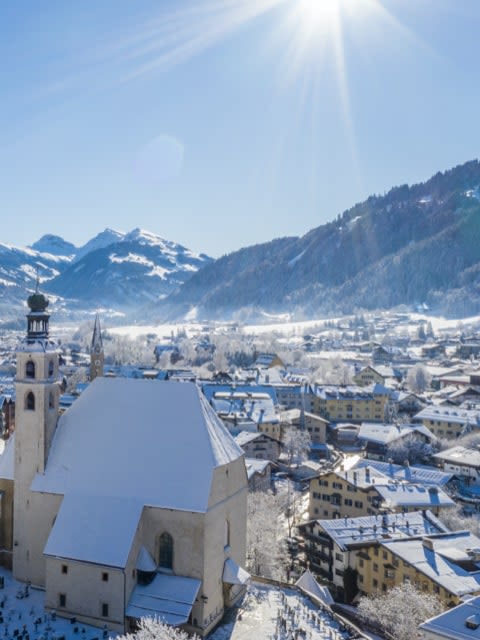
Kitzbühel is a historic town at around 760m, with a car-free medieval centre of painted façades, boutiques, cafés, and restaurants, and a glockenspiel that chimes over the old town each evening. Accommodation ranges from luxury hotels and chalets to traditional guesthouses and apartments. Staying near the old town puts the restaurants, shops, and the Hahnenkamm gondola all within walking distance.
Off the slopes, Kitzbühel's 750-year-old centre is made for wandering, with designer boutiques tucked behind brightly painted façades inspired by the local artist Alfons Walde. You can step into the town museum, set in a tower of the old town walls, to see Walde's famous winter paintings alongside the stories of Kitzbühel's ski legends, or warm up at the Aquarena, with its pools, slides, and saunas right in the middle of town. Après-ski here is legendary, spilling from umbrella bars at the foot of the Hahnenkamm into historic pubs and stylish wine bars, and the town even has its own casino for a more glamorous night out. Dining spans everything from Tyrolean classics in rustic huts on the mountain to award-winning restaurants in the old town.
Kirchberg's skiing starts just outside the village, where a gondola lifts you straight into the heart of KitzSki, with runs linking over the mountain to Kitzbühel and on towards Jochberg. The slopes on this side are mostly long, rolling blues and reds that sweep down through the forest, and the runs into the quiet side valley below the village are especially wide and peaceful. Beginners can find their feet on nursery slopes at the foot of the lifts, then head up to easy runs higher on the mountain, where there's plenty of space to build confidence. Intermediates have the whole linked area on their doorstep, so you can ski a different corner of KitzSki every day. Advanced skiers will find steep runs on the village's own small mountain, which hosts slalom races and is floodlit for night skiing, along with marked ski routes higher up after fresh snow.
Surrounded by forested slopes, Kirchberg is a lively Tyrolean village with a friendly, sociable feel and a real mix of nationalities in its bars and restaurants. It's the kind of place where you'll see the same faces at breakfast and again in the bars later on. Accommodation is mostly in family-run hotels, guesthouses, and apartments spread through the village, with chalets tucked away on its quieter edges. Wherever you stay, regular ski buses link you with the gondolas.
Après-ski is Kirchberg's calling card, and with more than 30 bars packed into a small village, the centre buzzes from mid-afternoon well into the night. It draws a young, international crowd who come back year after year, with everything from tented bars on the slopes to clubs that stay open into the early hours. For a different kind of night out, ride the chairlift up the village's own mountain and race back down a 3.5km toboggan run under floodlights, stopping halfway at a rustic inn where a campfire and mulled wine are waiting outside. You can also try ice climbing on one of the biggest ice-climbing towers in Europe. Back in the village, restaurants range from traditional Tyrolean inns to modern kitchens, so you can eat somewhere different every night of your stay.
Jochberg puts you right in the middle of KitzSki, with a 10-seater gondola rising from the village centre onto the slopes. From the top, you can head towards Kitzbühel on the spectacular 3S gondola, or the other way to the higher, snowier slopes on the border with Salzburg. Beginners can find their feet on a gentle drag lift in the village, then ride the gondola up to the easy blue runs that start from the top station, with wide blue runs to explore further along the ridge, too. Intermediates have some of the best cruising in the area, with long, flowing reds through the woods and open slopes with wide views, including the Wagstätt/Wurz piste, rated among the five best runs in KitzSki. For advanced skiers, the slopes further south are known for their varied terrain and deep-snow slopes, where freeride lines often stay untracked for longer than in the busier sectors, and marked ski routes run down to the village from the high ridges.
Jochberg is a traditional Tyrolean village with old farmhouses and inns. It's known locally as the water village, a reference to the beautiful springs, streams, and waterfalls that run through it. There are a range of accommodation options, from family-run guesthouses and traditional inns to modern apartments right beside the gondola, where you can ski straight back to your door. What sets Jochberg apart is the balance it strikes, with a peaceful village base and the slopes on your doorstep, while Kitzbühel's town centre is a short bus ride away.
Without the crowds or late-night scene of its bigger neighbours, Jochberg's evenings revolve around good food and a drink by the slopes. Après-ski centres on a lively bar right at the foot of the gondola, where skiers gather straight off the mountain. Dining is a real highlight, with cosy inns serving traditional Tyrolean dishes alongside award-winning cuisine. Away from the pistes, cross-country trails start right in the village, and a 5km toboggan run winds down from a mountain hut above. You can also join evening tours up the mountain, or head 150m underground into the old Kupferplatte copper mine, a reminder of the village's mining past, which stretches back thousands of years.
Every resort in KitzSki has practice areas close to the village, so it's easy to start learning wherever you stay. The practice lifts in the valley give beginners a gentle, uncrowded place to find their feet, away from faster skiers. Once you're ready to move on, there are more than 100km of blue runs to explore, with wide, carefully groomed slopes that give you plenty of room to build confidence. Ski schools in Kitzbühel, Kirchberg, and Jochberg run lessons for all ages, whether it's your first time on skis or you're brushing up after a break.
In Kitzbühel, wide nursery slopes sit beside the main gondola, just a short walk from the town centre. Kirchberg has nursery slopes at the foot of its lifts too, with easy runs higher up the mountain when you're ready for more of a challenge. In Jochberg, you can start on a gentle drag lift in the village, then ride the gondola up to two easy blue runs that begin at the top station. Further along the ridge there are higher and quiet slopes towards the Salzburg border that have more wide blues and several beginner slopes, well away from the busiest parts of the area.
Intermediates have the most to enjoy in KitzSki, where most of the terrain is blue and red and the runs are made for cruising. Because the whole area is linked, you can explore for days without repeating yourself, crossing between its two halves on the 3S gondola. The pistes are wide and carefully groomed, with steady pitches that let you settle into a rhythm and carve long, confident turns. Some intermediate runs go on for a very long way, too, and the longest carries you more than 8km from the top of the lifts all the way down to the valley, dropping around 1,200m as you go.
Above Kitzbühel and Kirchberg, the main mountain has the biggest choice of intermediate runs. This is also where you can ski the family route down the Streif, which follows the famous downhill course but skips its steepest sections, so you get a taste of the race. From Jochberg, you can take the gondola up to some of the best cruising in the area, including the Wagstätt/Wurz, a flowing piste rated among the five best runs in KitzSki. Further towards the Salzburg border, the slopes open out into wide, quieter runs, where you'll have more space to work on your technique. On the other side of the valley, the Kitzbüheler Horn also has wide red runs and few drag lifts which make for easy, enjoyable skiing.
KitzSki has a serious reputation among strong skiers, and it's built on more than one famous racecourse. Away from the cruising runs, you'll find steep, bumpy blacks and around 45km of marked ski routes that are checked for avalanches but never groomed, so you ski them exactly as the snow falls. The area isn't especially high, and that shapes where the good snow ends up. After a storm, the deepest powder settles among the trees and along the highest ridges, and that's where you'll want to head first.
Then there's the Streif. This is where the world's fastest downhill racers compete, and outside the race, confident experts can take it on themselves. It drops 860m in just over 3km, and with its steep pitches and sudden drops left ungroomed, it's marked as an extreme ski route for experts only. If the Streif isn't on your list, there's still plenty to get your heart racing, from the steep World Cup slalom slope above Kitzbühel to some of the toughest black runs in the area. A skills park with a groomed mogul slope is a good place to sharpen up before you tackle the real thing. And when the main slopes are busy, the quieter south of the area, towards the Salzburg border, rewards you with varied, open terrain and snow that often stays untracked for longer.
After a fresh fall, marked ski routes peel off the high ridges and wind down towards Jochberg through deep, open snow, some of the most satisfying skiing in the area when conditions line up. Before you set off, check the avalanche checkpoints at nine of the mountain stations, which show the latest conditions. Beyond the marked routes, the mountain isn't controlled, so carry avalanche safety equipment and ski with a local guide who knows where the snow is safe. If you're curious about ski touring, where you climb the mountain on skis fitted with grippy skins before skiing back down, the Bichlalm beside the Kitzbüheler Horn is set aside for it, and makes a quiet place to give it a try.
Snowboarders get a lot out of KitzSki. The pistes are wide and smoothly groomed, the kind that invite long, carved turns, and most of the area is served by gondolas and chairlifts, so you'll rarely have to wrestle a drag lift with your board. When the snow comes in, the trees lower down give you somewhere to play when the light goes flat, and the high ridges hold the deepest powder for anyone who likes to freeride. Riders have a particular soft spot for the Kitzbüheler Horn, where wide red runs and hardly any drag lifts make for an easy, flowing day on a board. If you're new to riding, the wide, quiet blues towards the Salzburg border give you plenty of room to fall, get up, and try again, well away from the crowds.
For freestyle, there are three parks to choose from. Up near the Salzburg border, one has jumps, tables, and quarter-pipes to work your way up to, while the Kitzbüheler Horn has a park of its own, alongside a course of banked turns and rollers that's just as much fun on a board as on skis. If you're working on new tricks, head to the skills park above Kitzbühel, where a giant airbag gives you a soft landing while you get the hang of them.
A single KitzSki pass covers the whole ski area, from the Streif above Kitzbühel to the family slopes of the Kitzbüheler Horn and the terrain towards the Salzburg border. Passes are available for a couple of days or longer, and multi-day passes are valid on consecutive days. The pass also covers local transport, including the ski buses that link the villages with the lifts and the regional train along the valley to the foot of the Hahnenkamm, which you can ride in your ski gear.
If you'd like to explore further afield, the SuperSkiCard covers KitzSki along with more than 80 other ski areas across Tyrol, Salzburg, and beyond, including the huge SkiWelt right next door. With it, you can take on the KitzSkiWelt Tour, a circuit linking the two areas that's billed as the longest ski circuit in the world.
Most international visitors fly into Salzburg, which is the closest airport to KitzSki at around 75km to 90km from the resorts. Innsbruck is around110km away, and Munich, the largest airport in the region with the widest choice of flights, is around 130km to 170km away. Memmingen, in southern Germany, is further out, at around 240km to 260km. From any of these airports, you can hire a car or book a shared or private transfer.
Kitzbühel and Kirchberg both have railway stations on the line that runs through the valley, with regular trains from Salzburg and connections from Innsbruck and Munich, usually with a change at Wörgl. Jochberg doesn't have its own station, so the easiest way to arrive by train is to travel to Kitzbühel, around 8km away, and take the bus or a short transfer from there.
Once you arrive, you won't need a car to get around. Ski buses run between Kitzbühel, Kirchberg, and Jochberg and on to the slopes further along the valley, and they're covered by your lift pass, along with the regional train to the foot of the Hahnenkamm. Each resort has a gondola close to the centre, so in most places, you can walk to the lifts or reach them with a short bus ride. In Kitzbühel, the old town is car-free and easy to explore on foot, with the main gondola a short walk away.
For the most reliable snow across the whole of KitzSki, plan your trip between mid-January and mid-March. The season itself starts unusually early, and KitzSki is usually one of the first ski areas in the Alps to open outside the glaciers, thanks to snow saved from the previous winter. That first slope opens in early November, mainly for racers in training, and the rest of the area follows step by step, with the whole linked area usually open by mid-December. The villages sit at around 800m, so snowmaking does a lot of work early and late in the season, keeping the main runs open all the way down to the valley.
Christmas and New Year, February, and Easter are the busiest times, when school holidays across Europe fill the slopes. Race week in January is busy too, when tens of thousands of fans pour into Kitzbühel for the Hahnenkamm races. The whole town turns into a celebration, which makes it a fantastic time to visit if you'd like to be part of it. If you'd prefer quieter pistes, aim for the rest of January or the first half of March, when the snow is usually at its best and there's more room on the mountain.
Early in the season, Kitzbühel's old town hosts a Christmas market from late November, with traditional crafts and seasonal treats filling the streets while the ski area opens up around it. Spring brings longer, milder days and softer snow. The Kitzbüheler Horn usually closes towards the end of March, while the main ski area carries on into April, finishing with a season finale of spring skiing above Kitzbühel. Late in the season, the higher slopes towards the Salzburg border tend to hold their snow best.
For most of the season, yes. The slopes sit on grassy mountains, so they need less snow to be skiable than rocky terrain, and snowmaking covers the main runs right down to the valley. The villages are fairly low, at around 800m, so for the most dependable snow, visit between mid-January and mid-March, and head for the higher slopes towards the Salzburg border late in the season.
Choose Kitzbühel if you'd like a historic town with designer shops, award-winning restaurants, and lively bars, with the main gondola a short walk from the old town. Kirchberg is a great fit if you love après-ski, with more than 30 bars packed into a small village. For a peaceful base right on the slopes, head to Jochberg, in the middle of the ski area.
Yes. Every resort has practice lifts and ski schools, and the Kitzbüheler Horn is especially well set up for families, with a family park full of small jumps and playful features. In Jochberg, children can follow a trail through the trees lined with hand-carved wooden bears. Off the slopes, you'll find swimming pools, toboggan runs, and ice rinks to keep everyone busy.
Yes, if you're an expert. The Streif is marked as an extreme ski route, left ungroomed and recommended only for very strong skiers. If you'd like a taste of it without the steepest sections, take the family route, which follows the famous course but bypasses its hardest parts, a great option for confident intermediates.
Yes. The races take place over a week in mid to late January, with the famous downhill on the Streif as the highlight, and tens of thousands of fans gather in the finish area at the foot of the mountain. The town turns into one big celebration all week. If you'd like to be there, book your trip early, as accommodation fills up fast.
Yes. You can wander Kitzbühel's car-free old town, browse its boutiques, visit the town museum, and swim and unwind at the Aquarena. There are winter walks on around 170km of trails, horse-drawn carriage rides, floodlit toboggan runs, and paragliding over the valley, and the cable cars make it easy to meet skiing friends at a mountain hut.
The SkiWelt next door is larger, with around 280km of pistes linking a string of family-friendly villages. KitzSki is known for its glamorous town, the legendary Streif, and a wider mix of terrain, from gentle cruising to marked ski routes for experts. The two sit side by side, and a SuperSkiCard covers both, so you can ski each on the same trip.
Start building your dream ski trip today with our one-stop ski shop - hundreds of resorts, unlimited combinations.




 4.9/5
I usually book flights, ground transportation, hotel, ski rental and lift tickets myself but this year used WeSki for a trip to Morzine. It was so much easier. Everything worked perfectly - ground transportation arrived on time and there was plenty of feedback throughout the whole process giving you confidence the vacation would go smoothly.

A really useful service that is so much easier to use than other 'all-inclusive' sites. It nicely bridges the gap between a travel agent and booking the trip yourself online. I'll use WeSki every time I go skiing from now on.
We booked a late minute skiing trip to Morzine through we ski. We looked at booking the trip ourselves but could get anywhere near the price quoted by we ski. The company was excellent and we had no problems at all from start to finish. I would definitely use them to book another weekend skiing trip.
Seamless experience from start to finish. I was spending ages trying to sort out a weekend break and managed to do it with we ski in minutes and for the same price as booking it all up yourself. Flight, transfers and accommodation was all as expected and faultless.