EN
EN
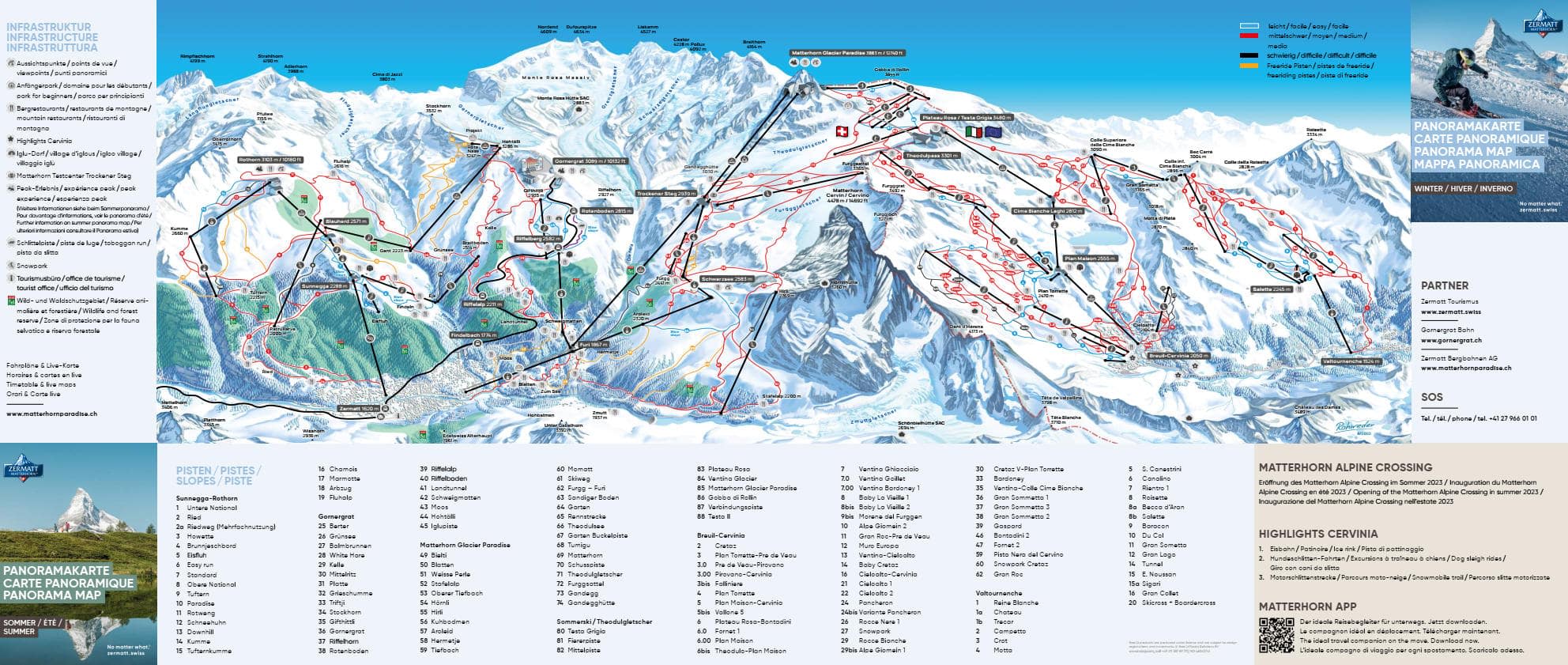
Matterhorn Ski Paradise is one ski area shared by two countries, spread beneath the Matterhorn on both sides of the border between Switzerland and Italy. Skiers can cross from one country to the other over the glacier at the foot of its peak, and together the two sides add up to 360km of pistes. This is the highest skiing in the Alps, topped by Matterhorn Glacier Paradise, which at 3,883m is Europe’s highest cable car station. Two resorts sit at either end of the area. Zermatt, on the Swiss side, is a car-free mountain village with around 200km of slopes spread across three linked sectors above it. In Italy, Breuil-Cervinia sits at 2,050m beneath the mountain’s southern face, with lifts rising from the edge of its pedestrianised centre.
Most of the pistes lie above 2,000m, on open, high-mountain terrain ringed by glaciers and 4,000m peaks, and the altitude keeps the snow reliable throughout the season. Beginners have wide, gentle blue runs on both sides of the border. Cervinia is known in particular for its broad slopes, which keep the gradient easy enough to build confidence quickly. Intermediates can cover huge distances on long red and blue runs, especially on the Italian side, where runs of over 10km roll from the glacier back down to the village. Around Zermatt, the terrain gets steeper and more varied, with mogul fields, black runs that drop through the rocks, and marked freeride routes that are secured but left ungroomed. For strong skiers, the biggest draw is the sheer length of the descents. One runs almost 15km from the glacier down to Zermatt, and another runs around 20km down the Italian side, each dropping more than 2,000m.
A holiday here brings two countries’ mountain cultures together in one ski area. Zermatt is one of the best-known resorts in the Alps, with busy streets of shops, hotels, and restaurants with the Matterhorn rising above the rooftops. Across the border, Cervinia switches to Italian, with espresso bars and family-run restaurants lining its streets. That contrast carries through to the food. Zermatt’s dining scene runs from slope-side huts serving fondue and raclette to some of the most celebrated fine dining in the Alps. Cervinia serves the hearty mountain cooking of north-west Italy, with polenta, local cheeses, and slow-cooked stews. Après-ski on both sides starts at terrace bars on the slopes. In Zermatt, it carries on into the village’s late-night bars and clubs, while in Cervinia, it moves down to relaxed village bars for a drink before dinner. You’ll find plenty to fill your days off the skis, from riding the Gornergrat Railway, Europe’s highest open-air cogwheel railway, to exploring the ice tunnels of the world’s highest Glacier Palace. In Cervinia, you can skate on an open-air rink lit up after dark, race ice karts, or head out by snowmobile, and both resorts have snowshoe trails and tandem paragliding flights over the valley.
| Country | Switzerland and Italy |
| Region | Valais (Switzerland) / Aosta Valley (Italy) |
| Total piste km | 360 km |
| Altitude | 1,524 m (Breuil-Cervinia) - 3,883 m (Piccolo Cervino / Klein Matterhorn) |
| Linked resorts | 2 Zermatt [Switzerland] Breuil-Cervinia [Italy] |
| Lifts | 52 |
| Runs | 73 (7 green, 25 blue, 27 red, 14 black) |
| Season | Year-round (glacier skiing on the Theodul/Plateau Rosa) |
| Ski pass name | Matterhorn Ski Paradise / International pass |
| Nearest airports | Geneva (~3 hr to Zermatt) Milan Malpensa (~2 hr to Cervinia) Turin (~1 hr 45 min to Cervinia) Zurich (~3 hr 30 min to Zermatt via train) |
| Glacier skiing | Yes - Theodul Glacier / Plateau Rosa, reaching 3,883 m at the Piccolo Cervino (Klein Matterhorn). Year-round skiing. |
| WeSki services | Lessons: Zermatt Transfers: both resorts (private and shared to Breuil-Cervinia; private to Zermatt) Ski equipment hire: Cervinia, Valtournenche, Zermatt |
Zermatt has three lift bases spread through the village, and each one leads to a different sector of skiing. Most of the terrain sits above the treeline on open, high-mountain slopes, with runs through the forest lower down leading back towards the village. Beginners can learn in any of the three sectors, which each have their own area of gentle slopes. Many lessons start at Wolli’s Park, at the top of an underground funicular from the village, where moving carpets and short tows are set aside for first-timers. Intermediates have a wide choice of long red runs, from open, rolling pistes high on the mountain to tree-lined runs closer to the village, while the wide blue runs on the glacier keep the gradient gentle at altitude. Advanced skiers have steep black runs and mogul fields, along with Zermatt’s yellow freeride routes, which are marked and secured from avalanches but left ungroomed. The best known of these is the Triftji, a long route on high, north-facing slopes that’s famous for its moguls. Confident off-piste skiers can also go heli-skiing with a mountain guide, which few resorts in the Alps allow.
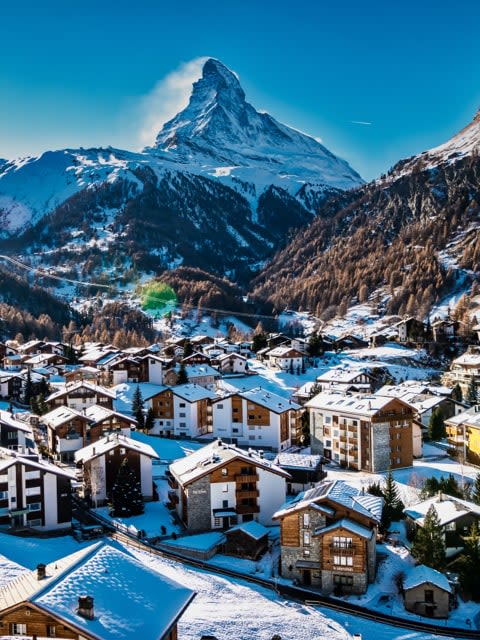
Without traffic, Zermatt’s streets are made for wandering, and you can get around on foot, by electric bus or taxi, or in the occasional horse-drawn carriage. Most of the village’s hotels are family-run, many by families who have welcomed guests for generations. They range from grand historic hotels to small guesthouses, with plenty of apartments and chalets alongside. Because Zermatt is compact, the slopes are within easy reach wherever you stay. You can base yourself near the funicular for the learning slopes, or near the gondola at the southern end of the village for the quickest way up to the glacier.
Days away from the pistes can be as active or as easy as you like, from curling and skating on the village rink to winter walks above the village and helicopter flights around the Matterhorn. Beneath the village streets, the Matterhorn Museum tells the story of the mountain’s first ascent and the climbing history that shaped Zermatt. Food is one of the strongest reasons to come, rooted in the cooking of the Valais, a region known for its air-dried beef, alpine cheeses, dark rye bread, and wines from Switzerland’s largest wine-growing area. Some mountain restaurants above the village still raise their own cattle and make their own cheese and dried meat. Down in the village, chefs recognised by the Gault&Millau and Michelin guides build their menus around the same local produce. Après-ski often starts in the mountain bars above the village, with DJs and live music, before moving down to a busy mix of cosy bars, pubs, and late-night clubs in the centre.
At 2,050m, Breuil-Cervinia has its slopes right at the edge of the village, with two ways up from the centre. Chairlifts climb straight onto the nearest runs, while a cable car and gondola rise about 500m to a broad mid-mountain area, where much of the skiing begins. Most of the skiing is on wide, open slopes above the treeline, groomed into long, smooth runs that let you cover big distances at an easy rhythm. Learning is one of Cervinia’s strengths, with two nursery areas to choose from. Beside the village lifts, gentle slopes and a magic carpet let you take your first turns a few steps from the centre. Up at the mid-mountain area, an enclosed learning zone with its own moving carpet and drag lift leads onto a wide, easy blue run. Intermediates have a huge choice of wide red and blue runs, including the Ventina, which runs 11.5km from the edge of the glacier back down to the village, dropping almost 2,000m along the way. Advanced skiers have a handful of steep black runs, including one that drops beneath the Matterhorn’s south face. After fresh snow, there’s off-piste to explore in the high, shaded bowls.
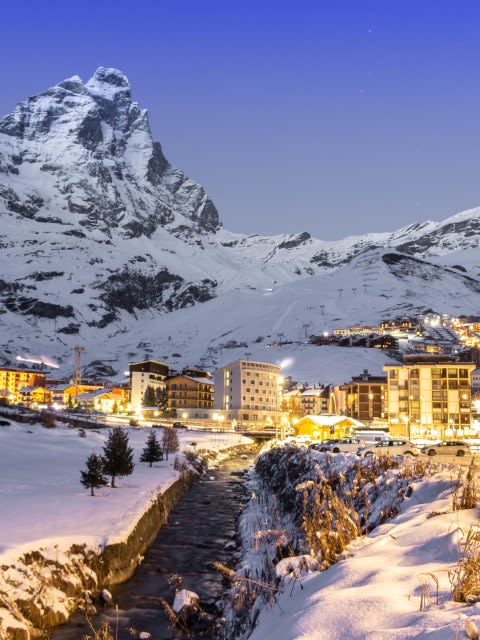
Developed as a ski resort in the 1930s, Breuil-Cervinia has a compact, pedestrianised centre at the very foot of the slopes. Its main street is lined with cafés, wine bars, shops, and pizzerias, which keeps the village full of life once the lifts close. Most hotels and apartments are within walking distance of the lifts, ranging from small, family-run hotels close to the slopes to luxury hotels with spas and gourmet restaurants.
Off the slopes, Cervinia keeps you busy with everything from dog sledding and ice climbing to cross-country skiing on a track at the edge of the village. Food is where the resort feels most Italian, built on the cuisine of the Aosta Valley, where fontina, the valley’s rich, nutty cheese, goes into almost everything. It’s melted into creamy polenta concia and into fonduta, the valley’s own take on fondue, and both are usually served alongside boards of local cured meats. Dinner often ends with a local tradition, when caffè valdostano, a coffee laced with grappa, is passed around the table in a carved wooden cup with several spouts so everyone can share it. Après-ski starts at the bars on the slopes just above the village and carries on into the centre, where wine bars and late-opening pubs keep the evenings going.
Learning to ski in Matterhorn Ski Paradise means learning at altitude, where the snow on the nursery slopes stays reliable from the start of the season to the end. Whichever resort you choose, you’ll find dedicated learning areas with moving carpets and gentle practice lifts, along with ski schools offering group and private lessons for adults and children. Once you’re comfortable on the nursery slopes, you can move onto long, wide blue runs, where the gradient stays gentle and there’s plenty of space to practise your turns. The altitude can make the first day feel more tiring than usual, so it’s worth taking it gently and building up as you adjust.
Of the two resorts, Breuil-Cervinia suits beginners especially well, with nursery slopes beside the village and a second, enclosed learning area at Plan Maison, the mid-mountain station. From there, you can progress onto the wide blue runs around it. One easy blue run is particularly worth trying: run 5, Plan Maison–Cervinia, which leads all the way back down to the village with views of the Matterhorn along the way.
In Zermatt, most beginners start at Wolli’s Park, a learning area at the top of the underground funicular, and there’s also a second practice area with its own lift up on the glacier. Once you’ve mastered the learning areas, you can move on to the rolling blue runs beside the mountain railway. They make a great place to practise, with the bonus of riding the train back down. The runs into Zermatt itself are graded red, so beginners will want to take the lifts down to the village.
Matterhorn Ski Paradise is made for intermediates who like to cover ground, with kilometres of red and blue runs linking the area’s high glacier slopes to the valleys below. Red is by far the most common grade here, so you’ll always have a new route to try, and the two sides of the border ski quite differently. On the Italian side, the slopes are broad, well groomed, and evenly pitched, so you can settle into a rhythm and cruise. One of the classic runs to try is the Ventina, which is a long red that starts at the edge of the glacier and runs all the way back down to Cervinia. Around Zermatt, the reds are more varied and it’s a great place to sharpen your technique, with steep pitches, rollers, and narrow sections. One particular Zermatt run worth trying is the Tufternkumme, a long red dropping around 900m on a wide, varied piste that suits both short and long turns.
For many intermediates, the opportunity to ski between two countries is a highlight of Matterhorn Ski Paradise. With an international pass, you can cross over the glacier at around 3,500m (if you do this, it’s worth setting off early since the return involves several lifts and has to be made before the last ones close). Another highlight is ending the day on the long red runs that wind down through the forest into Zermatt itself.
Advanced skiers will find most of the challenge around Zermatt, where the black runs are steep and technical, with narrow pitches, rocky sections, and mogul fields that call for strong technique. The steepest is Furgg–Furi, which drops around 565m over 3km through the rocks below the glacier. Beyond the groomed runs, the real draw is Zermatt’s network of yellow freeride routes. They’re marked and checked for avalanches but never groomed, so after a snowfall they’re full of fresh powder, and over the following days they build into long mogul fields. The cable car serving this area needs deep snow cover to open, so it’s usually available for skiing from late February onwards. In Cervinia, the steepest skiing is the Pista Nera del Cervino, a black run that drops beneath the Matterhorn’s south face, and Gran Roc, a black run that finishes just above the village. After fresh snow, there’s also off-piste to explore in the high, shaded bowls above the resort.
Off-piste is where Matterhorn Ski Paradise really stands out, and it’s a big reason strong skiers come here. Zermatt is known for its lift-served off-piste, with long glacier descents, open powder slopes, and steep couloirs all within reach of the lifts, and heli-skiing takes you further still onto the high glaciers. While the off-piste is exciting, we recommend skiing it with a mountain guide for the safest experience and, of course, to find the best snow. For ski tourers, Zermatt is also the finishing point of the Haute Route, a classic multi-day tour from Chamonix that’s one of the most famous in the world. It’s usually skied over five or six days, crossing high passes and glaciers between mountain huts, with Mont Blanc at the start and the Matterhorn at the finish.
Matterhorn Ski Paradise gives snowboarders a huge amount of natural terrain to explore, from long, ungroomed freeride routes to wide, groomed runs that are perfect for carving. For strong riders, Zermatt’s freeride terrain is the main attraction, with marked yellow routes that fill with fresh snow after a storm, plus guided off-piste and heli trips onto the high glaciers for anyone who wants to go further. If you’re learning, the wide blue runs beside Zermatt’s mountain railway are a great place to get comfortable on a board, and you can ride the train back up for another lap without using a drag lift. Cervinia’s broad, well-groomed slopes are ideal for snowboarding, with terrain that’s made for long carving turns. There are a few flatter stretches around the mid-mountain area and up on the glacier at the top of the ski area, where Cervinia meets Zermatt. They’re easy enough to ride as long as you pick up some speed beforehand.
If you’d rather spend the day hitting jumps and rails, both resorts have a dedicated snow park, each with its own character. In Cervinia, the Indian Park has long been the heart of the resort’s freestyle scene, a 400m stretch in the middle of the ski area with several lines of kickers, rails and boxes, and a boardercross course, all served by a chairlift. Up on the glacier at around 3,250m, Zermatt’s Gravity Park has a slopestyle line of jumps and rails for experienced riders, a beginner line of small jumps and boxes, and a fun slope that suits all ages. Thanks to its altitude, the park stays in good shape from the start of the season to the end.
You can ski the whole of Matterhorn Ski Paradise on one pass or choose a local pass for either side of the border, depending on how much of the area you want to explore. The international pass covers all 360km of pistes in Zermatt and Breuil-Cervinia, including the lifts up to Matterhorn Glacier Paradise, the Gornergrat railway, and the crossing over the glacier between the two countries. It’s the pass to choose if you want to ski in both Switzerland and Italy, or simply cover as much of the area as possible during your stay.
If you’re happy to stay on one side of the border, the local passes are a simpler option. The Zermatt pass covers around 200km of pistes across all three of the resort’s sectors, along with the Gornergrat railway, the snow park, and the local buses. It works well if you’re staying in Zermatt and plan to spend your holiday on the Swiss side. The Breuil-Cervinia pass covers around 160km of pistes on the Italian side, which suits skiers staying in Cervinia who are happy to spend their days on the wide, groomed runs around the resort.
With one resort in Switzerland and the other in Italy, your journey depends on which side of the border you’re staying, and from any of the four airports you can travel on by hire car or by private or shared transfer. For Zermatt, the closest airports are Geneva, around 230km away, and Zurich, around 240km away. Zermatt is car-free, so the road ends at Täsch, about 5km down the valley, where a shuttle train runs the last stretch into the village. You can also make the whole journey by rail, taking the Swiss train network from either airport to Visp. From there, you change onto the mountain railway that climbs the valley to Zermatt.
For Breuil-Cervinia, Turin is the closest airport, around 120km away, and Milan Malpensa is around 185km away. Both routes follow the motorway into the Aosta Valley before the final 27km climb up a winding mountain road to the resort. If you’d rather travel without a car, trains run to Châtillon-Saint-Vincent, where buses continue up to the village.
Once you arrive, you won’t need a car in either resort. In Zermatt, you get around on foot or by electric bus and taxi, and the buses link the village centre with all three lift bases. Breuil-Cervinia is compact, with most hotels and apartments within walking distance of the lifts and the pedestrianised centre.
Thanks to its altitude, Matterhorn Ski Paradise has a long winter season, with the high glacier slopes open from early November and skiing on the upper mountain carrying on into early May. The lower sectors around Zermatt open in late November and run until mid-April, so the whole area is open through the heart of winter. January to mid-March brings the deepest snow and the best chance of powder days. At either end of the season, the high runs still hold good snow even when the lower slopes are thinner. By April, the snow softens on the lower slopes as the days get warmer, while the glacier runs above 3,000m stay firm and wintry.
Timing your trip also shapes how busy the slopes feel. The busiest weeks are Christmas and New Year, the February school holidays across Europe, and Easter, when lifts and accommodation fill up fastest. Cervinia also gets busier at weekends, with day visitors driving up from Turin and Milan. For quieter slopes, early December, the weeks after New Year, and March are all good choices, and March in particular pairs reliable snow with longer days.
If you’d like to plan your trip around something special, Christmas and New Year bring festive celebrations to both resorts, with fireworks lighting up the sky over Zermatt at midnight. On the third weekend in January, Zermatt hosts the Horu Trophy, one of the largest open-air curling tournaments in Europe. More than 60 teams compete on rinks in the village centre, with the Matterhorn in view and spectators welcome to watch.
Yes, with an international pass, you can ski across the border at around 3,500m and return the same day. The lifts back over the border close earlier than the rest of the area, and each lift station posts its last crossing time, so plan your return around it. It’s also worth carrying a passport or ID card, since you’re crossing an international border.
You’ll want to be comfortable on red runs. Most of the routes that link Zermatt and Cervinia are red, with long descents at altitude, and some include short, narrow sections near the border. Confident intermediates can make the crossing easily, while newer skiers are usually happier exploring their own side first and saving the crossing for later in their stay.
You’ll have to travel back by road, which is a long journey. There’s no direct road between Zermatt and Cervinia, so the route runs around the mountains for more than 200km. A taxi is the quickest option but an expensive one, and the alternative is staying overnight on the other side, so it’s worth reaching the border with plenty of time to spare.
Yes, the lifts at the border can close in strong wind or poor visibility, since they sit on an exposed glacier at around 3,500m. When that happens, you can still ski your own resort’s slopes but won’t be able to cross the border. It’s worth checking the lift status each morning and saving your crossing day for clear, calm weather.
Choose Zermatt if you want steeper, more varied terrain, freeride routes, and a car-free village known for its dining. Choose Breuil-Cervinia if you prefer wide, gentle slopes, lifts at the edge of the village, and Aosta Valley cooking. Beginners and cruising intermediates often feel at home in Cervinia, while advanced skiers tend to lean towards Zermatt. For a full breakdown, see our Zermatt or Cervinia comparison guide.
Yes, when it’s running, the Matterhorn Alpine Crossing links Zermatt and Breuil-Cervinia entirely by cable car, so you don’t need skis to cross the border. The route rises over the glacier via Matterhorn Glacier Paradise, with views of the Matterhorn along the way. It depends on the weather and has had closures in parts of the winter, so check it’s running before planning around it.
Breuil-Cervinia often suits families with young children best, thanks to nursery slopes right beside the village and gentle blue runs where children can progress at their own pace. Zermatt also works well for families, with Wolli’s Park for young learners and car-free streets that are easy to explore together. Both resorts have ski schools offering lessons for children.
On a clear day, you can see 38 peaks above 4,000m and 14 glaciers across Switzerland, Italy, and France. From the viewing platform, the panorama takes in Mont Blanc to the west, the Eiger, Mönch, and Jungfrau to the north, and a rarely seen side of the Matterhorn. You can reach the top by cable car from Zermatt, so it’s open to non-skiers too.
Start building your dream ski trip today with our one-stop ski shop - hundreds of resorts, unlimited combinations.


 4.9/5
I usually book flights, ground transportation, hotel, ski rental and lift tickets myself but this year used WeSki for a trip to Morzine. It was so much easier. Everything worked perfectly - ground transportation arrived on time and there was plenty of feedback throughout the whole process giving you confidence the vacation would go smoothly.

A really useful service that is so much easier to use than other 'all-inclusive' sites. It nicely bridges the gap between a travel agent and booking the trip yourself online. I'll use WeSki every time I go skiing from now on.
We booked a late minute skiing trip to Morzine through we ski. We looked at booking the trip ourselves but could get anywhere near the price quoted by we ski. The company was excellent and we had no problems at all from start to finish. I would definitely use them to book another weekend skiing trip.
Seamless experience from start to finish. I was spending ages trying to sort out a weekend break and managed to do it with we ski in minutes and for the same price as booking it all up yourself. Flight, transfers and accommodation was all as expected and faultless.