
EN
EN
Ötztal ski area
The Ötztal is the longest side valley in Austria’s Tyrol, stretching around 65km south towards the Italian border with some 250 peaks over 3,000m along the way. Two of its best-known resorts, Sölden and Obergurgl-Hochgurgl, sit near the head of the valley, about 15 minutes apart by road, each with its own ski area and around 255km of pistes between them. Sölden is the larger and livelier of the two, the only ski resort in Austria with three lift-served peaks above 3,000m, and the venue for the World Cup’s season-opening race each autumn. Further up the valley, Obergurgl-Hochgurgl pairs a traditional village with a small cluster of hotels higher up the mountain, and as Austria’s highest parish village, Obergurgl has a long season that runs from mid-November into spring.
Skiing here is high and open, reaching up to 3,340m on Sölden’s two glaciers, which are linked to each other by a ski tunnel. Beginners have gentle nursery slopes in both resorts, and much of Obergurgl-Hochgurgl’s terrain is blue, so there’s plenty of easy skiing to explore. Intermediates can cruise long, wide runs in both areas, including Austria’s longest downhill run, a 15km descent from the top of Sölden’s highest peaks to the valley. Advanced skiers head to Sölden for steep glacier runs, including the World Cup race slope, and more than 70km of off-piste routes, while Obergurgl-Hochgurgl’s high peaks hold some testing black runs.
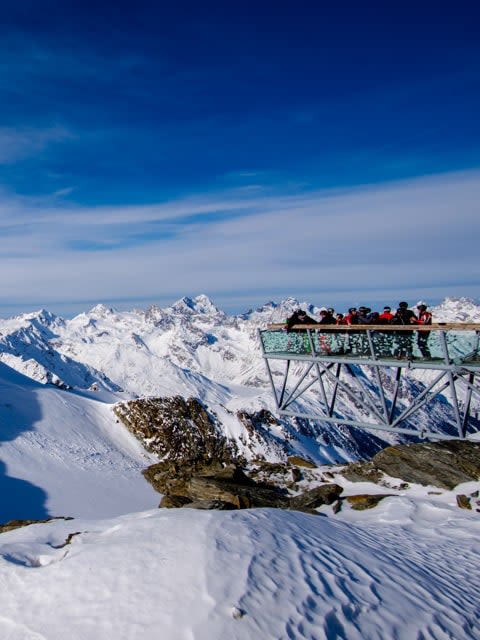
High above Sölden, the ice Q restaurant featured in the James Bond film Spectre, and the 007 Elements exhibition is built into the mountain beside it. In Obergurgl-Hochgurgl, you can ride up to the Top Mountain Star, a glass bar perched on a narrow ridge at the top of the ski area. Out in the snow, there are cleared winter walking trails, snowshoe routes, and floodlit toboggan runs across the valley, including a 7km run that winds from the slopes above Sölden back down to the village. Sölden’s slopes are dotted with more than 30 mountain huts serving hearty Tyrolean food, and its après-ski is famous, carrying on from slopeside bars into the village late into the night. Down the valley, the Aqua Dome thermal spa has outdoor pools set against the mountains.
| Country | Austria |
| Region | Tyrol (Ötztal Valley) |
| Total piste km | 254 km (combined across both areas) |
| Altitude | 1,350 m (Sölden) - 3,340 m (Tiefenbachkogl glacier, Sölden) |
| Linked resorts | 2 Sölden Obergurgl-Hochgurgl |
| Lifts | 56 |
| Runs | 90 (Sölden: 31 red, 13 black, approx. 144 km; Obergurgl-Hochgurgl: predominantly blue/red, approx. 110 km) |
| Season | Mid-October - early May (Sölden glaciers); mid-November - late April (Obergurgl-Hochgurgl) |
| Ski pass name | Ötztal Superskipass |
| Nearest airports | Innsbruck (~1 hr to Sölden, ~1 hr 15 min to Obergurgl) Munich (~3 hr) Zurich (~3 hr 30 min) |
| Glacier skiing | Yes - Rettenbach Glacier (3,056 m) and Tiefenbach Glacier (3,340 m), both above Sölden |
| WeSki services | Transfers: both resorts (private and shared to Sölden and Obergurgl-Hochgurgl) Ski equipment hire: Sölden, Obergurgl-Hochgurgl No WeSki lessons currently available |
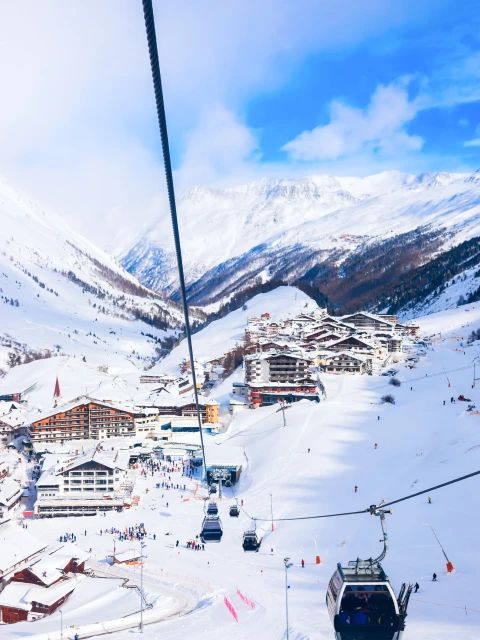
Sölden’s ski area spreads across two mountains, each reached by its own gondola from the village. One leads to wide, gentle slopes and on to the two glaciers, while the other climbs to the resort’s steepest terrain. Beginners can start on the nursery slope and easy blue runs at the top of the first gondola. Intermediates have long blues and reds to explore, and confident skiers can take on the BIG3 rally, a circuit that links Sölden’s three 3,000m peaks and their viewing platforms. Advanced skiers have two dedicated freeride areas, one with gentle slopes for a first taste of powder and the other with steep couloirs.
Strung along the valley floor, Sölden is a lively, international resort town, with ski shops, bars, and restaurants lining its long main street. You can stay anywhere from an apartment or guesthouse to a luxury wellness hotel, many within walking distance of the gondolas. For ski-in, ski-out stays, Hochsölden has a small cluster of four-star hotels about 700m above the village, right in the middle of the ski area.
Sölden has a large leisure centre with pools, saunas, and a climbing wall, as well as an ice rink for skating and curling. Winter walking trails follow the river through the valley, and you can also try a sleigh ride or a tandem paragliding flight. Hotel restaurants and slopeside huts serve hearty Tyrolean cooking, and for a special lunch, the ice Q restaurant at 3,048m is the highest restaurant in Austria with two Gault&Millau toques. The après-ski ranges from lively parties at bars on the slopes to live jazz and soul with mountain views up in Hochsölden.
Obergurgl-Hochgurgl’s skiing starts right at the village, at 1,930m, and climbs above 3,000m, so even the lowest runs sit high in the mountains. Gondolas rise from the centre and the entrance of Obergurgl, and a long gondola crossing two side valleys links its slopes with Hochgurgl’s. Beginners have gentle nursery areas beside the village and long, easy blues to move on to. Intermediates can cruise wide, well-groomed blues and reds across both sectors, and the compact layout makes it easy for mixed-ability groups to meet up at a mountain hut. Advanced skiers have steep blacks and mogul runs off the high peaks, with off-piste routes leading into the surrounding side valleys.
Obergurgl has a night-time traffic ban, so evenings are peaceful and most people walk to dinner. Accommodation is mainly in hotels, from family-run guesthouses to four- and five-star hotels, and many are ski-in, ski-out or a short walk from the lifts. Higher up, Hochgurgl is a small cluster of upmarket hotels right on the slopes, linked to Obergurgl by the gondola or a short drive.
Off the skis, you can follow a winter trail through an ancient pine forest just outside Obergurgl, or join the weekly night skiing and tobogganing in Hochgurgl. You can also skate on the floodlit ice rink or visit Europe’s highest motorcycle museum. Mountain huts serve hearty Tyrolean food, and there’s one at the top of the gondola above Obergurgl that looks out over 21 peaks above 3,000m. Down in the village, several hotel restaurants hold awards from the Michelin and Gault&Millau guides, so fine dining is never far from your door. Après-ski is relaxed and sociable, with umbrella bars, hotel lounges, and a hut above the village known for its live-music evenings.
Both resorts have their learning areas high in the mountains, so beginners in Ötztal start on high-altitude snow from day one. In Obergurgl, nursery slopes sit right beside the village, away from faster traffic, and much of the ski area is blue, so there’s plenty of easy terrain to explore. In Sölden, beginners take the gondola up to a nursery slope at mid-mountain, and there are also gentle blue runs on the wide, sunny slopes nearby to progress on to.
Once you’re linking turns, Obergurgl has long, easy blues leading back down towards the village, including blue run 6, which winds down from high above the resort. The slopes above Hochgurgl add more wide blues to explore. In Sölden, the wide blues around the hamlet of Hochsölden are a natural next step. Both resorts have ski schools with group and private lessons for adults as well as children. Younger skiers have their own spaces too, with a dedicated kids’ area in Obergurgl and a children’s club on the mountain in Sölden.
Intermediates have plenty of variety across both resorts, from wide, open slopes high above the treeline to runs that wind through the forest lower down. Obergurgl-Hochgurgl has mostly long, well-groomed blues and reds made for relaxed cruising, while Sölden’s reds tend to be steep and more varied. With lifts in both areas reaching above 3,000m, you can enjoy long descents with plenty of vertical.
In Sölden, the two glaciers add wide, high-altitude pistes, and confident intermediates can take on the BIG3 rally, which links the resort’s three 3,000m peaks for a full day of big-mountain skiing. In Obergurgl-Hochgurgl, the longest run is an 8km descent from the top of Hochgurgl down to the valley, dropping around 1,260m.
Advanced skiers will find most of the steep terrain in Sölden, with around 27km of black runs and some of the most demanding pistes high on the glaciers. The World Cup slope, piste 31 on the Rettenbach glacier, is the steepest in the resort and hosts the season’s opening races each autumn. In Obergurgl-Hochgurgl, black run 11 drops from the top of the gondola above the village and is known for its steep mogul field.
Off-piste, Sölden has more than 70km of freeride routes with descents of up to 2,000m, plus tree runs on its gentler mountain for days when the high slopes are windy. In Obergurgl-Hochgurgl, off-piste routes lead from the high peaks into the surrounding side valleys, and the area is popular for ski touring too. Much of this terrain is glaciated, so a local mountain guide is essential beyond the marked runs.
Snowboarding has a strong following in the Ötztal, and Sölden’s snowpark has made the resort a well-known meeting point for the international freestyle scene, drawing photographers and filmmakers too. The natural terrain suits riders of every level, from the gentler of Sölden’s two mountains, where moderate slopes make a good introduction to riding powder, to the steeper peaks above it, while Obergurgl-Hochgurgl’s wide, well-groomed slopes are made for carving. If you’re trying snowboarding for the first time, ski schools in both resorts run beginners’ snowboard lessons, including Obergurgl’s ski school, which has been teaching since 1922.
For freestyle, Sölden’s six-hectare snowpark sits high on the gentler mountain, with features for beginners through to pros, and a funslope nearby mixes waves, banked turns, a tunnel, and small jumps into a regular piste. Obergurgl-Hochgurgl has a family park, a funslope, and a funcross course, which suit riders trying their first features.
The Ötztal Superskipass covers both Sölden, including its two glaciers, and Obergurgl-Hochgurgl on one ticket. Any ski pass of three days or more automatically becomes the Superskipass, while shorter passes are valid only in the resort where you buy them. The pass also includes the local ski buses, night skiing in Obergurgl-Hochgurgl, and, with passes of six days or more, entry to Sölden’s 007 Elements exhibition and Hochgurgl’s motorcycle museum.
Most visitors settle into one resort for their stay. With the Superskipass, you can still spend a day skiing the other if you’d like, since it’s just a short drive along the valley.
For international visitors, Innsbruck is the closest airport, around 85–100km from Sölden and Obergurgl-Hochgurgl, while Munich is around 230–300km away and Zurich around 280–300km. From any of them, you can hire a car or book a shared or private transfer straight to your accommodation. The nearest railway station is Ötztal, at the entrance to the valley around 40–50km from the resorts, with direct trains from Innsbruck and Zurich.
Once you’ve arrived, Sölden and Obergurgl-Hochgurgl are around 15 minutes apart by road, and ski buses run up the valley between them. Sölden’s village stretches along the valley floor, with local buses linking it to the gondolas and the higher hamlets, including Hochsölden. Obergurgl is compact enough to explore on foot, and Hochgurgl is a short gondola ride or drive away.
For the most dependable snow, mid-January to mid-March is the best time to visit the Ötztal. Sölden’s glaciers open in the autumn and stay open into early May, while the main ski areas in both resorts run from mid-November to mid-April, and Obergurgl-Hochgurgl is usually among the first non-glacier ski areas in Tyrol to open. With so much of the skiing high up, the upper slopes tend to hold their snow into spring, and the glaciers keep skiing going after the lower runs close.
Christmas and New Year are the busiest weeks, along with the February school holidays, while January after the first week and the middle of March tend to be quieter. If you’d like to plan around an event, Obergurgl-Hochgurgl hosts World Cup slalom races in late November, with evening events in the village. In mid-March, the Diamond Beats winter festival brings curated music performances to Gurgl.
Yes, both resorts are well set up for families. Each has ski schools with children’s lessons and dedicated kids’ areas, and Sölden also has a children’s club on the mountain. Obergurgl-Hochgurgl’s gentle blues and family park suit young skiers, and the resort has been popular with British families since the 1960s. Off the slopes, Sölden’s leisure centre pools and the valley’s toboggan runs are fun for every age.
Choose Sölden for a bigger ski area with two glaciers, steep terrain, and lively après-ski, or Obergurgl-Hochgurgl for wide, well-groomed slopes, ski-in, ski-out hotels, and quiet evenings in a high mountain village. Beginners and relaxed cruisers will find Obergurgl-Hochgurgl’s mostly blue terrain especially suitable. For a full side-by-side, see our Sölden or Obergurgl comparison guide.
Yes, though they aren’t linked by lifts. The two resorts are about 15 minutes apart by road, and ski buses run up the valley between them. Any ski pass of three days or more automatically becomes the Ötztal Superskipass, so you can spend a day in the other resort without buying a separate ticket.
Yes. The valley has hundreds of kilometres of cleared winter walking trails, plus snowshoe routes and toboggan runs, several of them floodlit. Non-skiers can ride the lifts up to the ice Q restaurant and 007 Elements in Sölden, or the Top Mountain Star in Gurgl, and the Aqua Dome thermal spa down the valley has outdoor pools for a relaxing day.
The Ötztal skis higher, while Ischgl offers one bigger linked area. Ischgl’s ski area covers around 239km and crosses the border into Switzerland, while Sölden’s slopes reach 3,340m and its glaciers open in the autumn. Both Sölden and Ischgl are known for big après-ski, with Ischgl famous for its Top of the Mountain concerts, and Obergurgl-Hochgurgl offers a quieter high-mountain alternative.
Yes, the altitude makes it one of Austria’s best choices at either end of the season. Sölden’s glaciers open in the autumn and run into early May, and both main ski areas usually open in mid-November and run until late April. Obergurgl and Sölden often top rankings for early-season skiing in Austria.
Start building your dream ski trip today with our one-stop ski shop - hundreds of resorts, unlimited combinations.



 4.9/5
I usually book flights, ground transportation, hotel, ski rental and lift tickets myself but this year used WeSki for a trip to Morzine. It was so much easier. Everything worked perfectly - ground transportation arrived on time and there was plenty of feedback throughout the whole process giving you confidence the vacation would go smoothly.

A really useful service that is so much easier to use than other 'all-inclusive' sites. It nicely bridges the gap between a travel agent and booking the trip yourself online. I'll use WeSki every time I go skiing from now on.
We booked a late minute skiing trip to Morzine through we ski. We looked at booking the trip ourselves but could get anywhere near the price quoted by we ski. The company was excellent and we had no problems at all from start to finish. I would definitely use them to book another weekend skiing trip.
Seamless experience from start to finish. I was spending ages trying to sort out a weekend break and managed to do it with we ski in minutes and for the same price as booking it all up yourself. Flight, transfers and accommodation was all as expected and faultless.
WeSki is a trading name operated by Wetrip Weski Ltd (BR021500). All the flights and flight-inclusive vacations on this website are financially protected by the ATOL scheme. When you pay you will be supplied with an ATOL Certificate. Please ask for it and check to ensure that everything you booked (flights, hotels and other services) is listed on it. Please see our booking conditions for further information or for more information about financial protection and the ATOL Certificate go to: www.caa.co.uk.
Package vacations that do not include travel by air are financially protected via ABTOT.
For the latest travel advice from the Foreign & Commonwealth Office visit www.gov.uk/foreign-travel-advice.
Weski Europe BV (Chamber of Commerce registration number 87334100) is a registered participant of SGR. You can verify this on www.sgr.nl/english. Vacations listed on this website are covered by SGR’s guarantee, within the terms of the SGR guarantee scheme. Under SGR’s guarantee, consumers shall have their prepaid travel sum refunded if their counterparty is unable to fulfill its contractual obligations due to financial inability. Insofar as the agreement includes the transport and the destination has already been reached, the return trip will be arranged.