EN
EN
Skirama Dolomiti is a single ski pass covering around 380km of pistes across eight ski areas, set among the pale rock peaks of the Dolomites in northern Italy. The areas aren’t linked to each other by lifts, so it’s easiest to base yourself in one and drive to the others for a day. The biggest has around 150km of connected pistes, linking Madonna di Campiglio, one of Italy’s best-known ski resorts, with Pinzolo and the ski villages of Val di Sole. The second-largest area is shared by Passo Tonale and Ponte di Legno, with around 100km of pistes that climb onto a glacier at 3,000m. Smaller areas complete the Skirama pass, including Paganella-Andalo, where the lifts leave right from the village centre, and Folgaria, where wide, well-groomed runs wind through the forest.
Across these areas, you can ski everything from forest runs low in the valleys to open glacier slopes at 3,000m. Beginners, whether on skis or a snowboard, will find gentle learning areas close to the villages and plenty of wide, easy runs to practise on. Intermediates are especially well served, with long blues and reds through the trees and enough linked terrain in the bigger areas to ski somewhere new every day. Advanced skiers have steep blacks to tackle, including a World Cup race slope, as well as long descents of up to around 8km that run from the high peaks all the way down to the valley floor. Beyond the pistes, the high, glaciated mountains around the area are good terrain for ski touring. Touring skiers climb uphill using skins, strips of grippy fabric attached to the base of their skis, to reach quiet, untracked slopes away from the lifts.
Food is one of the great pleasures of a trip to the Skirama Dolomiti area. Expect hearty mountain cooking built on local ingredients, like cheeses from the high summer pastures, cured meats, and apples from the surrounding valleys, alongside Italian favourites such as fresh pasta and polenta. Some of the best meals are served in mountain huts right beside the pistes. When the lifts close, après-ski takes the form of an Italian aperitivo, with a glass of sparkling wine or a spritz and a few small bites to share. Madonna di Campiglio is the area’s most stylish resort, with several Michelin-starred restaurants for a special night out. Away from the pistes, you can go husky sledding or snowshoeing through protected forest, race down a toboggan run, unwind in a thermal spa set in a national park, or follow winter trails past old First World War forts.
| Country | Italy |
| Region | Trentino |
| Total piste km | 380 km |
| Altitude | 800 m (Pinzolo) - 3,016 m (Presena Glacier, Passo Tonale) |
| Linked resorts | 5 Madonna di Campiglio Pinzolo Val di Sole Paganella-Andalo Falcade |
| Lifts | 150 |
| Runs | 380 km across 8 ski areas within the network |
| Season | Late November - late April (glacier skiing at Presena extends to May) |
| Ski pass name | Skirama Dolomiti Adamello Brenta pass |
| Nearest airports | Verona (~2 hr) Bergamo (~2 hr 30 min) Innsbruck (~2 hr 30 min) Venice (~3 hr) |
| Glacier skiing | Yes - Presena Glacier (3,016 m) above Passo Tonale |
| WeSki services | Transfers: all 5 resorts (private to all; scheduled to Madonna di Campiglio and Pinzolo) Ski equipment hire: Madonna di Campiglio, Folgarida (Val di Sole), Passo Tonale (Val di Sole) No WeSki lessons currently available |
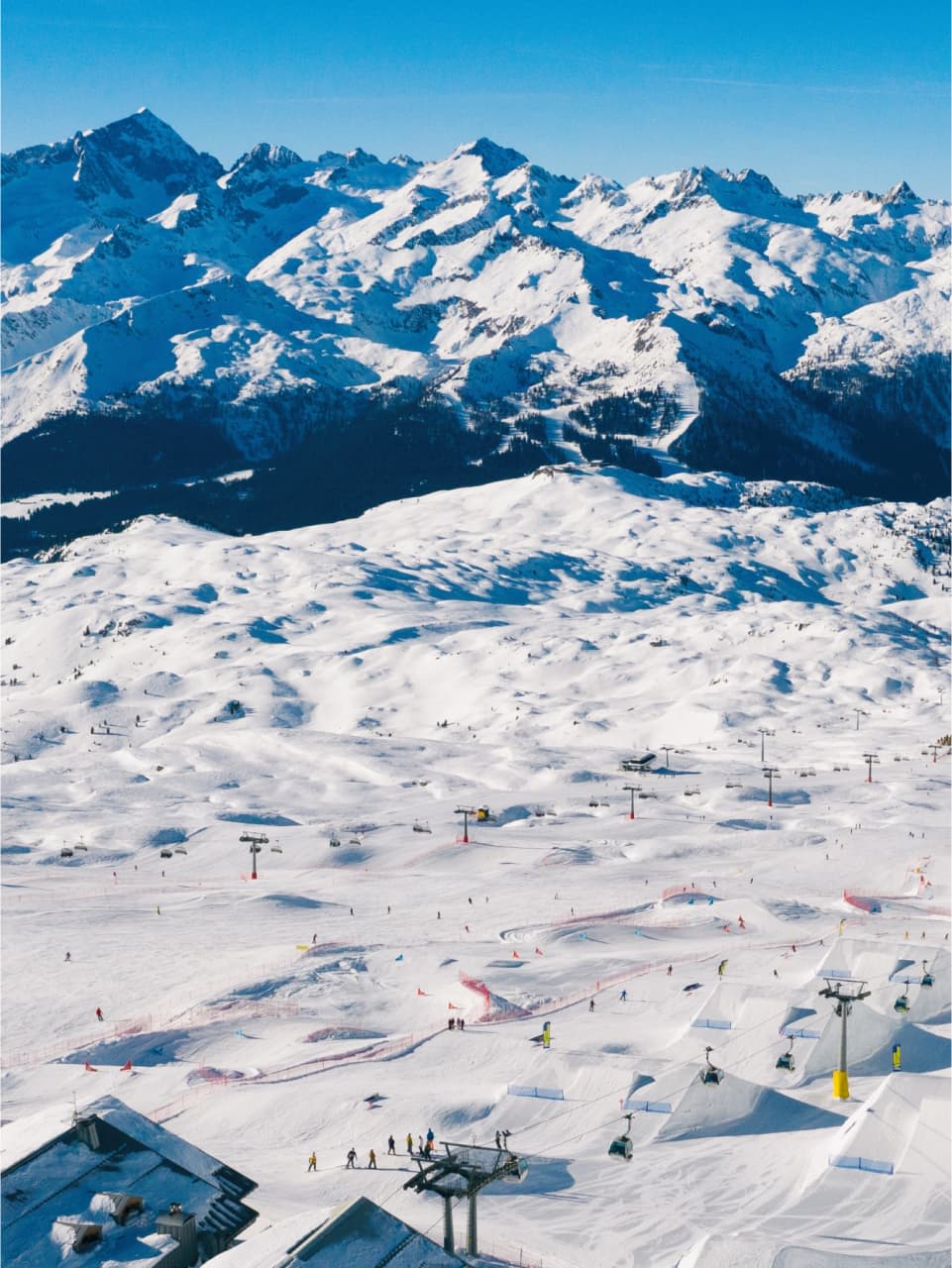
Madonna di Campiglio is one of Italy’s most stylish ski resorts, and the hub of the area’s biggest ski area, with lifts linking it to Pinzolo and Val di Sole. The town sits in a high valley with slopes rising on both sides, and the lifts start right from the centre. From the top, the views reach across to the jagged peaks of the Dolomites. Most runs are long, well-groomed blues and reds through the forest, so intermediates can cruise for days without repeating themselves. Beginners learn on gentle nursery slopes just outside town, a short bus ride from the centre and away from the busier main runs. Strong skiers have several steep blacks to take on, including the slope used for the World Cup night race. Freestylers of every level are well catered for too, with a small snowpark for children and first-timers and a bigger one higher up, full of jumps and rails.
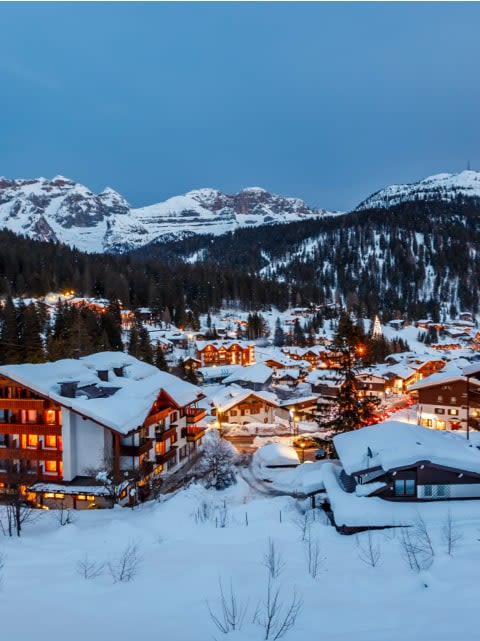
Off the slopes, Campiglio is as much about the town as the skiing. You’ll find locals and visitors alike wandering through the car-free centre, past elegant hotels and smart shops, to the little lake in the middle of town, which freezes into an outdoor ice rink each winter. Après-ski starts on the mountain, at the huts and bars near the bottom of the runs, then moves into town as the light fades. That’s the time for the passeggiata, the early-evening stroll that’s a local ritual, and visitors are welcome to join in. Evenings usually settle into an aperitivo before dinner at one of the town’s excellent restaurants, and a handful of bars and clubs keep going late. There’s plenty to do beyond skiing or snowboarding, too, whether that’s heading into the snowy forest by dog sled or on snowshoes, seeing the valley from above on a paragliding flight, or spending a slow afternoon in one of the town’s many spas.
Pinzolo is a traditional town in a wide valley just below Madonna di Campiglio, and a more relaxed, down-to-earth base for the same big ski area. A gondola climbs from the centre of town to Pinzolo’s own slopes, where the views open up across the jagged Dolomite peaks. These slopes cover around 30km, with more red and black runs than blue runs, so the skiing suits confident intermediates and strong skiers best. Among the blacks is the Tulot, a run so long and steep that it’s billed as one of the most thrilling in the Alps. Beginners have their own gentle nursery area with easy conveyor lifts, partway up the gondola. When you want more variety, another gondola links Pinzolo’s slopes to Madonna di Campiglio, and the new Plaza run means you can ski between the two in around 12 minutes.
Down in town, Pinzolo has a real local feel, with family-run hotels, independent shops, and restaurants serving hearty Trentino cooking. On the edge of town, the old church of San Vigilio holds one of the valley’s most unusual sights, a 16th-century fresco on its outside wall showing skeletons leading people from every walk of life in a Dance of Death. Evenings tend to be relaxed, with a drink in a cosy bar followed by a long, unhurried dinner. There’s plenty to round out the holiday, whether you ski or not, from skating at the town’s ice rink to snowshoeing through the woods or spending an afternoon at the thermal spa a short drive along the valley.
Val di Sole is a long valley of ski villages on the far side of Madonna di Campiglio’s slopes, with two quite different places to ski. Folgarida and Marilleva sit at the end of the big linked ski area, so you can ski from the village all the way across to Madonna di Campiglio and Pinzolo. Their own slopes cover around 50km, mostly blue and red runs through the forest, with a good handful of blacks for strong skiers. Both villages are built around the lifts, with hotels and apartments close to the slopes, and at Marilleva, some apartments let you ski right from your door. Further along the valley, Pejo is a smaller, quieter village set inside a national park, with around 20km of mostly red runs, plus beginner slopes and a snowpark. Its cable car climbs to 3,000m, where the area’s longest run drops around 8km all the way back to the village.
Down in the valley, the villages are small and traditional, each with its own pace, and Dimaro and Commezzadura sit on the quieter valley floor. Restaurants serve hearty mountain cooking and cheeses made in the valley, and evenings are relaxed, centred on a good dinner and a drink in the village. In Pejo, natural mineral springs feed a thermal spa, which is the perfect way to ease tired legs after a day on the slopes, and a floodlit slope opens for night skiing twice a week. There’s plenty more to fill a holiday, from dog sledding and snowshoeing to tobogganing and ice skating.
Passo Tonale is a ski village high on a mountain pass at around 1,880m, which makes it one of the most snow-sure bases in the area. Lifts start right in the village, and the slopes around it are wide, open, and mostly gentle, so beginners and relaxed intermediates have plenty of room to find their feet. Higher up, the lifts climb onto the Presena Glacier at 3,000m, a vast, high-alpine snowfield with big views across the surrounding peaks. From there, a run of around 11km drops all the way down to Ponte di Legno, one of the longest descents in Europe. Strong skiers have plenty to tackle, from steep, technical blacks on the glacier to the Paradiso, a 3km black run that drops more than 700m. With a guide, the open bowls beyond the pistes make for great off-piste skiing after fresh snow. Freestylers have a snowpark with sections for every level, from first jumps to a skicross course.
The village is built for skiing, with hotels, apartments, and hire shops gathered close to the lifts, so you can be among the first on the slopes each morning. As the lifts wind down, après-ski finds an easy balance between lively and laid-back, with music spilling out of the busier bars and quiet corners for a glass of local wine. Plus, a floodlit slope means night skiing for anyone who wants to carry their evening on where the day left off. And for a change of pace, there’s a whole other side to the mountain to discover, whether that’s racing across the snow on a snowmobile, riding behind a team of huskies, or heading out on snowshoes, skates, or a fat bike.
Ponte di Legno is a lively mountain town in the valley below Passo Tonale, and the two share around 100km of slopes. A gondola climbs from town straight up to the pass, putting the wide-open slopes and the glacier within easy reach. Closer to town, the skiing heads into the trees, with runs winding down through thick pine forest. Beginners can find their feet on gentle slopes just outside town. Intermediates have long, rolling reds that carry them through the forest and down to the neighbouring village of Temù. Strong skiers can head for the Corno d’Aola, where steep blacks cut between the trees and keep you on your toes. For confident skiers, one of the best ways to end the day is the 11km run from the glacier, which drops around 1,700m all the way back into town.
Ponte di Legno has a long history of welcoming skiers, and back in 1912 it was named Italy’s first winter sports destination. The town sits on a wide plateau where two mountain streams meet, with national parks rising on either side. Its pedestrian centre of narrow, cobbled streets is made for wandering, with small squares, cosy cafés, and craft shops tucked along the way. As the lifts close, the bars and wine bars around the centre start to fill up, and the evening drifts into a long dinner of hearty mountain cooking. If you’re not quite ready to stop skiing, a floodlit run through the forest opens for night skiing on certain evenings. Days off the slopes are just as easy to fill. You can glide along cross-country trails in the valley, go sledging, or follow snowshoe trails out into the national parks. The local museum tells the story of the First World War front that once ran through these mountains, and the town’s spa hotels are ready for an afternoon of rest.
Paganella-Andalo is a ski area of its own, a short drive from the bigger linked slopes, with lifts leaving right from the village of Andalo. Its 50km of wide, well-groomed pistes climb to a summit with views across the Dolomites. Most are reds, which suits intermediates who like long, flowing runs. Beginners are well looked after, with gentle blue runs and children’s areas with easy conveyor lifts close to the village. Strong skiers can take on the Olimpionica, a black run that drops around 300m in just over 1km, and freestylers have a snowpark high on the mountain.
Andalo is a compact village set around a small lake, with hotels, shops, and restaurants close to the lifts. Much of village life off the slopes revolves around its big leisure park, home to swimming pools, a wellness centre with saunas, and an ice rink. Evenings are easygoing, starting with an aperitivo after the lifts close and moving on to dinners of hearty Trentino cooking. There’s more to round out the holiday too, from night-time snowshoe walks to horse riding and ice climbing with a guide.
Folgaria is the main village of Alpe Cimbra, a high, rolling plateau with a ski area of its own. Its slopes link up with neighbouring villages to form around 100km of pistes, known for being wide, beautifully groomed, and lined with forest. Most of the runs are blues and reds, which makes Folgaria a relaxed, confidence-building place for beginners and intermediates. First-timers are especially well looked after, with six dedicated learning areas spread across the slopes. Strong skiers have a few steep, technical runs to test their edges. For something truly unique, a marked ski circuit loops around the area past old First World War forts, so you can take in a bit of history between runs.
Folgaria itself is a welcoming village with a cheerful Italian feel, and evenings revolve around hearty local cooking in cosy restaurants and mountain huts. The plateau also has a character all its own. In the nearby village of Luserna, most people still speak Cimbrian, an ancient language with Bavarian roots. Elsewhere, one of the old forts is now a museum, and a former Cold War missile base has been turned into one too. Days off the slopes are easy to fill. The cross-country trails here are among the best in the region, and there’s also an indoor ice rink, swimming pools, and snowshoe trails through the snowy forest.
Beginners are well looked after across Skirama Dolomiti, with gentle learning areas close to the villages throughout the area. Passo Tonale is one of the best places to learn, with wide, open slopes right on its doorstep that give you plenty of room to practise. For families, Paganella-Andalo and Folgaria are especially good choices, with excellent children’s areas, gentle blue runs, and an easy-going pace that keeps the whole group relaxed. In Madonna di Campiglio, the main nursery slopes sit just outside town, a short bus ride from the centre and away from the busier runs, with easy blues nearby to move onto when you’re ready. Pinzolo has its own learning area partway up the gondola, so you’re up among the mountains from your very first lesson. Every resort has local ski schools, many with English-speaking instructors, so booking lessons for adults or children is easy.
Once you’ve found your feet, the next step is the area’s blue runs, which are typically wide and carefully groomed, so you can practise your turns without feeling rushed. Some wind gently through the forest, where the trees make the slopes feel calmer and help you see more clearly when the cloud comes in. Others open out higher up, giving you more space to build speed and confidence. Snowmaking covers most of the slopes too, so the easier runs stay smooth and reliable through the season.
Most of the pistes across Skirama Dolomiti are blue and red runs, so intermediates have plenty to explore. The biggest playground is the linked area around Madonna di Campiglio, where around 150km of connected slopes let you ski from one village to the next on long, well-groomed runs through the forest. One of the best days out is to ski the length of it, crossing from Pinzolo through Madonna di Campiglio to Folgarida and Marilleva and back again. In Val di Sole, Pejo’s cable car climbs to 3,000m for a scenic descent of around 8km, mostly red before it eases into a gentle blue near the bottom. At Passo Tonale and Ponte di Legno, a second linked area of around 100km mixes wide, open runs up high with reds through the trees, and confident intermediates can take on the 11km descent from the glacier all the way down to town. With several separate ski areas on one pass, it’s easy to spend different days of your trip skiing somewhere new.
Strong skiers will find plenty of steep terrain across Skirama Dolomiti, spread across several areas. Most of it is on the pistes, made up of fast, well-groomed blacks, and it comes in two styles. Lower down, steep, sustained runs drop through the forest. Up high, the terrain opens out into exposed, technical slopes on and around the glacier. Long descents are a big part of the appeal too, with some runs dropping well over 1,000m from the high peaks to the valley floor. In the linked area around Madonna di Campiglio, the highlight is the slope that hosts the World Cup night slalom, a steep, sustained black that’s open for anyone to ski. Pinzolo has the Tulot, a long, steep black through the forest, and Marilleva’s black runs add more challenge on the Val di Sole side. At Passo Tonale, the Paradiso drops more than 700m in around 3km, and the blacks on the glacier above it are steep and technical. Lower down at Ponte di Legno, the Corno d’Aola area has steep runs that cut between the trees. Even the smaller areas have a surprise or two, like Paganella’s Olimpionica, a short, punchy black that drops around 300m in just over 1km.
Off the pistes, the best terrain is around Passo Tonale, where open bowls beneath the glacier come alive after fresh snow, and the forest above Pinzolo has some good powder spots too. The high, glaciated mountains across the area are also popular for ski touring. For anything beyond the marked runs, go with a local mountain guide, who will know where the snow is safest.
Snowboarding has a well-established following across Skirama Dolomiti, with dedicated snowboard schools and some of the best-known terrain parks in the Alps. For most riders, though, the real draw is the pistes themselves. The wide, carefully groomed runs are made for long, flowing carves, whether you’re cruising the forest reds around Madonna di Campiglio or the open, rolling slopes high up at Passo Tonale, where the natural bowls and smooth pitches are great fun on a board. After fresh snow, Tonale’s open terrain beneath the glacier is a favourite with freeriders, ideally with a local guide.
If you’re trying snowboarding for the first time, you’re in good hands. The gentle learning areas near the villages work just as well on a board as on skis, and local ski schools across the area offer snowboard lessons. Madonna di Campiglio even has a school dedicated entirely to snowboarding. Passo Tonale’s wide beginner slopes are especially good for finding your balance, with plenty of space and no trees to worry about.
For anyone who loves freestyle or wants to give it a go, the parks here are some of the best around. Madonna di Campiglio’s main snowpark, high above town, is widely rated among the best in Europe. It has more than 40 features, from big jumps and rails to an easier line for those just starting out, and there’s a smaller park lower down especially for children and beginners. Passo Tonale’s park has sections for every level, plus a boardercross course. There are also smaller parks at Pinzolo, Marilleva, Pejo, and Paganella-Andalo.
The Skirama Dolomiti pass, sold as the Superskirama, covers all eight ski areas on a single ticket, with around 380km of pistes and 150 lifts, including the glacier above Passo Tonale. It’s available for anywhere from 2 to 14 consecutive days, as well as for the full season. If you’re planning to stay in one place, local passes are also available. The Campiglio Dolomiti di Brenta pass covers the whole linked area around Madonna di Campiglio, including Pinzolo, Folgarida-Marilleva, and Pejo. Passo Tonale and Ponte di Legno share their own local pass, and on longer passes you can pay a supplement to spend a day skiing elsewhere on the Skirama network. Paganella-Andalo and Folgaria have local passes of their own too.
Which pass suits you depends on how much you want to explore. If you’re staying around Madonna di Campiglio or in Val di Sole, the local pass is enough for most skiers, since the linked area alone has plenty to fill a week. The full Skirama pass is worth it if you’d like to try different areas during your stay, such as a day on the glacier at Passo Tonale or on the wide, well-groomed slopes at Paganella-Andalo.
Bolzano is the closest airport, around 105km from Madonna di Campiglio, followed by Verona at around 165km and Bergamo at around 175km. Milan’s two airports are a little further, with Linate around 205km away and Malpensa around 260km. Innsbruck, across the border in Austria, is around 220km away, and Venice is the furthest, at around 290km. Distances vary across the area, though, so it’s worth checking the route to your resort. Passo Tonale and Ponte di Legno sit closer to the Milan side, while Paganella-Andalo and Folgaria are closer to Verona. By train, the nearest main station is Trento, around 75km from Madonna di Campiglio, with bus connections on to the resorts.
Once you’re there, the linked area around Madonna di Campiglio is easy to get around on skis, with lifts joining Pinzolo, Madonna di Campiglio, and the villages of Val di Sole. Ski buses connect the villages to the lifts throughout the season, and in Val di Sole, a ski bus also runs between Pejo and Folgarida-Marilleva. The other ski areas aren’t linked by lifts, so if you’re planning day trips to Passo Tonale, Paganella-Andalo, or Folgaria, having a car makes things much easier.
The ski season usually runs from late November to late April, and the glacier above Passo Tonale often opens as early as late October and stays open into early May. Snowmaking covers most of the pistes, so conditions are reliable from the start, but the best natural snow tends to fall between January and mid-March. Later in the season, longer, milder days bring softer spring snow, especially on the lower slopes, while the glacier stays wintry well into spring.
The busiest times are Christmas and New Year, through to Epiphany on 6 January, and the long weekend around 8 December, which is a national holiday in Italy. February is busy too, when many European schools take their winter break. Madonna di Campiglio is especially popular at all of these times. For quieter slopes, aim for the first half of December, mid-January once the holidays are over, or March, when the snow is often still good and the days are longer.
A few events are worth planning around. Each winter, usually around Christmas, Madonna di Campiglio hosts the 3Tre, a men’s World Cup slalom raced under floodlights, which fills the town with atmosphere. In January, the Winter Marathon sees vintage cars set off from Madonna di Campiglio on a rally across the Dolomite passes. In February, the Habsburg Carnival takes over the town for a week, with skiers in historical costume on the slopes, torchlit descents, and a grand imperial ball.
No. The pass covers eight separate ski areas that aren’t linked by lifts, so you’d need to drive between them. The largest, Campiglio Dolomiti di Brenta, links Pinzolo, Madonna di Campiglio, and Folgarida-Marilleva with around 150km of pistes, and confident intermediates can ski from one end to the other and back in a day.
No, but you should be comfortable on red runs to make the full journey. Pinzolo and Madonna di Campiglio are linked by gondola, so much of that connection is a lift ride, while the route over to Folgarida and Marilleva involves more skiing. Check the piste map before you set off, and leave plenty of time for the journey back.
You’ll need a taxi or bus back to your resort. The villages in the linked Campiglio area are a short drive apart by road. Ski buses run between them during the day but may not run late, so a taxi is usually the most reliable option once the lifts close. Keep an eye on the time when you’re skiing far from your base.
Passo Tonale and Marilleva 1400 are the best options. At Tonale, the lifts start right in the village, and at Marilleva 1400, some apartments let you ski straight from your door. In Andalo, Pinzolo, and Madonna di Campiglio, the lifts leave from the centre, so most accommodation is a short walk or ski bus ride away.
Occasionally. The highest lifts, especially those up to the glacier above Passo Tonale, can close in strong winds. Much of the skiing in the linked Campiglio area and around Ponte di Legno sits lower down in the forest, where it’s more sheltered, so there’s usually somewhere to ski even on a windy day.
They’re separate passes covering different parts of northern Italy. Dolomiti Superski is much larger, with around 1,200km of pistes across 12 ski areas, including the famous Sella Ronda circuit. Skirama Dolomiti covers around 380km further west, centred on Madonna di Campiglio and the Brenta Dolomites. Neither pass covers the other’s slopes.
Yes. Madonna di Campiglio has the most to offer, with a car-free centre, shops, spas, an ice rink on a frozen lake, and dog sledding nearby. Andalo has a large leisure park with pools, a wellness centre, and an ice rink, and Pejo has a thermal spa inside a national park. Snowshoeing is available across the area.
Paganella-Andalo and Folgaria stand out, with gentle slopes, children’s snow areas, and plenty to do off the slopes, from Andalo’s leisure park to Folgaria’s indoor ice rink and swimming pools. Passo Tonale is also a good choice for children who are learning, thanks to its wide, open beginner slopes right by the village.
Start building your dream ski trip today with our one-stop ski shop - hundreds of resorts, unlimited combinations.



 4.9/5
I usually book flights, ground transportation, hotel, ski rental and lift tickets myself but this year used WeSki for a trip to Morzine. It was so much easier. Everything worked perfectly - ground transportation arrived on time and there was plenty of feedback throughout the whole process giving you confidence the vacation would go smoothly.

A really useful service that is so much easier to use than other 'all-inclusive' sites. It nicely bridges the gap between a travel agent and booking the trip yourself online. I'll use WeSki every time I go skiing from now on.
We booked a late minute skiing trip to Morzine through we ski. We looked at booking the trip ourselves but could get anywhere near the price quoted by we ski. The company was excellent and we had no problems at all from start to finish. I would definitely use them to book another weekend skiing trip.
Seamless experience from start to finish. I was spending ages trying to sort out a weekend break and managed to do it with we ski in minutes and for the same price as booking it all up yourself. Flight, transfers and accommodation was all as expected and faultless.