EN
EN
In Zell am See-Kaprun, a ski day can start high on a glacier and end with a walk along the shore of a mountain lake, and that contrast is what draws people to this corner of Austria’s Salzburg region. Most visitors base themselves in one of its two resorts. One is the lakeside town of Zell am See, with its own ski mountain rising right behind the rooftops. The other is Kaprun, a smaller village a short bus ride away, where a chain of lifts climbs from the centre all the way up to the glacier. Together, the area’s three ski areas add up to 138km of pistes, topping out at 3,029m on the Kitzsteinhorn glacier. On the shared pass, the mountain above Zell am See also links by lift into the neighbouring Skicircus, for 408km in all.
Although Zell am See and Kaprun share one pass, the mountains around them ski like two different holidays. Above Zell am See, the slopes are rolling and wooded, with long valley runs that carry you all the way back into town. The same mountain is also home to the Funslope XXL, one of the longest fun slopes in the world, where tunnels, waves, and banked turns wind down through the forest. Up on the glacier, the skiing is high, open, and snow-sure, on wide pistes that suit everyone from improving beginners to fast carvers. First-timers in Kaprun can start on a gentle slope right in the village, then move up to the easy runs of its local ski area before taking on the glacier. Intermediates get the best of both, from wide glacier pistes to long, rolling valley runs, with the Skicircus next door when you want even more ground to cover. Advanced skiers will find steep black runs on both mountains, from the glacier’s Black Mamba to the Trass, which drops about 1,000m from the top of Zell am See’s mountain to the valley. For many, though, the biggest draw is off-piste, as the Kitzsteinhorn is one of Austria’s best-known freeride spots, with five marked freeride routes close to the lifts.
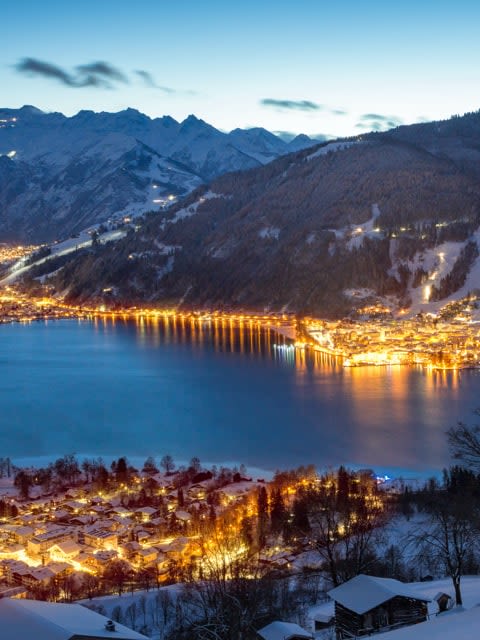
Each resort in the ski area has its own pull. Zell am See is a historic lakeside town, with a medieval centre right on the water and plenty going on beyond the slopes. Kaprun is a mountain village built around skiing, where you can step onto a lift in the middle of town and ride it up towards the glacier. Mountain huts are a big part of eating here. They’re dotted across the slopes of both ski areas and serve Pinzgau cooking, the hearty farmhouse food of the valley that’s built around local cheese, dumplings, and slow-cooked dishes. One morning, it’s worth starting your ski day with breakfast at the top of the glacier, where Salzburg’s highest restaurant serves a summit breakfast. Après-ski starts on the mountain terraces with live music, and because the valley runs finish in Zell am See itself, you can ski straight down into the town’s bars and clubs. Days off the skis have their own highlights, from tunnel tours inside the Kitzsteinhorn to winter walks along the lakeshore, more than 100km of cross-country trails, and an afternoon in Kaprun’s thermal spa.
| Country | Austria |
| Region | Salzburg (Pinzgau) |
| Total piste km | 138 km |
| Altitude | 750 m (Zell am See) - 3,029 m (Kitzsteinhorn glacier) |
| Linked resorts | 2 Zell am See Kaprun |
| Lifts | 52 |
| Runs | 56 (9 green, 18 blue, 18 red, 11 black) |
| Season | Mid-October - mid-May (Kitzsteinhorn glacier); mid-December - mid-April (Schmittenhöhe) |
| Ski pass name | Zell am See-Kaprun ski pass |
| Nearest airports | Salzburg (~1 hr 15 min) Munich (~2 hr 15 min) Innsbruck (~2 hr) |
| Glacier skiing | Yes - Kitzsteinhorn glacier (3,029 m) above Kaprun, open from mid-October |
| WeSki services | Lessons: Kaprun Transfers: both resorts (private and shared to Zell am See and Kaprun) Ski equipment hire: Zell am See, Kaprun |
Zell am See is a lakeside town with its own mountain, the Schmittenhöhe, rising from the edge of town, with gondolas from both the centre and the neighbouring district of Schüttdorf. Beginners have a dedicated learning area at the foot of the Schüttdorf gondola. Intermediates can cruise wide, open slopes across the upper mountain and varied reds through the forest lower down. Advanced skiers have long, steep blacks that drop around 1,000m from summit to valley through the trees, the longest being the Trass at more than 4km. Away from the groomed pistes, marked ski routes are left ungroomed, so fresh snow brings powder through the trees.
Zell am See’s largely car-free old town is easy to explore on foot, with boutiques, delicatessens, and cafés around the town square, and a lakeside promenade a few minutes away, looking across the water to the Kitzsteinhorn glacier. Places to stay range from family-run guesthouses and self-catering apartments to five-star spa hotels on the lakeshore. Stay in or near the old town to keep the gondola within walking distance, or in Schüttdorf, beside the other main gondola.
Off the slopes, there’s plenty to keep you busy, from skating on the frozen lake in a cold winter, or at the indoor rink, to toboggan runs and horse-drawn sleigh rides. Food is a real strength here. Mountain huts across the slopes serve lunch with views over the lake, and in town, traditional inns and pizzerias sit alongside some of Austria’s most acclaimed fine dining. Evenings centre on the old town, with music bars and a club open into the early hours.
Kaprun is known for the Kitzsteinhorn, a glacier ski area reaching around 3,000m, which gives the resort snow-sure skiing through the whole season. Most of the glacier’s runs are wide, open reds above the treeline, ideal for intermediates who like long, carving turns. Advanced skiers have steep blacks to tackle, and the Kitzsteinhorn’s open, high-alpine slopes are also well known for freeriding, good enough to host a Freeride World Tour qualifying event. Freestylers will find snowparks for every level. Closer to the village, Kaprun’s own mountain, the Maiskogel, has gentle blue runs through the trees that finish right in the village centre, plus a small nursery slope for complete beginners.
Kaprun sits at the foot of the Hohe Tauern mountains, and life in the village centres on the base of the Maiskogel gondola, with ski shops, cafés, and après bars close by. Accommodation ranges from family-run guesthouses and apartments to boutique hotels and a large spa resort with its own thermal pools, and ski buses connect the village to both mountains.
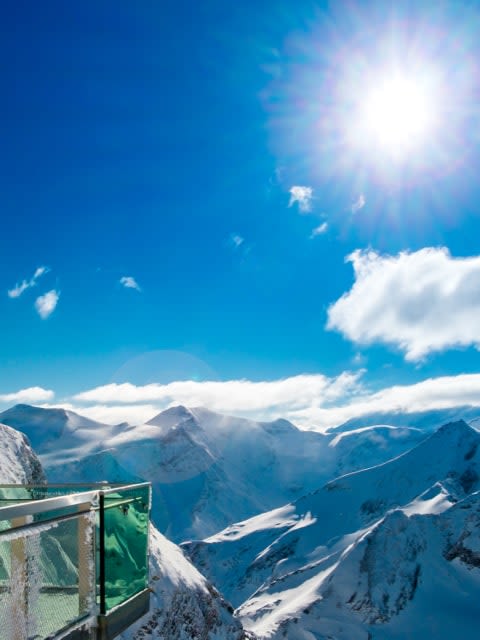
Off the slopes, there’s plenty to keep you busy, from the panorama platform at the top of the Kitzsteinhorn, with views to Austria’s highest mountain, to the alpine coaster, an indoor climbing wall, and the thermal spa. Après-ski starts at the umbrella bars on the glacier and carries on at the foot of the gondola, with live music into the evening. Dinner is a highlight too, as many of Kaprun’s restaurants cook with produce from the surrounding region, from beef raised on nearby farms to game and local fish.
Beginners in Zell am See-Kaprun can learn on gentle blue runs through the forest on the lower mountains, or on broad, open slopes high on the Kitzsteinhorn glacier, where the snow stays reliable all season. Ski schools in both resorts offer lessons for adults and children.
In Zell am See, first-timers start in a learning area with a covered moving carpet at the base of the Schüttdorf gondola. From there, you can ride up to the Glocknerwiese, a wide blue slope where ski schools take their groups next, and easy runs lead all the way back down into town. In Kaprun, the nursery area is right in the village centre. Once you’re ready for longer runs, the Maiskogel’s wide blues take you from the top of the mountain back to the village, and the glacier has gentle runs across its upper slopes.
Younger skiers have their own play areas too. On the Glocknerwiese, a dragon-themed kids’ park has wave tracks and archways to ski through, and the Maiskogel has a fun run with waves and small features for young freestylers.
Much of the intermediate skiing in Zell am See-Kaprun is about distance, with long reds that keep a steady pitch over hundreds of metres of vertical. You can choose between forest runs above Zell am See and wide, open slopes on the glacier above Kaprun.
On the Schmittenhöhe above Zell am See, the reds wind through the trees and link easily from one lift to the next. Confident intermediates tend to head for the reds around the Sonnkogel peak, and the mountain’s longest run takes you 6km from the summit down to Schüttdorf, dropping 1,250m on the way. Above Kaprun, the glacier’s reds are broad and consistent, and linking them from the top of the ski area gives you a 5km descent with 1,000m of vertical. When visibility drops up high, the tree-lined runs on the Maiskogel are a good alternative closer to the village.
Advanced skiers in Zell am See-Kaprun can choose between two kinds of steep terrain. Most of the area’s black runs are on the Schmittenhöhe above Zell am See, where they’re long, sustained descents through the forest, with close to 1,000m of vertical on the longest. The glacier above Kaprun is higher and more open, with shorter, steeper pitches above the treeline.
Zell am See’s toughest black is the Trass, which runs for more than 4km from the summit down through the trees. On the Kitzsteinhorn, the Black Mamba is the steepest run on the glacier, a short, very steep black, and there’s a dedicated mogul run for practising bumps. Off-piste, both mountains have marked ski routes that are left ungroomed for powder and moguls. Beyond them, the open glacier above Kaprun has wide freeride terrain to explore with a guide.
The Kitzsteinhorn is a fixture on the snowboard calendar. Each spring, it hosts the national championships for Austria and Germany and the finals of an international tour for young riders. The natural terrain across the area suits every style of riding. On the glacier, wide, open slopes give you space for long carves, and its freeride routes lead into powder close to the lifts. Lower down, the forested runs above Zell am See and on the Maiskogel are full of natural rolls and banks to play with.
If you’re new to snowboarding, the Maiskogel’s wide, gentle blues and the learning areas in both resorts give you room to practise your first turns, and snowboard lessons are available in Zell am See and Kaprun. For freestyle, the Kitzsteinhorn’s four snowparks have lines for every level, including an easy park for first jumps and boxes, and the Eagle Line is a fun slope packed with waves and banked turns. On the Schmittenhöhe, a snowpark beside the Funslope XXL has butter boxes, wave boxes, and kickers.
Whichever resort you stay in, the lift pass for a ski holiday in Zell am See-Kaprun is the Ski ALPIN CARD. You buy it for the number of days you need, and it’s valid on consecutive days. It covers every lift on the Schmittenhöhe above Zell am See, and on the Kitzsteinhorn, the Maiskogel, and the village nursery slope in Kaprun. It also includes the neighbouring Skicircus Saalbach Hinterglemm Leogang Fieberbrunn, reached from the Schmittenhöhe by gondola and a short bus ride, for 408km of pistes and up to 121 lifts in total.
Because the Ski ALPIN CARD covers the whole area, it’s the only pass most visitors need, and it includes the ski buses in and between Zell am See and Kaprun. For a longer trip that takes in more of the region, the SuperSkiCard is sold separately and covers 23 ski areas, with more than 2,800km of pistes, across five Austrian regions and neighbouring Bavaria.
Salzburg is the closest airport to Zell am See-Kaprun, around 80 to 105km away. Innsbruck is around 145 to 160km away, and Munich around 200 to 230km. From any of the three, you can hire a car or take a shared or private transfer straight to your accommodation. By train, Zell am See’s station is in the town centre, on the railway line between Salzburg and Innsbruck, with direct trains from both cities. Kaprun is around 7km away, with regular buses from the station.
Getting around once you’re there is easy without a car. Ski buses link the lift stations in Zell am See and Kaprun and also run between the two resorts, and Zell am See’s centre is easy to explore on foot.
For the most dependable snow, mid-January to mid-March is the best time to visit Zell am See-Kaprun. The main season runs from early December to early April on all three mountains. The Kitzsteinhorn glacier opens in October and stays open into May, so the snow up high stays reliable at both ends of the winter, while the lower runs above Zell am See depend more on conditions early and late in the season.
Christmas, New Year, and the February school holidays are the busiest times. The weeks after New Year and the first half of March tend to be quieter. Late January and early February are worth planning around for two events in Zell am See. During balloonalps, hot-air balloons take to the skies over the valley, with passenger flights you can join and a night-time balloon glow, and the FAT Ice Race brings classic and racing cars, plus skijoring, to an ice track at the town’s airfield.
Yes. Both resorts have children’s ski areas and ski schools with lessons for children, and the Maiskogel above Kaprun is a family mountain with gentle runs that lead back down into the village. Off the slopes, families can ride the alpine coaster in Kaprun, swim and skate at Zell am See’s leisure centre, or relax in the separate children’s spa at Kaprun’s thermal spa resort.
Stay in Zell am See for a lakeside town with more restaurants, shops, and nightlife, or in Kaprun to be closest to the glacier. Zell am See’s own mountain has long forest runs and most of the area’s black runs. In Kaprun, lifts link the village centre to the Kitzsteinhorn’s snow-sure slopes, with gentle family terrain on the Maiskogel just above the village.
No, the two resorts aren’t linked by lift. They’re around 8km apart, and ski buses run between them throughout the ski day, included with the Ski ALPIN CARD. That makes it easy to spend a day on the other resort’s mountain, whether you want the glacier’s high, open slopes or the forest runs above Zell am See.
Yes, with the Ski ALPIN CARD. From the far side of the Schmittenhöhe, a gondola takes you down to Viehhofen, where a shuttle bus runs to the Skicircus lifts. Coming back, a blue run leads down to the same gondola for the ride back up. The shuttle only runs while the gondola is operating, so plan to be back before it closes.
You can ski lower down. If strong wind or poor visibility closes the glacier’s upper lifts, the Maiskogel above Kaprun and the Schmittenhöhe above Zell am See are lower and mostly wooded, and their tree-lined runs give better visibility on stormy days. Both are covered by the same pass, and ski buses link the two resorts.
Yes. Non-skiers can ride the cable cars to the panorama platforms at the top of the Kitzsteinhorn, follow winter walking trails on the Schmittenhöhe, and meet skiers for lunch at the mountain huts. In the resorts themselves, there’s Kaprun’s thermal spa, skating in Zell am See, toboggan runs, horse-drawn sleigh rides, and an alpine coaster in Kaprun.
Zell am See-Kaprun is the only one of the three with both a glacier and a lake. Saalbach’s Skicircus is a bigger linked area, with 270km of pistes and a reputation for lively après-ski, and Kitzbühel is a historic town famous for its Hahnenkamm downhill race. Both top out at around 2,000m, against 3,029m on the Kitzsteinhorn, and the Skicircus is on the same Ski ALPIN CARD.
Start building your dream ski trip today with our one-stop ski shop - hundreds of resorts, unlimited combinations.


 4.9/5
I usually book flights, ground transportation, hotel, ski rental and lift tickets myself but this year used WeSki for a trip to Morzine. It was so much easier. Everything worked perfectly - ground transportation arrived on time and there was plenty of feedback throughout the whole process giving you confidence the vacation would go smoothly.

A really useful service that is so much easier to use than other 'all-inclusive' sites. It nicely bridges the gap between a travel agent and booking the trip yourself online. I'll use WeSki every time I go skiing from now on.
We booked a late minute skiing trip to Morzine through we ski. We looked at booking the trip ourselves but could get anywhere near the price quoted by we ski. The company was excellent and we had no problems at all from start to finish. I would definitely use them to book another weekend skiing trip.
Seamless experience from start to finish. I was spending ages trying to sort out a weekend break and managed to do it with we ski in minutes and for the same price as booking it all up yourself. Flight, transfers and accommodation was all as expected and faultless.