EN
EN
 Hidden gem
 Backcountry (off-trail) skiing
 Stunning viewsHidden gemBackcountry (off-trail) skiingStunning viewsHidden gemBackcountry (off-trail) skiingStunning viewsHidden gemBackcountry (off-trail) skiingStunning views
Lost Trail Powder Mountain sits high in the Bitterroot Mountains, a range in the northern Rockies in the northwest of the United States. It takes its name from the Lewis and Clark expedition, who lost the trail crossing this remote pass on the Montana-Idaho line back in 1805, and it's still a place you climb a long way into the mountains to reach, with barely a building in sight. Running since 1938, it's one of Montana's oldest ski areas, and it's still run by the same family. Not much has changed over the years, and that's a big part of the charm. The pace is easy, the two-seat chairlifts have been carrying skiers up for generations, and the single log lodge fills with locals and tourists alike. One of this area’s highlights is its snow, with light, dry powder that, with so few people to track it out, can still be waiting days after it falls.
The skiing spreads across two linked mountains, with room to roam over some 1,800 acres and 60-odd runs. It's high, cold country, the summit topping out near 2,500m and the runs dropping around 550m below it, and the terrain suits every level. Green runs reach both summits, so new skiers aren't stuck on the lower slopes and can ride up for incredible views. Intermediates have the most to play with, including long cruisers like Oreo, which rolls on for nearly 3km from the top lift. And strong skiers can go hunting for the good stuff, whether that's steep chutes, powder-filled bowls, or glades threaded through the trees. One of the best parts of a ski holiday here comes down to the snow quality. Lost Trail pulls in around 9m of light, dry snow in a typical season, all of it natural, since there's no snowmaking on the mountain. The season usually runs from early December into April.
The mountain itself keeps things simple, a single day lodge with a cafeteria, a rental shop, and a ski school, which is all part of the appeal. One thing worth knowing as you plan: Lost Trail runs Thursday to Sunday and on major holidays rather than every day, so it's worth shaping your trip around that. What surrounds it is the biggest draw. The pass sits between two vast wilderness areas, the Selway-Bitterroot to the west and the Anaconda-Pintler to the east, wild country where you'll spot elk in the meadows and ridgelines running off in every direction. There's more than downhill to do here, too. Right across the pass, the Chief Joseph trails offer miles of groomed cross-country skiing and snowshoeing through the forest, at every level, kept in shape by a local club that works hand in hand with the ski area. And on the way back down toward the valley, it's worth stopping for a soak in the mineral hot spring near Sula, a fine way to end a cold day on the hill.
Check out Lost Trail ski deals to start planning your trip.
Lost Trail Powder Mountain sits high in the Bitterroot Mountains, a range in the northern Rockies in the northwest of the United States. It takes its name from the Lewis and Clark expedition, who lost the trail crossing this remote pass on the Montana-Idaho line back in 1805, and it's still a place you climb a long way into the mountains to reach, with barely a building in sight. Running since 1938, it's one of Montana's oldest ski areas, and it's still run by the same family. Not much has changed over the years, and that's a big part of the charm. The pace is easy, the two-seat chairlifts have been carrying skiers up for generations, and the single log lodge fills with locals and tourists alike. One of this area’s highlights is its snow, with light, dry powder that, with so few people to track it out, can still be waiting days after it falls.
The skiing spreads across two linked mountains, with room to roam over some 1,800 acres and 60-odd runs. It's high, cold country, the summit topping out near 2,500m and the runs dropping around 550m below it, and the terrain suits every level. Green runs reach both summits, so new skiers aren't stuck on the lower slopes and can ride up for incredible views. Intermediates have the most to play with, including long cruisers like Oreo, which rolls on for nearly 3km from the top lift. And strong skiers can go hunting for the good stuff, whether that's steep chutes, powder-filled bowls, or glades threaded through the trees. One of the best parts of a ski holiday here comes down to the snow quality. Lost Trail pulls in around 9m of light, dry snow in a typical season, all of it natural, since there's no snowmaking on the mountain. The season usually runs from early December into April.
The mountain itself keeps things simple, a single day lodge with a cafeteria, a rental shop, and a ski school, which is all part of the appeal. One thing worth knowing as you plan: Lost Trail runs Thursday to Sunday and on major holidays rather than every day, so it's worth shaping your trip around that. What surrounds it is the biggest draw. The pass sits between two vast wilderness areas, the Selway-Bitterroot to the west and the Anaconda-Pintler to the east, wild country where you'll spot elk in the meadows and ridgelines running off in every direction. There's more than downhill to do here, too. Right across the pass, the Chief Joseph trails offer miles of groomed cross-country skiing and snowshoeing through the forest, at every level, kept in shape by a local club that works hand in hand with the ski area. And on the way back down toward the valley, it's worth stopping for a soak in the mineral hot spring near Sula, a fine way to end a cold day on the hill.
Check out Lost Trail ski deals to start planning your trip.
Lost Trail rises from the pass in two directions, the Montana side and the Idaho side, with trails following its natural fall line down through subalpine forest before opening onto steeper, more exposed ground near the ridge. The runs have real character, with natural rolls and pitch changes, corridors cut through the trees, and terrain that keeps the mountain interesting. New skiers and riders have a gentle learning area at the base and easy greens to step up on. Intermediates are perhaps the best served of all, with long, consistent groomers down Saddle Mountain and rolling blue runs to link together. And strong skiers get to go hunting, above all in the glades, where old burns have left perfectly spaced trees and powder that sits tucked between them, along with steeper chutes and off-piste pockets up near the top.
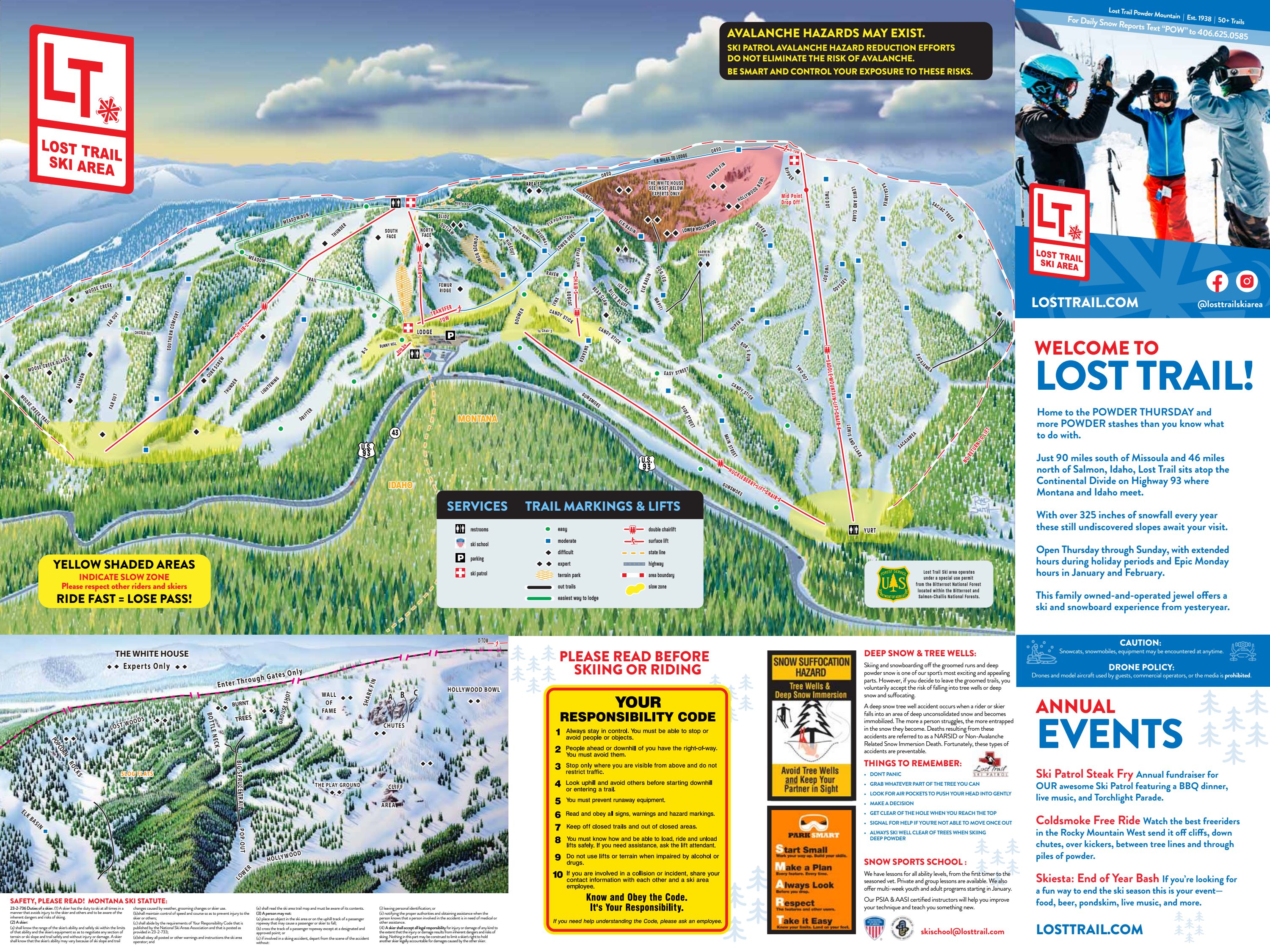
Skiing starts at the base lodge, right on top of the state line pass, where Chair 1 is the main way up. From there you can work over to the Idaho side or cross toward Saddle Mountain, which is the higher and more rewarding of the two hills. Every lift is an old fixed-grip double, slow and characterful, and a scattering of rope tows link each section together, so you'll ride the odd tow to get from one part of the mountain to the next. It's a small, two-sided area that's easy to find your way around once you've got your bearings, and the unhurried lifts are part of its old-school feel.
Important for international vistiors: If you've mostly skied in Europe, the grading here works a little differently. Green circles are the beginner runs, close to European greens and easy blues. Blue squares cover intermediate terrain, but across a wider range than European blues, so some ski tougher than others. Black diamonds are advanced, and double black diamonds are expert-only. There's no direct equivalent to the European red, so it's worth taking a run or two to get a feel for how the grades translate.
Beginners start on the Montana side, where a gentle learning area sits right by the base lodge, served by its own rope tow. It's a calm, low-key place to start, kept clear of fast runs. Once you're ready to leave it behind, there are easy green runs close by to build on which are wide and forgiving, with Chicken Out among the gentlest first descents on the mountain. The light, dry snow helps as well, it's softer and easier to move around on than the heavier stuff at lower, warmer resorts, which is no small thing when you're starting out.
Lost Trail is a good place to get going and keep improving over the course of a trip. After the learning area and base greens, a natural next step is trying lower-pitch blue runs on the same side, which can ease you into steeper terrain without a sudden jump in difficulty. You're not pinned to the bottom for long, both of the mountain's summits can be reached on gentle runs, so you can ride a chair up and take a long, easy way down while you're still building confidence.
WeSki insider tip: Once you're happy on the blues, ride the Saddle Mountain chair to the top and take Oreo down. The upper part is gentle and beginner-friendly, easing into a mellow blue back to base, and it lets you ski a long descent from high on the mountain, with the peaks all around you, sooner than you might expect.
For intermediates used to groomed-only resorts, Lost Trail is a gentle way into more natural, unmanicured skiing. Most of the cruising is on the Saddle Mountain side, where long groomers hold a steady, comfortable pitch and flow down through the trees. It's ideal for warming up and stringing laps together. Southern Comfort is a good one to start on, and the well-known Oreo run rolls on for the best part of 3km if you want length. Crossing to the Idaho side changes the feel, with different aspects and snow, so even though it’s a compact mountain you’ll have a sense of covering new ground.
When you want more, push towards the upper mountain, where the blue runs steepen and the trees start to open out for more serious pitch and longer fall lines. This is also where the step up to the easier blacks feels natural. The short black off Chair 5 is a good first one to try, gentle enough for a confident blue skier to have a go without it feeling like a leap.
WeSki insider tip: If you've never skied in the trees, this is the place to try it. The glades off Saddle Mountain are a highlight for a lot of regulars, and because old burns left the trees widely spaced, they're one of the more forgiving places anywhere to give it a first go. Pick a lightly gladed line, take it slowly, and you'll likely be hooked.
Lost Trail has more appetite for steep skiing than its easy-going reputation lets on. Head up top and the pitches turn sustained and serious, dropping through tight trees and past cliff bands, rock drops, and wind-loaded snow that all ask for a bit of care. The coldest, driest snow tends to hold on the north-facing steeps off Chair 1, which stay good long after the sun has softened everything else. When you want it rougher, the Moose Creek glades run steeper still, and marked runs like Bear Claw and Area 51 hand you the pitch without the route-finding. Best of all, though, is the tree skiing. In the sheltered glades the snow stays soft, and you can pick your own line down through the forest.
None of this is tame. It's high, exposed terrain, and the ungroomed blacks demand real confidence and a willingness to read the snow as you go. What sets Lost Trail apart is how much variety it fits into such a small footprint. Tight trees, open bowls, narrow chutes, and steep faces all sit within a short lift ride of one another, which is why the mountain skis so much bigger than its size suggests.
WeSki insider tip: The mountain's best expert terrain is hidden in plain sight. Off the Oreo run, a set of marked gates opens into the White House, a double-black zone of chutes, cliffs, and open bowls that plenty of visitors ski straight past without realising it's there. When it's open, duck through the gates for some of the most exciting in-bounds skiing on the mountain.
Lost Trail is a powder mountain at heart, which makes it a natural fit for snowboarders. The deep, light snow, the open glades, and the steep upper-mountain terrain are exactly the sort of riding boarders come looking for. The groomed blues down Saddle Mountain are great for laying out carves, and the forest is full of natural hits, rolls, and side-hits to play on, so freestyle riders can session the mountain itself rather than a built park, though there are a couple of small terrain parks as well. There's one thing to plan around, though. The layout has some flat connectors and a few rope tows linking the two sides, so keep your speed up and choose your lines to avoid ending up unstrapped and walking.
Off-piste is really what Lost Trail is all about. So little of the mountain is groomed that, once you're comfortable off the marked runs, the whole place opens up, tight tree runs, open faces, and ridgeline chutes, all within the boundary ropes. Given the snow it gets and how few people are around to ski it, you can still be finding untracked lines days after a storm, and the north-facing slopes in particular keep their powder cold and dry. It's a mountain that rewards a bit of curiosity, dropping off the side of a run into the trees and seeing where they take you.
Beyond the ropes, the terrain gets wilder still. Lost Trail allows uphill travel under its own policy, and the Bitterroot Range around it opens onto serious backcountry, including the Selway-Bitterroot Wilderness, home to some of the most remote ski touring anywhere in the lower 48 states. This is committing, serious country with real avalanche exposure, so it's strictly for experienced tourers who carry a beacon, probe, and shovel and know how to use them. For anyone with the skills, though, Lost Trail sits right at the doorstep of some wonderfully wild country.
Lost Trail's snow sports school runs group and private ski or snowboard lessons for all ages and abilities taught by certified instructors. First-timers start on a two-hour introductory lesson before moving into shorter sessions matched to their level. For a short trip, private lessons are recommended, where you can book a single session and shape it around whatever you want from the mountain. Given how much of Lost Trail is ungroomed, an hour or two spent learning to ski powder or pick a line through the trees, with someone who knows exactly where to point you, is time well spent. Group lessons run on ski days too, sorted by ability, if you'd rather learn alongside others.
Lost Trail keeps a couple of small terrain parks, which suits the mountain's low-key, natural feel. Frontcountry Park holds the built features, kickers, rails, boxes, and a wallride, while Powder Park, down at the bottom of Powder Bowl, mixes natural jumps and rollers with a few boxes and tables. Between them there's a gentle way in for anyone hitting features for the first time, along with bigger stuff to progress onto, and in a good season the mountain runs the odd rail jam and slopestyle event.
Lost Trail makes a wonderful family adventure. This is proper Montana mountain country, with deep powder, quiet forests, and elk down in the valleys, and the family-run, small-scale feel of the place makes it welcoming and easy to settle into with children. Here, the mountain and the setting are the whole point, somewhere a family can ski together through the day and unwind together in a cabin come evening.
On the mountain, beginners are in good hands. Lost Trail has a gentle learning area at the base and a ski school known for patient, friendly teaching. Children who can already ski have plenty to grow into, with tree runs, powder, and a couple of small terrain parks for anyone drawn to freestyle. Best of all for families, because green runs lead off both summits, a family of mixed abilities can ride the chair up together and each pick their own way down, meeting again at the bottom. Everyone skis the same mountain, whatever their level.
Family time here isn't only about downhill skiing. Right across the pass, the Chief Joseph trails offer easy cross-country skiing and snowshoeing that young children can join in with. A few minutes down the road, the Lost Trail hot springs are a real family favourite, with warm mineral pools for soaking tired legs after skiing and an on-site restaurant serving pizza and hearty plates right by the pool on select evenings. Most families base themselves in cosy cabins down in the valley and cook together after a day on the snow, with a handful of relaxed spots nearby in Sula, Conner, and Darby for breakfast or a meal out. For anything more, the town of Hamilton, about an hour and a half north, makes an easy day trip.
Lost Trail sits in a wild, remote pocket of Montana, and the best things to do off the slopes come straight from the landscape around it. There are hot springs to soak in, quiet trails to ski and snowshoe, wildlife to look out for, and a handful of small western towns down in the valley, each with its own history and character. Here's what's worth seeking out.
Dining around Lost Trail is all about hearty, honest Montana cooking. Up at the mountain, the day lodge keeps you fed with warming cafeteria food to fuel a day on the snow, burgers, soups, chilli, and hot drinks by the fire. Down in the valley, the small towns have a scattering of log-built saloons, cafés, and steakhouses serving big plates of the local staples, steaks, burgers, game, and Montana beef, in generous portions that suit a long day out in the cold. Darby, about 40 minutes north, has the best of it, with a couple of characterful spots right on its old western main street.
WeSki insider tip: For a proper taste of Montana, order a bison burger, leaner and richer than beef, which turns up on menus all over the valley. And whatever you eat, save room for something huckleberry, whether it's pie, cheesecake, or a milkshake made from the wild mountain berry the region is known for.
Après-ski at Lost Trail is a low-key affair. When the lifts stop, the day lodge has a small bar where you can settle in for a beer among the locals and other skiers, warm, easy, and quiet. The evening here is really about winding down after a day in the cold, a soak, a hearty meal, and a cold beer before doing it all again tomorrow. Most of what's on offer is a short drive down in the valley, so here are the spots worth knowing.
Après-ski spots to know:
There's nowhere to stay at the ski area itself, so a Lost Trail trip means basing yourself down in the Bitterroot Valley and driving up to the mountain. Most people stay in a cabin. The valley and the surrounding forest are dotted with them, from simple, cosy log cabins to roomier rentals and a few rustic lodges, most with a wood stove to come home to and long views out over the mountains. It's a self-catering, back-to-basics sort of stay, comfortable and characterful rather than polished, which fits the mountain perfectly. At the other end of the scale, the valley also has a handful of country inns and a luxury ranch or two, if you'd rather someone else did the cooking.
Where you base yourself is a trade-off between closeness and comforts. Staying around Sula or Conner keeps you nearest the slopes, about 25 minutes away, and deepest in the quiet valley scenery, which for a lot of people is the whole appeal. Darby, roughly 40 minutes north, adds a bit more choice and a small town with shops and places to eat. Hamilton, about 90 minutes north, has the widest range of hotels and services, but it's a fair drive to ski each day, so it works best as a stop on the way in rather than a daily base. Wherever you land, plan to self-cater, and stock up on provisions in Hamilton or Missoula before you head up the valley.
A Lost Trail lift ticket is refreshingly simple. It covers the whole mountain, every lift and run, for however long you're skiing. Being a small, family-owned hill, Lost Trail keeps its prices down, and multi-day options make a longer trip better value still. Lost Trail is also one of the independent mountains on the Indy Pass, so if you happen to have one, you get a couple of days here as part of the network, but for most visitors a standard lift ticket is all you'll need. The main thing to plan around is the schedule, since the mountain runs Thursday to Sunday and on major holidays rather than every day, so it pays to build your ski days around that.
Check for family and multi-day pass options when booking your Lost Trail ski holiday through WeSki to find the best fit for your trip.
You can hire skis and snowboards at the base lodge, where the rental shop keeps a freshly tuned fleet of recent gear, boots, boards, poles, and skis, along with a workshop for waxing and repairs. Given how remote Lost Trail is, this is really the place to sort your kit, and it's worth knowing that rentals are first-come, first-served and can't be booked ahead, so on a busy holiday it pays to turn up early and get fitted before the lifts start turning. The shop runs from 9am to 4:30pm on the days the mountain is open, and rentals for children aged five and under are free.
You'll want a car at Lost Trail. There's no village at the mountain and public transport in this part of the valley is very limited, so for most visitors a car is the practical way to reach the slopes, get out to dinner, and do anything else. It isn't quite the only option, some lodges and guest ranches shuttle their guests up to the mountain, and a couple of local companies can arrange transfers and airport pick-ups if you book ahead, but taxis and ride-hailing aren't something to count on this far south. If you're driving, US-93 is plowed through winter, though the pass itself can get tricky in a storm, so carry chains and check conditions before setting off. Towns are spread out, as well, so fill up on fuel and stock up on provisions down in the valley before heading up.
Lost Trail sits in a remote corner of the northwest United States, so reaching it takes a bit of doing. The nearest airport is Missoula Montana Airport (MSO), about 145km north, from where the route runs south down US-93 through the Bitterroot Valley to the pass. Missoula is a regional airport, so international visitors usually connect through a larger US hub, with Seattle, Denver, and Salt Lake City the common ones, before the short flight in.
WeSki offers car rentals from the airport as well as private transfers to Lost Trail. Add them to your Lost Trail ski holiday package for seamless door-to-door travel.
Yes, more so than its reputation suggests. There's a dedicated learning area on the Montana side with gentle green runs, and because both of the mountain's summits can be reached on easy runs, beginners aren't stuck at the bottom and have a clear way to progress onto the blues. The light, dry snow is forgiving to learn on, as well. It's a good place to find your confidence and build up over a trip.
North America grades runs differently from Europe. Green circles are beginner runs, close to European greens and easy blues. Blue squares are intermediate, but they span a wider range than European blues, so a confident intermediate may find some of them quite testing. Black diamonds are advanced, and double black diamonds are expert-only, often steep and technical, with cliffs and chutes. There's no direct equivalent to the European red.
Lost Trail gets a lot of snow, around 9 metres of light, dry powder in a typical season. Sitting up on the Continental Divide, it catches storms from more than one direction, and the high, cold setting keeps the snow light. There's no snowmaking at all, so it runs entirely on natural snowfall, which in most winters is plentiful. The cold helps the snow keep well, and with so few skiers about, fresh tracks can last a good while after they fall.
Lost Trail is much smaller and more remote than Montana's big names like Big Sky, Whitefish, and Bridger Bowl. What it gives up in size and facilities, it makes up in snow and quiet. Its snowfall rivals the snowiest resorts in the state, and it packs a lot of varied terrain into a small, low-key area with just a handful of lifts. The main difference is the amenities. Where the larger resorts have full base villages, Lost Trail keeps things simple with a single day lodge, which for a lot of skiers is exactly the appeal, big natural snow, room to roam, and none of the fuss, usually for less.
Evenings at Lost Trail are low-key. There isn't a real nightlife scene, the after-dark options are a handful of pubs and lodge restaurants in the valley towns, 25 to 50 minutes away. Most people wind down instead with a soak in the hot springs, a hearty dinner, and a quiet drink before another day on the snow. If a lively night out matters to you, this isn't the place, but if that sounds like a good evening, you'll feel right at home.
Not only weekends, though it isn't open every day either. Lost Trail runs Thursday to Sunday, plus major holidays, rather than daily. That's part of being a small, family-run mountain, it opens when it makes sense to. Days can shift a little from season to season, so it's worth checking the current schedule when you plan, especially if you're travelling from overseas and building a trip around it.
For most visitors, yes. Lost Trail is remote, with no village at the mountain and very limited public transport, so a car is the practical way to reach the slopes and get around the valley. It isn't quite the only option, some lodges shuttle their guests up, and private transfers can be arranged, but taxis and ride-hailing aren't reliable this far out. Pick up a hire car at Missoula airport, carry chains and check road conditions in a storm, and stock up on provisions in the valley or in Missoula on the way in.
 4.9/5
4.9/5I usually book flights, ground transportation, hotel, ski rental and lift tickets myself but this year used WeSki for a trip to Morzine. It was so much easier. Everything worked perfectly - ground transportation arrived on time and there was plenty of feedback throughout the whole process giving you confidence the vacation would go smoothly.

A really useful service that is so much easier to use than other 'all-inclusive' sites. It nicely bridges the gap between a travel agent and booking the trip yourself online. I'll use WeSki every time I go skiing from now on.
We booked a late minute skiing trip to Morzine through we ski. We looked at booking the trip ourselves but could get anywhere near the price quoted by we ski. The company was excellent and we had no problems at all from start to finish. I would definitely use them to book another weekend skiing trip.
Seamless experience from start to finish. I was spending ages trying to sort out a weekend break and managed to do it with we ski in minutes and for the same price as booking it all up yourself. Flight, transfers and accommodation was all as expected and faultless.