
EN
EN
 Snow-sure resort
 Stunning views
 Top facilities
 Traditional charmSnow-sure resortStunning viewsTop facilitiesTraditional charmSnow-sure resortStunning viewsTop facilitiesTraditional charmSnow-sure resortStunning viewsTop facilitiesTraditional charm
Tucked into the foot of the Marmolada glacier in the heart of the Italian Dolomites, Arabba is a resort that's earned its reputation quietly. This is a small, traditional village with a serious mountain attached to it: the kind of place where you can hear your boots crunch on fresh snow in the morning and ski all day without repeating a run. At 1,602m, the village sits at a useful altitude, and with the Marmolada glacier reaching 3,342m above, the vertical range is impressive. Arabba is a key access point to the Sella Ronda, the famous circuit linking four Dolomite valleys, and holds a pass to the wider Dolomiti Superski network, where over 1,200km of pistes connect across 12 valleys.
Skiing here leans towards confident intermediates and advanced skiers. The local area covers 63km of pistes, with the steep, north-facing runs off Portavescovo providing some of the best snow and most challenging terrain in the Sella Ronda. A gondola from Malga Ciapela accesses the Marmolada, the highest peak in the Dolomites with long descents that make the trip worthwhile. Snowmaking in the region is the most comprehensive in the Alps, guaranteeing good piste coverage even in lean years, and a season that runs from early December through to mid-April.
Away from the slopes, Arabba keeps things authentic. The village is small and unhurried, with Ladin culture running through its character, a handful of welcoming restaurants, and cosy bars where locals and visitors mix over inexpensive wine. It's a place where the mountains are the main event, with dramatic Dolomite spires on every horizon, and where evenings are about good food and early nights before another day on some of the finest terrain in the Italian Alps.
Tucked into the foot of the Marmolada glacier in the heart of the Italian Dolomites, Arabba is a resort that's earned its reputation quietly. This is a small, traditional village with a serious mountain attached to it: the kind of place where you can hear your boots crunch on fresh snow in the morning and ski all day without repeating a run. At 1,602m, the village sits at a useful altitude, and with the Marmolada glacier reaching 3,342m above, the vertical range is impressive. Arabba is a key access point to the Sella Ronda, the famous circuit linking four Dolomite valleys, and holds a pass to the wider Dolomiti Superski network, where over 1,200km of pistes connect across 12 valleys.
Skiing here leans towards confident intermediates and advanced skiers. The local area covers 63km of pistes, with the steep, north-facing runs off Portavescovo providing some of the best snow and most challenging terrain in the Sella Ronda. A gondola from Malga Ciapela accesses the Marmolada, the highest peak in the Dolomites with long descents that make the trip worthwhile. Snowmaking in the region is the most comprehensive in the Alps, guaranteeing good piste coverage even in lean years, and a season that runs from early December through to mid-April.
Away from the slopes, Arabba keeps things authentic. The village is small and unhurried, with Ladin culture running through its character, a handful of welcoming restaurants, and cosy bars where locals and visitors mix over inexpensive wine. It's a place where the mountains are the main event, with dramatic Dolomite spires on every horizon, and where evenings are about good food and early nights before another day on some of the finest terrain in the Italian Alps.
Skiing and snowboarding in Arabba is a proper mountain experience. Terrain is predominantly red and black, with long descents that reward good technique and wide slopes framed by the Dolomite's limestone towers. There's a satisfying sense of scale here. You can ski the local pistes in the morning, loop the Sella Ronda circuit after lunch, and still have time for a run off the Marmolada glacier before the lifts close.
Arabba isn't the first resort you'd pick for a complete beginner, but it's perfectly manageable if you know where to go. Gentle nursery slopes sit near the village, and the nearby Passo Campolongo area has wide, easy runs that are ideal for building confidence. The real advantage for beginners here is the quiet slopes. As you learn and progress, you won't find yourself dodging crowds.
Once you've found your feet, a handful of mellow blue runs provide good progression without throwing anything too steep at you. The Bec de Roces area also has some straightforward terrain that's worth exploring once you're linking turns comfortably.
WeSki insider tip: Head to the Campolongo side for your first few days. The runs here are wider, the gradient is gentler, and it connects easily back to the village.
Arabba has an excellent range of terrain for intermediates ready to push themselves. Red runs off Portavescovo are long, well-groomed, and satisfyingly steep in places - perfect for building confidence on more demanding gradients. From here, you can also access the Sella Ronda circuit, a 40km loop that takes you through four valleys and some of the most scenic skiing in the Alps.
The Marmolada glacier run is a highlight for intermediates. This is a long, sweeping descent from over 3,000m that's well within the reach of a confident skier and feels truly special. Blue and red runs connect the main sectors, so you can cover a lot of ground without ever feeling out of your depth.
WeSki insider tip: Do the Sella Ronda clockwise for slightly easier descents and less crowded runs (most day-trippers go anticlockwise).
For strong skiers, Arabba's steep terrain is where the resort comes into its own. The Portavescovo sector has a collection of demanding black runs with sustained pitches and variable snow conditions that reward technical skiers. The Marmolada descent from 3,342m (the Bellunese run) is one of the longest and most exhilarating in the Dolomites, dropping over 1,700 vertical metres back to Malga Ciapela.
Off-piste opportunities are excellent for those with the right experience and a guide. North-facing couloirs off Portavescovo hold snow well, and there are several marked ski routes and itineraries that offer a taste of backcountry terrain without full expedition-level commitment. The Marmolada glacier also opens up some serious off-piste lines after fresh snowfall.
WeSki insider tip: Hire a local guide for the off-piste descents off the Marmolada. The terrain is complex and conditions change quickly at altitude.
Arabba works well for snowboarders, particularly those who enjoy freeriding and natural terrain. Long, wide descents off Portavescovo and the Marmolada glacier are a joy to carve, and the off-piste options are varied enough to keep things interesting. The main thing to watch for is the flat connecting sections on the Sella Ronda - boarders sometimes need to unclip and walk short stretches, so plan your route accordingly.
Arabba is one of the better Dolomiti Superski resorts for off-piste. The Marmolada glacier provides high-altitude freeride terrain with long descents, while the Portavescovo sector has steep north-facing couloirs that hold powder well after a storm. Several marked itineraries bridge the gap between piste and full backcountry, making this a good stepping stone for skiers looking to develop their off-piste skills. A guide is strongly recommended, since the glaciated terrain on Marmolada requires knowledge of crevasse risks.
Several ski schools operate in Arabba, including the Scuola Sci Arabba and smaller independent instructors. Group and private lessons are available for all ages and levels, and English-speaking instructors can typically be arranged. For children, dedicated kids' classes run throughout the season with a focus on fun and confidence-building.
Arabba has a terrain park near the Portavescovo sector with a selection of jumps, rails, and boxes suited to intermediate and progressing freestyle riders. It's not the biggest park in the Dolomites, but it's well-maintained and usually quiet (good for lapping features without long waits). The wider Dolomiti Superski area also includes larger parks if you want more variety.
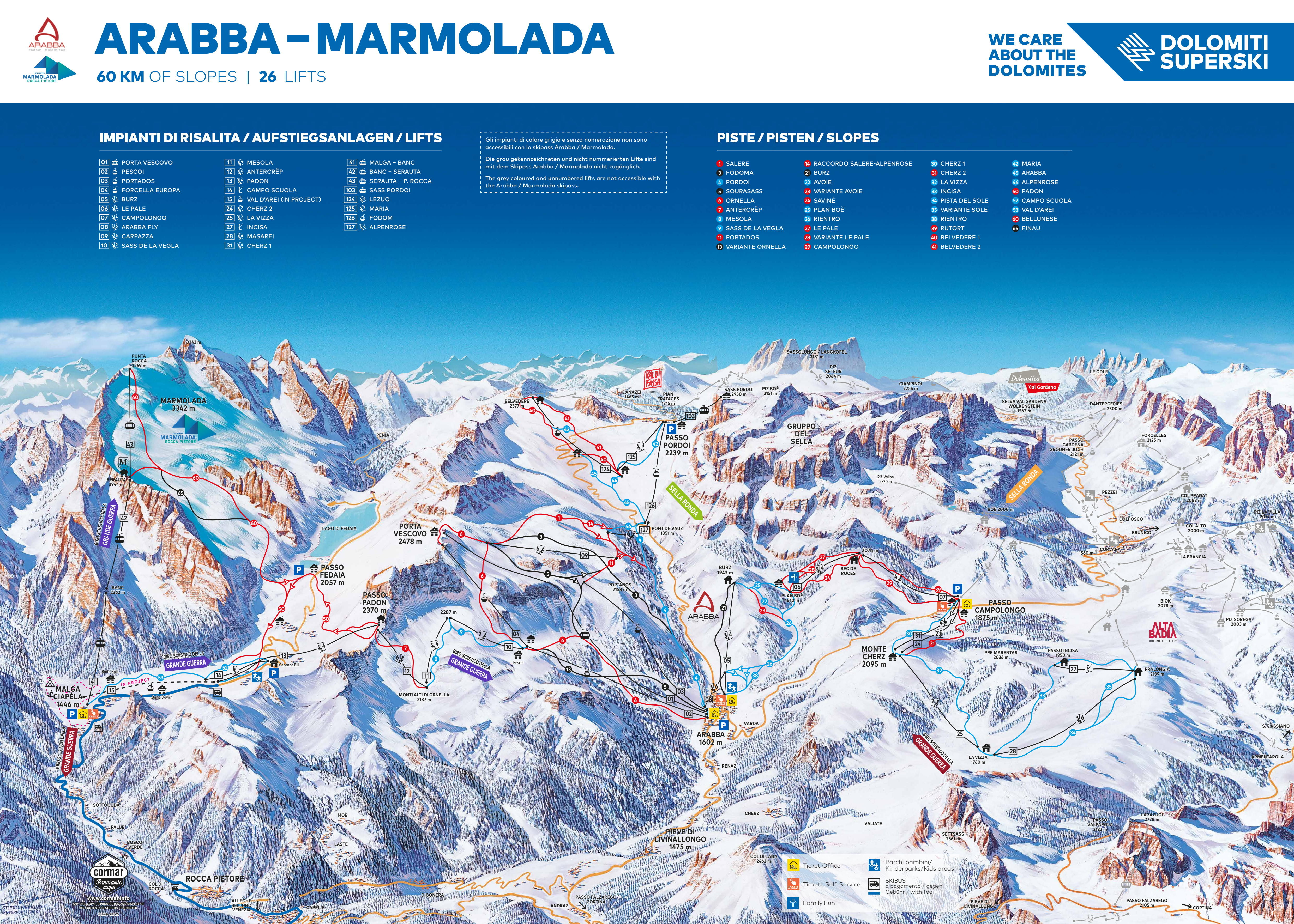
Arabba's compact size works in its favour for families. The village is easy to navigate on foot, the slopes are right on your doorstep, and the pace is relaxed enough that you won't feel rushed between ski school drop-offs and lunch. Two ski schools in the village offer children's programmes, and there's a ski kindergarten for younger children. It's worth noting that Arabba's own beginner terrain is limited: families with very young first-timers may find the gentle slopes around Passo Campolongo or a day trip to nearby Corvara a better fit for those early lessons.
Once children are confident on blue runs, the whole area opens up. The Sella Ronda circuit is an adventure that feels like a proper day out, with the anticlockwise route offering wide, cruising terrain that suits developing intermediates. Older teenagers will enjoy the long, steep descents off Portavescovo and the connection up to the Marmolada glacier at 3,342m, which adds a genuine high-mountain dimension. The Dolomiti Superski pass covers over 1,200km of pistes across the region, so families with mixed abilities can always find terrain that works for everyone.
Off the slopes, Arabba has ice skating, sledging, and snowshoe walks that suit mixed-age groups. The cable car up to the Marmolada viewpoint is accessible to non-skiers and worth the trip for the panoramic views alone. Village restaurants are family-friendly and accustomed to early diners, and the Ladin culture that still runs through Arabba gives the whole experience a distinctive character that children tend to pick up on.
Arabba sits at the intersection of four Dolomite valleys, surrounded by some of the most striking mountain scenery in the Alps. For rest days, non-skiers, or anyone wanting a change of pace, the setting alone makes time away from the slopes feel worthwhile. The combination of alpine activities, scenic viewpoints, and a quiet village atmosphere means there's plenty to fill a day without touching a pair of skis.
Arabba and its surroundings provide a solid range of snow-based activities beyond skiing and snowboarding. The Dolomite landscape lends itself well to exploration on foot or at altitude:
For days off the mountain, Arabba and the surrounding area have enough to keep things interesting. The pace is unhurried and the options lean towards relaxation, culture, and scenery:
Arabba's dining scene is modest in size but high in quality. The village leans towards traditional Ladin and Italian mountain cooking that's hearty, seasonal, and made with local ingredients. You'll find everything from slope-side lunches to candlelit dinners, and the smaller village means most places have a personal touch.
WeSki insider tip: Try casunziei, crescent-shaped ravioli filled with beetroot and dressed with melted butter and poppy seeds. It's a Ladin speciality you won't find easily outside the Dolomites.
Arabba's après-ski scene has a vibe that leans towards well-earned drinks on a sunny terrace, quiet bars, and early-ish evenings. It suits skiers who prefer their evenings unhurried and their mornings fresh. A handful of bars pick up as the lifts close, and the atmosphere is friendly and social. Hotel bars often have the best ambience, and live music pops up regularly during the season.
Après-ski spots to know:
Accommodation is mainly hotels and smaller family-run guesthouses, with a few apartment options. Hotels range from comfortable three-star family hotels to well-appointed four-star properties with spa facilities. Arabba is a compact village, so almost everything is within walking distance of the main lifts.
The village centre clusters around the main road, with the Portavescovo gondola and chair lifts easily reachable from most properties. Staying near the centre puts you close to restaurants and shops, while properties towards the edges of the village tend to be quieter. Malga Ciapela, at the base of the Marmolada lift about 5km away, is an alternative for those focused on glacier skiing.
The Dolomiti Superski pass covers Arabba and gives access to the full network of 12 valleys and over 1,200km of pistes, including the Sella Ronda circuit. A local Arabba-Marmolada pass is also available if you plan to stay within the immediate area.
Check for family and multi-day pass options when booking your Arabba ski holiday package through WeSki to find the best fit for your trip.
Arabba has several equipment rental shops in the village centre, making it easy to pick up and return gear. You'll find everything from standard ski and snowboard packages to high-performance demos and children's equipment. Pre-booking is recommended during peak weeks to guarantee your preferred gear.
WeSki partners with SkiSet shops in Arabba, letting you add equipment to your package and collect on arrival. Browse Arabba ski deals to build your perfect trip.
Arabba's small size means the village itself is easily walkable, and you can get from one end to the other in about ten minutes. Most visitors staying in the village won't need more than their own two feet. The main lifts are accessible from the centre, and ski buses connect the village to Malga Ciapela (for the Marmolada gondola) and to Passo Campolongo throughout the day. A regular ski bus service also links to the wider Sella Ronda access points.
In the evenings, transport is more limited. Taxis are available but best booked in advance. If you're staying in Malga Ciapela or slightly further out, check the last bus times with your accommodation.
The nearest airports to Arabba are Innsbruck (approximately 140km), Venice Marco Polo (around 190km), and Verona (roughly 230km). Venice and Verona have the most frequent flight connections. The drive from any of these airports passes through dramatic mountain scenery, particularly the final approach through the Dolomite passes.
WeSki offers car rentals from the airport as well as private and shared transfers to Arabba. Add them to your Arabba ski holiday package for seamless door-to-door travel.
Arabba can work for beginners, but it's not the strongest choice if you're a complete first-timer. It's an excellent resort to grow into rather than start from scratch. The terrain is weighted towards intermediate and advanced skiers, so you'll find fewer dedicated green runs than at some neighbouring resorts. That said, the nursery slopes near the village and the gentle runs around Passo Campolongo provide a quiet, uncrowded space to learn. Once you're comfortable linking turns, the blue runs on the Bec de Roces side offer good progression.
Arabba sits at the more serious, skiing-focused end of the Dolomiti Superski spectrum. Compared to larger villages like Selva Val Gardena or Corvara, Arabba is quieter, less commercialised, and more focused on the mountain than the nightlife. The direct access to Marmolada glacier sets it apart (no other Sella Ronda village gets you to 3,342m). It suits skiers who prioritise terrain variety and on-mountain time over a lively resort scene.
Yes. Arabba is actually one of the best starting points for the Sella Ronda. The full circuit is around 40km and typically takes four to six hours depending on your pace and how often you stop. Starting from Arabba gives you efficient access to the loop in either direction. An early start helps you avoid bottlenecks at the main lift stations mid-morning. Most confident intermediate skiers complete it comfortably with time for a leisurely mountain lunch.
Arabba's season runs from early December to mid-April. The altitude, with skiing up to 3,342m on the Marmolada, means snow conditions are generally reliable throughout. The glacier holds snow even when lower resorts are struggling, which gives Arabba an edge for late-season skiing. School holiday weeks (Christmas, half-term, Easter) are busiest, but the resort rarely feels overcrowded compared to larger Dolomite villages.
Not once you're there. The village is compact and walkable, and ski buses connect you to Malga Ciapela and the main lift access points throughout the day. A car can be useful for exploring the wider Dolomites on rest days, but for day-to-day skiing and village life, you can manage without one.
Arabba is a solid choice for families, particularly those with children who are already skiing. The village is safe, compact, and easy to navigate, and the relaxed pace means you won't feel the pressure of a bigger resort. Ski school options are available for all ages, and the quieter slopes are ideal for building children's confidence. Families with very young non-skiing children may find fewer dedicated crèche facilities than at purpose-built resorts, so it's worth checking availability in advance.
 4.9/5
4.9/5I usually book flights, transfers, hotel, ski rental and lift passes myself but this year used WeSki for a trip to Morzine. It was so much easier. Everything worked perfectly - transfers arrived on time and there was plenty of feedback throughout the whole process giving you confidence the holiday would go smoothly.

A really useful service that is so much easier to use than other 'all-inclusive' sites. It nicely bridges the gap between a travel agent and booking the trip yourself online. I will use WeSki every time I go skiing from now on.
We booked a late minute skiing trip to Morzine through we ski. We looked at booking the trip ourselves but could get anywhere near the price quoted by we ski. The company was excellent and we had no problems at all from start to finish. I would definitely use them to book another weekend skiing trip.
Seamless experience from start to finish. I was spending ages trying to sort out a weekend break and managed to do it with we ski in minutes and for the same price as booking it all up yourself. Flight, transfer and accommodation was all as expected and faultless.

WeSki is a trading name operated by Wetrip Weski Ltd (BR021500). All the flights and flight-inclusive holidays on this website are financially protected by the ATOL scheme. When you pay you will be supplied with an ATOL Certificate. Please ask for it and check to ensure that everything you booked (flights, hotels and other services) is listed on it. Please see our booking conditions for further information or for more information about financial protection and the ATOL Certificate go to: www.caa.co.uk.
Package holidays that do not include travel by air are financially protected via ABTOT.
For the latest travel advice from the Foreign & Commonwealth Office visit www.gov.uk/foreign-travel-advice.