
FR
FR
Domaine skiable de Ski Arlberg
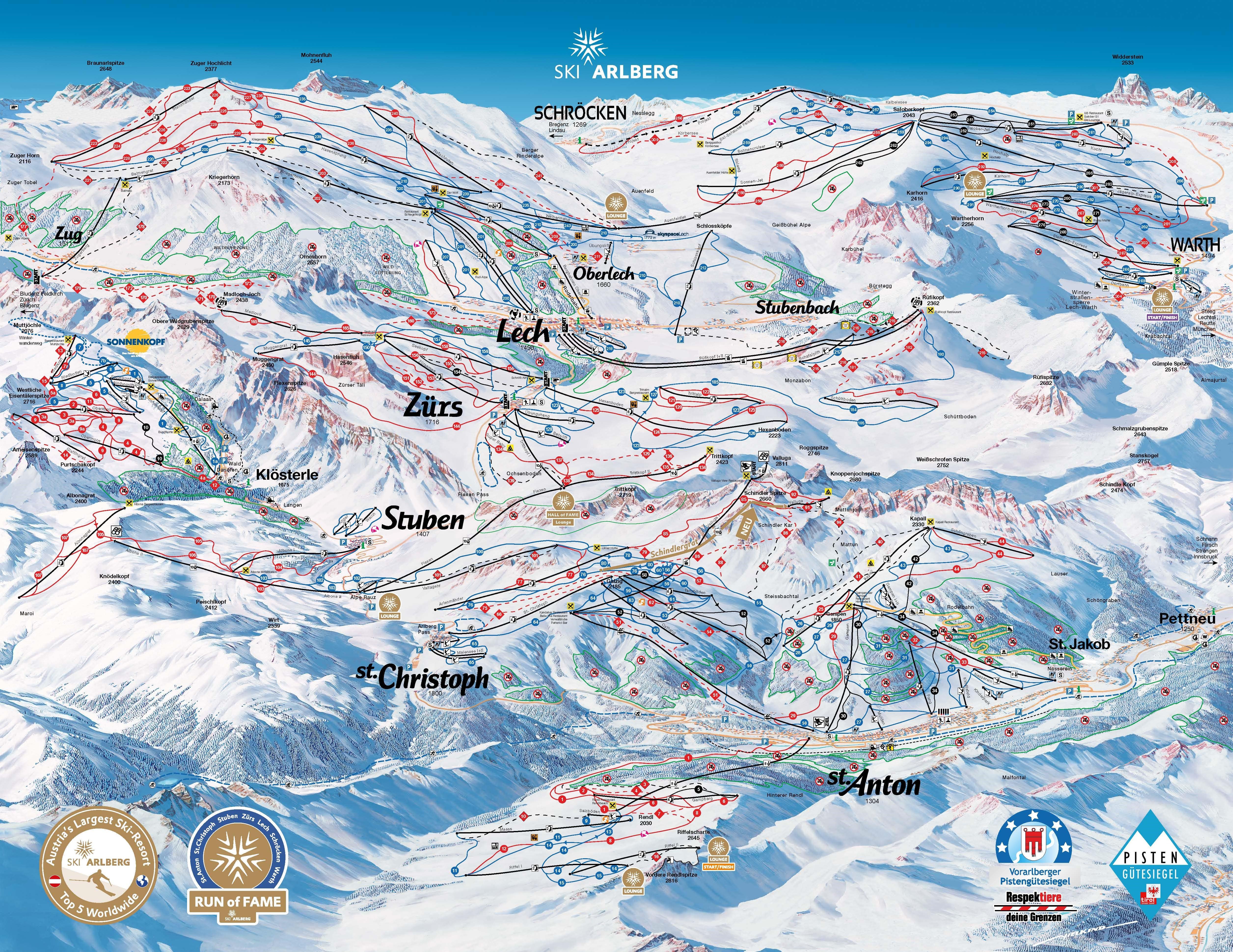
Ski Arlberg is the largest connected ski area in Austria, with more than 300km of pistes and around 200km of deep-snow runs spread across the Arlberg mountains. Known as the cradle of alpine skiing, it’s where Hannes Schneider founded one of the first ski schools in 1921. Born in Stuben, he taught guests in groups by ability, and his method became the blueprint for ski schools around the world. Heavy snowfall is part of the area’s reputation too, as its mountains catch the storms that roll in from the Atlantic. You can base yourself in any of its four linked resorts, starting with St. Anton, the largest, which is famous for its steep slopes, freeriding, and lively slopeside après-ski. Over the pass in Vorarlberg, Lech Zürs pairs two elegant villages known for luxury hotels and fine dining. Stuben is a tiny village in the middle of the area, with steep, north-facing slopes rising straight above it. At the northern end, Warth-Schröcken, a pair of small villages, gets the most snow of all, around 11m in an average winter.
The skiing spreads across big, open mountainsides, reaching 2,811m at the top of Valluga, the highest peak in Ski Arlberg. If you’re new to skiing, Lech Zürs has learning areas and practice lifts in each of its villages, suited to adult beginners as well as children. Intermediates can cruise wide, rolling blue and red runs around Lech, Zürs, and Warth. Make time for the White Ring, a 22km circuit around the mountains between Lech and Zürs, with lifts linking each run so you can ski the whole loop without taking your skis off. Around St. Anton and Stuben, advanced skiers have steep black runs, plenty of north-facing slopes, and freeride terrain that draws skiers from all over the world. You can also explore ski routes, marked runs that are protected from avalanches but left ungroomed, so they hold deep snow and bumps.
Dining is a highlight across the Arlberg, starting with mountain huts that serve hearty Austrian cooking, from cheese dumplings to apple strudel and homemade cakes. Lech Zürs has been named a World Gourmet Village, and its restaurants hold awards from both the Michelin and Gault&Millau guides. St. Anton’s après-ski happens right on the slopes, at bars along the final run into the village, where DJs play and people dance in their ski boots. In Lech, you’ll find après on hotel terraces, at ice bars, and in fireside lounges, all with a stylish feel. When you want a break from skiing, you can speed down a floodlit toboggan run of more than 4km in St. Anton, explore the history of skiing at the village museum, or unwind in the indoor and outdoor pools at its leisure centre. A winter walking trail above Lech leads to the Skyspace, an underground chamber by the American light artist James Turrell, where an opening in the dome frames the sky overhead.
| Country | Austria |
| Region | Tyrol / Vorarlberg |
| Total piste km | 305 km |
| Altitude | 1,270 m (St. Anton) - 2,811 m (Valluga) |
| Linked resorts | 4 St. Anton Lech Zürs Stuben Warth-Schröcken |
| Lifts | 88 |
| Runs | 131 (46 blue, 56 red, 29 black) |
| Season | Late November - late April |
| Ski pass name | Ski Arlberg pass |
| Nearest airports | Innsbruck (~1 hr 15 min) Zurich (~2 hr) Friedrichshafen (~1 hr 30 min) Munich (~2 hr 45 min) |
| Glacier skiing | No |
| WeSki services | Transfers: all 4 resorts (private, shared, and scheduled to St. Anton and Lech Zürs; shared to Stuben; private to Warth-Schröcken) Ski equipment hire: St. Anton, Warth No WeSki lessons currently available |
Gondolas from the centre of St. Anton and from the quieter Nasserein end of the village take you straight up into the main ski area. Across the valley, Rendl is a separate area with its own gondola. Beginners have a nursery area at Nasserein and gentle runs at mid-mountain, and the ski school Hannes Schneider founded in 1921 still teaches here. Intermediates will find long, rolling reds to explore on the slopes above the village. Advanced skiers have steep terrain to tackle, including the Karl Schranz run, where World Cup races are held, and ski routes beneath the Valluga, where a guide can take you up the summit cable car to ski the north face.
St. Anton is a busy, international village at 1,304m, with a railway station just a short walk from the gondolas. Its pedestrian centre is lined with ski shops, bakeries, and restaurants. Accommodation runs from family-run guesthouses and chalets to luxury and boutique hotels, much of it within walking distance of the lifts. For a quieter stay, base yourself at the Nasserein end or in St. Jakob, a short ski bus ride down the valley.
Off the slopes, winter walks and sleigh rides lead into the Verwall valley just outside the village, and a weekly ski show at the race finish stadium tells the history of skiing with more than a hundred performers on skis. You can eat well across the village, from hearty Tyrolean cooking in traditional inns to fine dining in the top hotels. Après-ski starts at huts on the final run home, where bands play rock and blues, and carries on in the village’s bars and clubs until late.
Two villages make up Lech Zürs, a few kilometres apart and linked by lifts and pistes, with Zürs sitting higher up near the top of a mountain pass. In Lech, cable cars and chairlifts leave from the centre of the village, while in Zürs the slopes run right down to the hotel doors. Beginners can learn on gentle slopes at Oberlech, a hamlet on the mountainside above Lech, or at the practice lifts in each village. Intermediates have long blues and reds to cruise between Lech and Zürs, including the White Ring circuit. Advanced skiers can explore steep ski routes, and Lech Zürs is the only place in Austria where you can go heliskiing, flying with a guide to one of two peaks for a descent through deep snow.
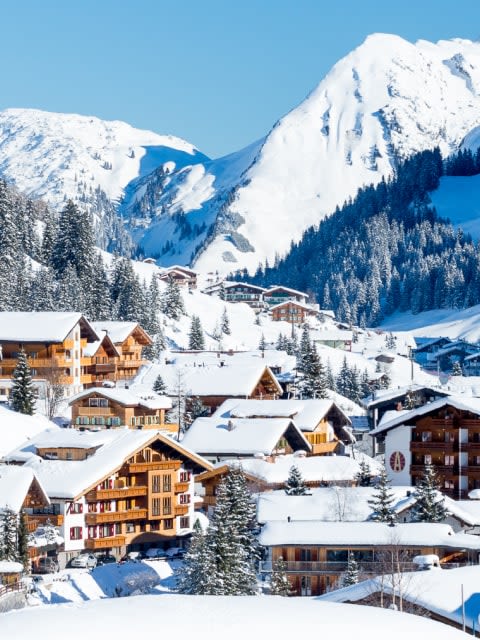
Lech sits along the river Lech at 1,444m, a stylish village with cafés and boutiques around its centre. You can stay anywhere from a family-run guesthouse to a five-star hotel. Above the village, Oberlech is car-free in winter and reached by cable car, and its hotels are linked by underground tunnels, with luggage carried up for you. Zürs, at 1,716m, is a small village made up almost entirely of upmarket hotels, and ski buses run between Zürs and Lech.
Away from the pistes, you can explore the traditional side of Lech Zürs on foot, on a toboggan, or in a horse-drawn sleigh. Sleighs leave from the covered wooden bridge in Lech for rides up the valley to the hamlet of Zug, winter trails follow the river, and a toboggan run heads down from Oberlech. Within a small area, you’ll find everything from rustic mountain huts to gourmet restaurants, so you’re never far from a good meal. Après-ski starts on hotel terraces and carries on in a handful of late bars and clubs.
Stuben sits at the foot of the Albona, a mountain rising to around 2,400m that’s known for its snowy north-facing slopes, and a chairlift from the village takes you straight up onto it. First-timers can start on the quiet nursery slopes in the village, and can take guided instruction at Stuben’s ski school, which has been teaching here for around a century. There’s also a great blue run for beginners, which comes back down from the top of the first chairlift. Intermediates can cruise long reds on both sides of the mountain, choosing between longer north-facing runs and sunnier slopes on the south side. Advanced skiers come for the freeride terrain, with steep, snowy slopes to explore off the groomed runs, and the lifts above Stuben link into the rest of Ski Arlberg whenever you want to explore further.
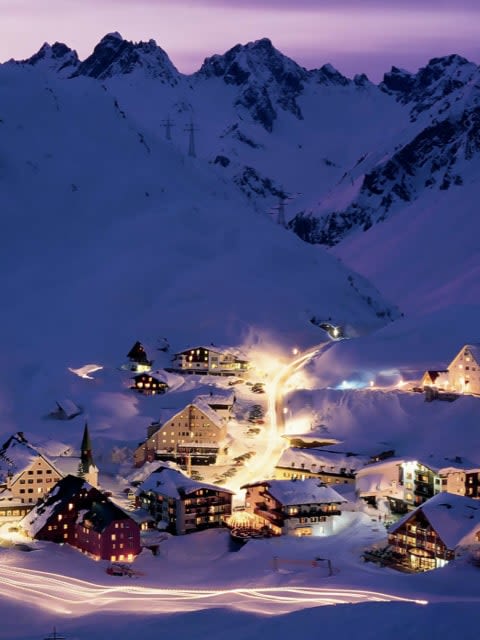
Thought to be named after the warm room, or Stube, where travellers sheltered before crossing the Arlberg pass, Stuben is still a small village of welcoming inns at around 1,400m. Most places to stay are family-run hotels, guesthouses, and apartments, all within a short walk of the lift. When you’re not skiing, you can follow a short winter walking trail from the village or join the ski school for snowshoe hikes and cross-country skiing. Hotel restaurants serve hearty Austrian and international cooking, and a few bars host lively après-ski parties.
Warth-Schröcken’s ski area is compact and easy to get around, rising to around 2,050m above the mountain pass between its two villages. In Warth, a gondola leaves from the centre of the village, while from Schröcken a short bus ride takes you up to the lifts at the pass. First-timers have practice areas to learn on, and easy runs link Warth with the pass, so beginners can explore almost the whole local area. Intermediates can cruise wide, well-groomed runs, with village runs leading straight back down to Warth and Schröcken. Advanced skiers can take on three steep black runs and explore freeride terrain on the area’s highest peak.
Warth and Schröcken sit on either side of the Hochtannberg pass, around 10km apart by road, in a corner that’s famous for its mountain cheese. Warth, the larger of the two at around 1,500m, has hotels, guesthouses, and apartments close to the lifts, many with direct access to the slopes. Schröcken, at around 1,270m, is a small village spread across the hillside, linked to the pass by ski bus.
Snowy trails lead out from both villages for winter walks, snowshoeing, and sledging, and cross-country tracks loop across the pass. The best-known walk leads to the Körbersee, a mountain lake reachable only on foot or skis in winter, which was voted Austria’s most beautiful place in 2017. Cosy restaurants serve hearty local cooking, from raclette to fluffy shredded pancakes. Après-ski is relaxed, with umbrella bars on the slopes, a lounge bar at the pass, and live music evenings at a hotel in Warth.
Ski Arlberg has around 130km of wide, gentle blue runs, and every resort has practice lifts close to the village, so you can start learning wherever you stay. In St. Anton, beginners head to the nursery area at Nasserein, at the quieter end of the village, and the gentle slopes at Gampen, the mid-mountain area above it. Lech Zürs has learning areas in each of its villages, including Oberlech, a hamlet above Lech with easy blue runs right outside the hotels. Stuben has quiet nursery slopes in the village, and Warth-Schröcken has a practice circuit up at the mountain pass between its two villages.
Once you’re linking turns, gentle runs lead from Lech all the way over to Zürs, with the ski bus to bring you back, and in Warth-Schröcken you can reach almost the whole local area on blues. Every resort has ski schools offering group and private lessons for adults as well as children. Children have their own kids’ areas across the resorts, and in Lech Zürs these come with moving carpets, colourful figures, and kids’ clubs for younger skiers.
Intermediates have around 120km of red runs to explore alongside the blues, and many of them are long and varied. High above the treeline, wide, open slopes give you room to carve, while lower down, runs wind through the forest, and several carry on all the way back to the villages. Pistes are groomed daily, so you’ll find plenty of smooth cruising across the area.
St. Anton’s reds are steep and sustained, a satisfying challenge for confident intermediates, with long runs all the way back down to the village. In Lech Zürs, the White Ring loops around the mountains between the two villages, and its longest stretch is a 4km descent with almost 1,000m of vertical. Stuben’s long reds face north, so they tend to keep their snow well, while Warth-Schröcken has wide, gentle runs made for relaxed cruising.
Advanced skiers have around 50km of black runs to tackle, along with ski routes, marked runs that are protected from avalanches but not regularly groomed. Above St. Anton, the Schindlerkar is a classic ski route that drops from a high ridge into a wide bowl, with more than 1,000m of descent towards the village. In Lech Zürs, the Langer Zug is a 4.7km ski route whose top section is one of the steepest groomed slopes in the world, and Warth-Schröcken has three steep black runs of its own.
The off-piste is what made the Arlberg famous, with steep couloirs, open bowls, and powder runs fed by heavy snowfall, drawing freeriders from around the world. Some of the most exciting lines drop from the high ridges above St. Anton, where narrow chutes sit right beside the lifts, while Stuben’s north-facing slopes hold their snow well. Local ski schools and mountain guides lead off-piste days across the area, and a guide is essential for terrain beyond the marked runs.
Snowboarding has a loyal following on the Arlberg. Stuben is home to the Longboard Classic, a race that has drawn riders from around the world since 1999 and is often called the Woodstock of snowboarding. The natural terrain is what makes riding here special, with wide, open slopes high above the treeline, open bowls known for their powder, and ski routes left ungroomed for deep snow and natural features. If you’re trying snowboarding for the first time, ski schools across the area teach beginners, and the gentle nursery slopes in each resort make a good place to start.
For riders who want to mix in some freestyle, two snowparks offer plenty to play on. Above St. Anton, the park has separate lines for beginners, intermediate riders, and pros, while Lech’s snowpark, beside a chairlift just above the village, has around 20 features, from rails and boxes to kickers. Funslopes in St. Anton and Warth mix rollers, banked turns, tunnels, and small jumps into a regular piste, making them an easy introduction to freestyle for riders of every level.
The Ski Arlberg pass is the main ticket for the whole area, covering every lift in St. Anton, Lech Zürs, Stuben, and Warth-Schröcken, with more than 300km of pistes and around 200km of deep-snow runs. It also includes the local ski buses in and around the resorts, which makes it easy to get between your accommodation and the lifts. Passes are sold for a set number of consecutive days, so you can match yours to the length of your trip.
Innsbruck is the closest airport to most of the area, around 100–120km from St. Anton, Lech Zürs, and Stuben, while Friedrichshafen, on Lake Constance, is around 100–140km away and the nearest to Warth-Schröcken. Zurich is around 170–200km away, and Munich around 200–300km, depending on your resort. From any of them, you can hire a car or book a shared or private transfer straight to your accommodation. St. Anton also has its own railway station in the village, with direct trains from Zurich and Innsbruck.
Once you’ve arrived, the lifts connect all four resorts during the day, so there’s no need for a car to move around the slopes. Most of the villages are compact enough to explore on foot, and local taxis can take you between them in the evening. The road between Lech and Warth closes in winter, which makes the gondola the only direct link between the two.
For the most dependable snow, mid-January to mid-March is the best time to visit Ski Arlberg. The lifts usually open in early December and run until mid- to late April, with Warth-Schröcken closing about a week earlier. Snowfall tends to peak in January, and the snowpack keeps building into March. Later in spring, the high slopes around Lech Zürs hold their snow well, while lower runs back down to St. Anton soften as the days warm up.
Christmas and New Year are the busiest weeks, followed by the February school holidays, while January after the first week and the middle of March tend to be quieter. If you’d like to plan around an event, the Stanton Ski Open in St. Anton kicks off the season in early December with a weekend of concerts, food trucks, and equipment tests. In mid-January, around 1,000 skiers take on the White Ring race in Lech Zürs, a 22km circuit that’s open to amateurs, with a limited number of places.
Yes, Ski Arlberg is a great choice for families. Every resort has ski schools teaching children, and Lech Zürs has kids’ areas with moving carpets, plus kids’ clubs, in Lech, Oberlech, and Zürs. Car-free Oberlech, above Lech, has hotels right on the slopes, while Warth-Schröcken has a children’s ski area and easy runs linking most of its slopes.
Choose St. Anton for steep skiing, famous freeride terrain, and a lively après-ski scene, or Lech Zürs for wide, groomed runs, elegant hotels, and award-winning restaurants. Lech Zürs also has learning areas in each of its villages, which suits beginners. Both are covered by the Ski Arlberg pass and linked by lifts, so you can ski the other side during your stay.
You’ll want to be confident on red runs. The lift link crosses high, open terrain, and several runs along the way are reds, including the descents into Zürs. Beginners can still enjoy both sides by staying on the easy slopes around their own resort and travelling between the villages by road.
Yes, if you’re a strong, fit skier. The Run of Fame is an 85km circuit with 18,000m of descent that links every resort, from St. Anton through Stuben, Zürs, Lech, and Schröcken to Warth and back. It takes a full day of steady skiing, so some skiers split it over two days instead.
You’ll need to travel back by road, usually by taxi. Between St. Anton, Stuben, and Lech Zürs, it’s a short drive over the pass, but the road between Lech and Warth closes in winter, so returning to Warth-Schröcken takes much longer. Check closing times for the connecting lifts before heading to the far side of the area.
Yes. Every resort has cleared winter walking trails, and you can go tobogganing, snowshoeing, or on a horse-drawn sleigh ride, or relax in a spa or pool. A special lift ticket for guests without skis lets non-skiers ride up the mountain to meet friends for lunch. The award-winning restaurants of Lech Zürs are a draw in their own right.
Start building your dream ski trip today with our one-stop ski shop - hundreds of resorts, unlimited combinations.
 4.9/5
Je réserve habituellement moi-même les vols, les transferts, l'hôtel, la location du matériel de ski et les forfaits ski, mais cette année j'ai utilisé WeSki pour un séjour à Morzine. C'était tellement plus simple. Tout a parfaitement fonctionné - les transferts sont arrivés à l'heure et il y avait beaucoup de retours d'information tout au long du processus, ce qui vous donne confiance que les vacances se dérouleront sans problème.

Un service vraiment utile qui est beaucoup plus facile à utiliser que d'autres sites "tout compris". Il comble parfaitement le fossé entre une agence de voyage et la réservation du séjour par vous-même en ligne. J'utiliserai WeSki chaque fois que j'irai au ski à partir de maintenant.
Nous avons réservé un séjour au ski de dernière minute à Morzine via WeSki. Nous avions envisagé de réserver le séjour nous-mêmes, mais nous n'avons pas pu trouver un prix aussi avantageux que celui proposé par WeSki. L'entreprise a été super et nous n'avons rencontré aucun problème du début à la fin. Je passerai certainement de nouveau par eux pour réserver un autre week-end au ski.
Une expérience fluide du début à la fin. Je passais des heures à essayer d'organiser un week-end et j'ai réussi à le faire avec WeSki en quelques minutes et pour le même prix que si je l'avais réservé moi-même. Le vol, le transfert et l'hébergement étaient tous comme prévu et nous n'avons rencontré aucun problème.

WeSki est un nom commercial exploité par Wetrip Weski Ltd (BR021500). Tous les vols et séjours incluant des vols sur ce site web sont financièrement protégés par le programme ATOL. Lorsque vous effectuez un paiement, un certificat ATOL vous sera fourni. Veuillez le demander et vérifier que tout ce que vous avez réservé (vols, hôtels et autres services) y figure. Veuillez consulter nos conditions de réservation pour plus d'informations ou, pour en savoir plus sur la protection financière et le certificat ATOL, rendez-vous sur : www.caa.co.uk.
Les formules tout compris qui n'incluent pas le transport aérien sont financièrement protégées par ABTOT.
For the latest travel advice from the Foreign & Commonwealth Office visit www.gov.uk/foreign-travel-advice.
Weski Europe BV (numéro d'enregistrement 87334100 à la chambre de commerce) est un membre enregistré de SGR. Vous pouvez vérifier cela sur www.sgr.nl/english. Les vacances répertoriées sur ce site web sont couvertes par la garantie de SGR, selon les termes du programme de garantie SGR. Sous la garantie SGR, les consommateurs verront la somme de leur voyage prépayée remboursée si leur contrepartie est incapable de remplir ses obligations contractuelles en raison d'une incapacité financière. Dans la mesure où l'accord comprend le transport et que la destination a déjà été atteinte, le voyage de retour sera organisé.