
FR
FR
Domaine skiable de Silvretta Arena
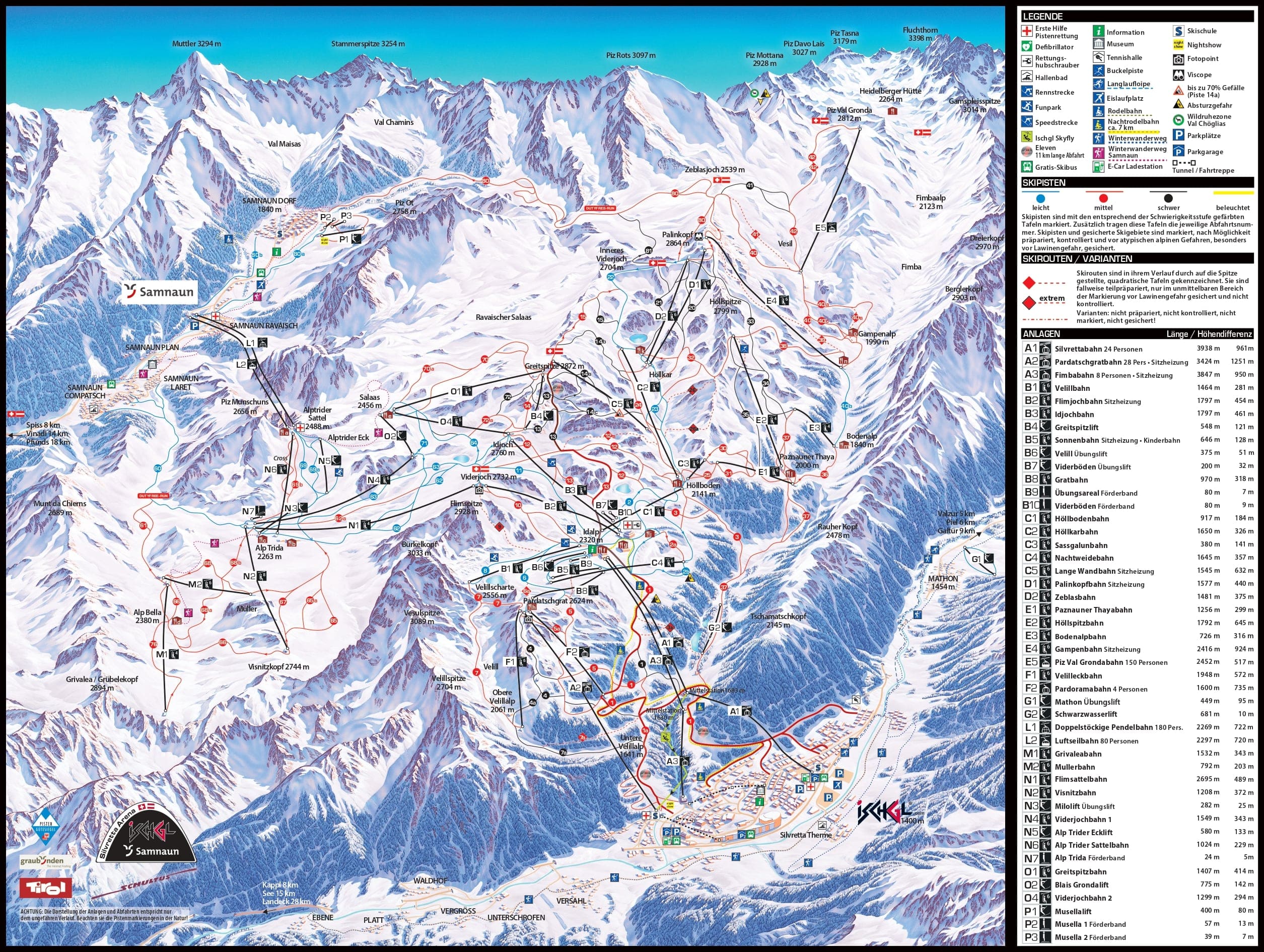
Silvretta Arena is one of the largest cross-border ski areas in the Alps, with 239km of pistes stretching over the mountains between the resort of Ischgl in Austria and the Swiss village of Samnaun. Ischgl lies in the Paznaun, a long valley that’s home to three more resorts, Galtür, Kappl, and See. Each has its own separate ski area, linked to Ischgl by ski bus, and a single lift pass covers all four, with more than 360km of pistes between them. Ischgl is the best-known of the four, with gondolas from its village straight up into the ski area and a famous après-ski scene. At the head of the valley, Galtür has the highest ski area, recognised several times for being particularly family-friendly. Kappl’s slopes face south, and the steep peaks above its pistes host international freeride competitions. See, the first village you reach on the way up the valley, shares a local lift pass with Kappl. A gondola from the village centre takes you up to wide, open slopes and a big bowl with easy and more challenging deep snow right beside the pistes.
Above the treeline, wide, open pistes cover most of the Silvretta Arena ski area, topping out at 2,872m on the Greitspitze, a peak on the Swiss border. The only runs through the forest are the ones that lead back down to Ischgl. Beginners can learn in any of the four resorts. Galtür, Kappl, and See each have practice areas and ski schools, and in Ischgl, beginners start on gentle slopes up on the mountain, at the top of the village gondolas. Red runs make up most of the area’s pistes, so intermediates have long, varied cruising on both sides of the border. From Ischgl, the Smugglers’ Circuit links them into a loop over to Samnaun and back, and its longest version covers more than 37km of pistes. The route is named after the smugglers who once carried goods over these mountains from Samnaun. The village has been duty-free since 1892, so its shops make an easy stop along the way. Advanced skiers have steep blacks from the highest peaks, plus powder slopes they can reach straight from the lifts with no climbing needed.
Ischgl opens and closes every season with its Top of the Mountain concerts, when international stars play an open-air stage high in the ski area. Après-ski is lively here too, with one of the best-known scenes in the Alps. It starts at bars on the slopes above the village, then moves down to bars and clubs that stay open late. Ischgl has also built a reputation for fine dining, with restaurants recognised by both the Michelin Guide and Gault&Millau. Mountain huts are a Tyrolean tradition, and each of the four ski areas has its own, serving hearty local cooking like schnitzel and cheese noodles topped with crispy onions. The area also has plenty of winter activities to enjoy besides skiing. Highlights include Ischgl’s floodlit toboggan run, one of the longest in the Austrian Alps, with a 7km evening ride from high on the mountain down into the village. Further up the valley, Galtür is known for cross-country skiing, and one of its trails climbs to a reservoir deep in the Silvretta mountains.
| Country | Austria (and Switzerland - Samnaun) |
| Region | Tyrol (Paznaun Valley) |
| Total piste km | 239 km (Ischgl-Samnaun); additional terrain at Galtür, Kappl, and See |
| Altitude | 1,050 m (See) - 2,872 m (Palinkopf) |
| Linked resorts | 4 Ischgl Galtür Kappl See |
| Lifts | 45 (Ischgl-Samnaun); additional lifts across the other areas |
| Runs | 143 (Ischgl-Samnaun: 28 blue, 72 red, 43 black) |
| Season | Late November - early May (Ischgl) |
| Ski pass name | Silvretta Arena ski pass (covers Ischgl-Samnaun, Galtür, Kappl, and See) |
| Nearest airports | Innsbruck (~1 hr 30 min) Friedrichshafen (~2 hr) Zurich (~2 hr 30 min) Munich (~3 hr) |
| Glacier skiing | No |
| WeSki services | Transfers: all 4 resorts (private and shared to Ischgl, Galtür, Kappl, and See) Ski equipment hire: Ischgl No WeSki lessons currently available |
Ischgl is the gateway to Silvretta Arena. Its gondolas leave from the village centre and take skiers up to the Idalp, which is a broad plateau at the heart of the ski area. Beginners can learn up here on gentle slopes with their own practice lifts and magic carpets, and ski schools are based right beside them. From the Idalp, long red runs spread out across the mountains, giving intermediates plenty of variety on both sides of the border. Advanced skiers can head up to the high ridges for steep, north-facing blacks, where the snow stays in good shape. For off-piste, a cable car to the Piz Val Gronda peak gives access to around 100 hectares of freeride terrain. Its wide, open slopes run down into a neighbouring valley, with easy lines for newer freeriders as well as steep ones for experts.
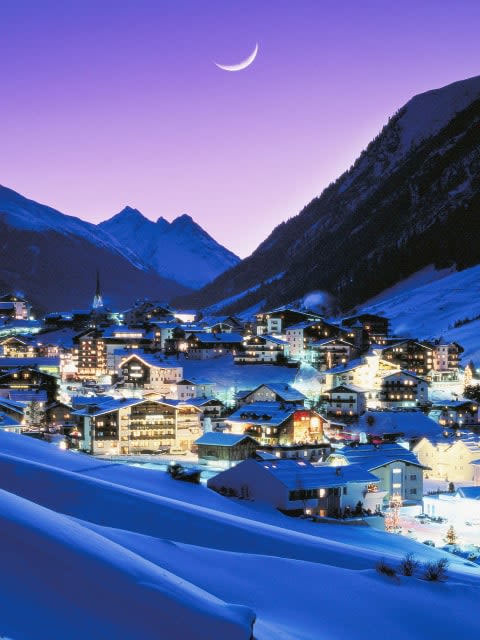
The centre of Ischgl is connected to its lifts by underground tunnels with moving walkways, making it easy to walk to the slopes in ski boots. Above ground, the village itself is compact and busy, with designer boutiques, sports shops, and bars lining its largely pedestrianised streets. Much of the accommodation is in four- and five-star hotels, and there are guesthouses and apartments too, most within walking distance of the lifts. For a quieter base, some visitors choose Mathon, a small hamlet a few kilometres up the valley. Its chalets and apartments are linked to Ischgl by ski bus.
A day off the slopes in Ischgl might mean a paragliding flight over the valley, a horse-drawn sleigh ride, or cross-country skiing on the trails around the village. But when you’re ready to relax, Ischgl’s biggest draw away from the snow is the Silvretta Therme. Its pools cover more than 1,000 square metres, including a heated rooftop pool with its own bar and wide mountain views. Eating out is a highlight too, and the village’s gourmet restaurants are known for creative menus built around regional ingredients. Alongside them, village inns and Mediterranean restaurants serve more traditional home-style cooking. Then, of course, there’s Ischgl’s high-energy après-ski, with live bands and DJs in the bars at the foot of the slopes, while nightclubs in the village centre stay open until the early hours.
Galtür’s ski area is known as the Silvapark, with two lifts leading up to it. One leaves from the edge of the village, and the other from Wirl, a small hamlet a couple of kilometres up the road. The mountain is divided into six themed sectors, signposted by ability and style of skiing, making it an easy place to find terrain that suits you. First-timers can learn on a large practice area in the valley at Wirl. When they’re ready, they can move higher up the mountain to easy blue runs like the family run (No. 3), a gentle 3.2km descent. Most of the pistes are red, giving intermediates plenty of runs to cruise on, from wide, open slopes up high to long runs that sweep back down towards the valley. Advanced skiers have steep blacks on the flanks of Ballunspitze, the peak above the ski area, including the Ballun run (No. 6), the toughest in the Silvapark. On the western side of the ski area, there’s more technical terrain and a sector set aside for freeriding, with ungroomed ski routes and deep-snow slopes.
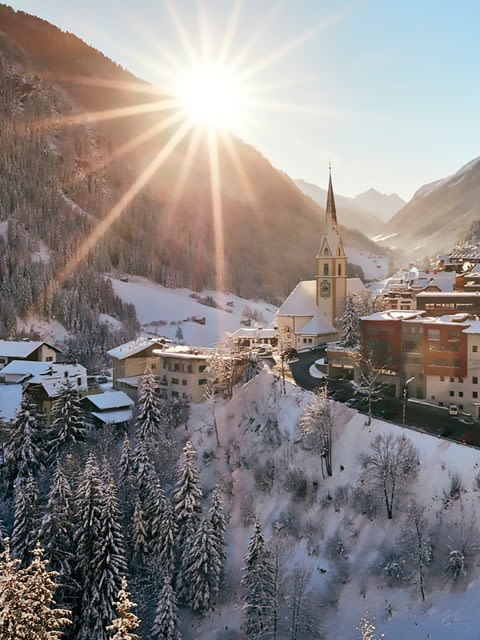
Galtür has deliberately avoided large-scale development, and it remains a traditional village with a small population at the head of the Paznaun valley. Its compact centre is easy to get around on foot, with bakeries, a few bars, and a sports centre close to the main square. Most of the accommodation is in apartments and guesthouses, alongside a handful of four-star hotels. Staying in the village keeps you close to all of this, and ski buses run regularly up to the lifts at Wirl, where a few hotels are right beside the slopes. Buses also run down the valley to Ischgl whenever you want to ski further afield.
Galtür is a natural base for exploring the mountains away from the pistes, with cross-country trails, snowshoe routes, and winter walks leading straight out of the village. It’s also a starting point for ski touring, where you climb on skis fitted with skins and then ski back down. Many tours set out from the Jamtalhütte, a mountain hut up a long side valley, which Ernest Hemingway used as a base for his own ski tours in the 1920s. Back in the village, the avalanche protection wall houses the Alpinarium, a museum with exhibitions on life in the mountains and an indoor climbing wall. When it comes to dining, most meals are enjoyed in hotel restaurants and mountain huts, where traditional Austrian cooking is the focus. After the lifts close, Galtür’s après-ski is low-key and sociable, with folk tunes and party favourites playing at a few huts and bars around the slopes.
Kappl’s ski area stretches across the sunny, south-facing side of the Paznaun valley, and most of its slopes lie above 1,800m, which helps keep the snow in good condition. First-timers can learn on a large practice area at the mid-mountain hub, where gentle slopes and covered magic carpets make it easy to get comfortable. As they progress, easy blue runs nearby are the natural next step. Higher up, intermediates have wide, well-groomed red pistes across open slopes, laid out clearly enough that it’s easy to find your way around. The reds get steeper towards the top of the ski area, while the runs around the mid-mountain suit more relaxed cruising. Confident intermediates can follow the Lattenabfahrt for 8km, from the highest point of the ski area all the way down to the valley. Advanced skiers have steep blacks and ski routes near the top, but the real draw for them is the freeride terrain, where powder slopes start straight from the top lifts and offer a wide choice of lines.
Kappl stretches along the valley and up the hillsides, with a main village and dozens of small hamlets scattered around it. Most of the shops and restaurants are in the centre, with hotels, guesthouses, and apartments spread across the village and hamlets. The main village has a traditional, unhurried feel, and it’s close to the slopes too, with a gondola into the ski area leaving from the valley below. Some visitors choose to stay in the higher hamlets for their wide views across the valley, and although they’re not within walking distance of the lifts, a ski bus takes you down. Buses also run to See, which shares a local lift pass with Kappl, and up the valley to Ischgl.
There’s plenty to enjoy in Kappl on a day off the slopes, from winter walks and snowshoe hikes through the snowy forests around the village to ski tours higher up in the mountains. You can also ride the gondola up and toboggan 6km back down to the valley. Traditional cooking is at the heart of dining here, with mountain huts across the ski area serving local favourites like cheese dumplings made with Paznaun alpine cheese and Kaiserschmarrn, a fluffy shredded pancake. In the evenings, restaurants and inns in the village serve the same kind of home-style cooking. Après-ski starts on the big panoramic terrace at the mid-mountain hub, where you can grab a drink at the ice bar and take in wide views across the valley. Later, it carries on at cosy bars down at the foot of the gondola.
The ski area at See rises straight from the village, with wide, clearly laid-out slopes and around 1,200m of vertical from top to bottom. First-timers can learn on a practice area at the mid-station, served by a conveyor belt and small drag lifts. From there, beginner runs like the Panorama run give them wide, gentle terrain to progress on. Most of the pistes on See’s mountain are red intermediate runs, spread across open, north-facing slopes up high, with longer red runs lower down that lead all the way back to the village. Advanced skiers will find See’s biggest challenges off the groomed pistes, on ungroomed ski routes and wide slopes of deep snow, alongside a few steep blacks. The steepest route, the Adrenalin, drops into a big bowl around the Ascherhütte, which is a cosy, traditional mountain hut that’s been here since 1895.
See is the first village at the entrance to the Paznaun, and it keeps things simple and peaceful, with a handful of restaurants, cafés, and shops around its centre. When you choose where to stay, you’ll find a range of hotels, guesthouses, and apartments, with some right beside the slopes and more tucked into the small hamlets on the hillsides. A gondola to the slopes leaves from the heart of the village, so the lifts are an easy walk from the centre. Regular ski buses also connect See with Kappl, its partner on the local lift pass, and with Ischgl further up the valley.
When you’re not on the slopes, See has plenty to fill your days, from winter walks and snowshoe tours to an ice rink in the village centre. For something more adventurous, you can try ice climbing on frozen waterfalls around the village, with experienced guides running courses for beginners. Up on the mountain, rustic huts and a big panoramic restaurant at the top of the gondola serve classic Austrian dishes. Down in the village, restaurants and cafés mix local specialities with international cooking, most of them a short walk from the gondola. See’s après-ski is fun and cosy, and most of it happens on the mountain. It starts at an incredible skybar on a platform above a 300m drop, where you can enjoy drinks alongside views over the Paznaun. From there, a handful of huts, terraces, and bars keep the fun going on the way down to the valley.
Every resort in the Paznaun has its own practice area, with gentle slopes, magic carpets, and short beginner lifts, so you can learn to ski wherever you stay. Every resort also has ski schools offering group and private lessons for all ages. Galtür, Kappl, and See all make learning easy, with clearly laid-out ski areas and practice slopes close to their first lifts. In Galtür, first-timers begin on a large practice area in the valley at Wirl, right at the foot of the slopes. Kappl and See keep their learning areas up at the mid-mountain, and Kappl’s is particularly big, with most of its magic carpets under cover. In Ischgl, beginners head up to the Idalp, the high plateau at the heart of Silvretta Arena, where four practice lifts serve gentle slopes beside the ski schools. The runs from there back into the village are reds, so beginners ride the gondola back down instead.
Once you’ve found your feet, wide blue runs lead away from every practice area. From the Idalp, easy runs carry on across the border to Alp Trida on the Swiss side, so beginners can ski into Switzerland as well. In Galtür, the family run (No. 3) gives you 3.2km of gentle skiing from high on the mountain before you move on to reds.
Silvretta Arena has 140km of red runs, spread across both sides of the border. Most of them sit high above the treeline, on wide, open mountainsides where long, well-groomed descents lead from one lift to the next, making it easy to cover a lot of ground. Some reds are steady and easy-going, while others hold longer, steeper pitches for confident skiers.
In Ischgl, carving fans head for the Velilltal run (No. 7), which sweeps down through a side valley. Run No. 80 takes you around 8km from the Palinkopf, one of the area’s highest peaks, all the way down to Samnaun. Kappl’s reds face south, with long runs that carry on from the top of the ski area to the valley. Across the valley, See’s reds spread over open, north-facing slopes. In Galtür, wide, well-groomed reds make up most of the Silvapark.
Silvretta Arena has 37km of black runs, and the steepest sit on the highest ridges, many of them facing north. Alongside them, 15km of ski routes are marked and checked for avalanches but never groomed, so they hold deep snow and moguls. Deep-snow slopes also lie between and beside the pistes across the whole area.
On piste, the Lange Wand (No. 14a) gives strong skiers a steep descent from the Greitspitze, the area’s highest peak. For freeriders, each resort has its own terrain to explore. In Ischgl, a cable car to the Piz Val Gronda serves a big area of open, ungroomed slopes. Kappl’s freeride terrain starts right from its top lifts and has hosted international contests, including the Freeride Junior World Championships. See’s steepest ski route, the Adrenalin, plunges into the wide bowl around the Ascherhütte, and Galtür sets aside a whole sector of its ski area for freeriding.
Snowboarders get a lot out of the Paznaun, where wide, open slopes high above the treeline leave plenty of room for big, carving turns. Powder stashes sit close to the pistes in all four ski areas, and Kappl’s steep peaks have hosted international freeride contests for snowboarders and skiers alike. Most of the lifts in Silvretta Arena are gondolas and chairlifts, so getting around on a board is easy. The main exception is the long red down to Samnaun (No. 80), where flat stretches make for hard going for snowboarders
The Paznaun also suits first-time riders. The learning areas at the Idalp in Ischgl and at the mid-mountain in Kappl and See all have magic carpets, which are far easier to ride on a board than drag lifts. Ski schools across the valley offer snowboard lessons, and once you can link a few turns, the wide blue runs around each practice area give you room to keep improving.
For freestyle, the Ischgl Snowpark on the Idalp splits into separate areas for beginners, intermediate riders, and pros, with jumps, rails, and boxes, plus a chill area with music. Galtür, Kappl, and See each have smaller parks of their own, and Kappl’s offers both beginner and medium lines.
Ski passes in the Paznaun range from a local ticket for Kappl and See to one that covers the whole valley, so the right choice depends on where you stay and how far you want to explore. The Kappl & See pass covers both neighbouring ski areas, and a short shuttle bus links them, making it easy to ski both on the same day. The VIP SkiPass covers all of Silvretta Arena, from Ischgl over the border to Samnaun. It’s issued only to guests staying in Ischgl or Mathon, with the local guest card their accommodation provides.
For the whole valley, the Silvretta SkiPass covers all four ski areas, Ischgl-Samnaun, Galtür, Kappl, and See, with more than 360km of pistes on a single ticket. It’s sold for two days or more, either as consecutive days or as flexible passes that let you pick your ski days within a longer stay. You can easily mix days in Silvretta Arena with days in the smaller ski areas, though Galtür, Kappl, and See open a little later in the season and close a little earlier than Silvretta Arena. Every pass also covers the ski buses that run up and down the valley between Landeck and Galtür, and multi-day passes usually include entry to Ischgl’s Top of the Mountain concerts.
Innsbruck is the closest airport to the Paznaun valley, around 85–110km from the four resorts. Friedrichshafen, in southern Germany, is around 155–180km away, while Zurich and Munich are both around 220–250km from the valley. Private and shared transfers run from each airport to the resorts, and car hire is available if you’d rather drive. Drivers need a motorway vignette, a prepaid toll pass, for Austria, plus one for Switzerland when coming from Zurich. By train, the nearest station is Landeck-Zams, where buses leave from right outside the station for the Paznaun.
Once you’re in the valley, ski buses run between Landeck, See, Kappl, Ischgl, and Galtür, and they’re included with your ski pass or with the guest card your accommodation provides. A short shuttle also links Kappl and See, and in Galtür, buses connect the village with the lifts at Wirl. Services are more limited at the very start and end of the season. Taxis are easy to find for evenings out or trips between villages.
Silvretta Arena opens at the end of November and stays open into early May, while Galtür, Kappl, and See run from mid-December to April. Much of the skiing sits above 2,000m, and snowmaking covers almost all of Silvretta Arena’s pistes, so conditions tend to hold up well from the early weeks of the season. The natural snow is usually deepest from January to March. From April, longer days and softer spring snow make for relaxed skiing, especially up on the high slopes.
Christmas and New Year, February, and Easter are the busiest times of the season. Early January, once the holidays are over, and March outside Easter tend to be quieter on the slopes. Ischgl’s Top of the Mountain concerts are the big events to plan around. International stars open the season with a concert at the end of November. From Easter, a series of spring events brings more concerts up on the mountain, along with food events, through to the closing concert in early May. Concert days draw big crowds to Ischgl.
No. Only Ischgl is linked by lift, across the border to Samnaun in Switzerland, and together they form Silvretta Arena. Galtür, Kappl, and See each have their own separate ski area, and ski buses run between all four villages along the Paznaun valley. Kappl and See share a local lift pass, and the Silvretta SkiPass covers all four ski areas.
No. From the Idalp above Ischgl, easy blue runs lead across the border to Alp Trida on the Swiss side. From the Swiss slopes, a double-decker cable car runs down to Samnaun village and back up, so you don’t need to ski the descent to reach the shops. Confident intermediates can also ski all the way down to Samnaun on long red runs.
You’ll need to travel back by road. Once the lifts close, buses and taxis are the only way between Samnaun and Ischgl, and the road route is far longer than the ski route over the mountains. The lift stations post the times you need to start heading back, so check them before you cross the border.
There’s no passport control on the slopes, as Austria and Switzerland are both in the Schengen Area, but it’s still wise to carry ID. Because Samnaun is duty-free, customs allowances apply to anything you buy there and bring back into Austria, so check the limits before you shop.
Yes, all four resorts have runs leading back down to the village or the valley lifts. In Ischgl, the runs back into the village are reds, so less confident skiers can ride the gondola down. Kappl’s longest run carries on all the way to the gondola station in the valley, and in Galtür and See, long runs lead down from the upper slopes.
Galtür, Kappl, and See are the best bases for families. Galtür’s Silvapark has two sectors designed for children and has won several awards for being family-friendly. See holds a family ski area certification and runs a Kids Club for children from age two. Kappl’s adventure park at the mid-mountain offers all-day childcare beside its learning slopes.
Yes, there’s plenty to do without skis. Ischgl’s Silvretta Therme has indoor pools and a heated rooftop pool, and winter walking and snowshoe trails lead out from every village. Non-skiers can also go tobogganing, skate on the ice rink in See, try cross-country skiing around Galtür, or visit the Alpinarium, a museum about life in the mountains.
Ski Arlberg is bigger as a single linked area, with more than 300km of pistes and a reputation for steep terrain and freeriding around St. Anton. Silvretta Arena climbs a little higher, to 2,872m, and its 239km lean towards long, open reds, with skiing across the border into Switzerland. Arlberg’s resorts are linked by lifts, while the Paznaun’s four resorts are connected by ski bus.
Yes. Ischgl-Samnaun has been on the Ikon Pass since 2025/26, with up to seven days on the full Ikon Pass and five on the Ikon Base Pass, and no blackout dates. From 2026/27, those days also cover Galtür, Kappl, and See, shared across all four ski areas.
Start building your dream ski trip today with our one-stop ski shop - hundreds of resorts, unlimited combinations.
 4.9/5
Je réserve habituellement moi-même les vols, les transferts, l'hôtel, la location du matériel de ski et les forfaits ski, mais cette année j'ai utilisé WeSki pour un séjour à Morzine. C'était tellement plus simple. Tout a parfaitement fonctionné - les transferts sont arrivés à l'heure et il y avait beaucoup de retours d'information tout au long du processus, ce qui vous donne confiance que les vacances se dérouleront sans problème.

Un service vraiment utile qui est beaucoup plus facile à utiliser que d'autres sites "tout compris". Il comble parfaitement le fossé entre une agence de voyage et la réservation du séjour par vous-même en ligne. J'utiliserai WeSki chaque fois que j'irai au ski à partir de maintenant.
Nous avons réservé un séjour au ski de dernière minute à Morzine via WeSki. Nous avions envisagé de réserver le séjour nous-mêmes, mais nous n'avons pas pu trouver un prix aussi avantageux que celui proposé par WeSki. L'entreprise a été super et nous n'avons rencontré aucun problème du début à la fin. Je passerai certainement de nouveau par eux pour réserver un autre week-end au ski.
Une expérience fluide du début à la fin. Je passais des heures à essayer d'organiser un week-end et j'ai réussi à le faire avec WeSki en quelques minutes et pour le même prix que si je l'avais réservé moi-même. Le vol, le transfert et l'hébergement étaient tous comme prévu et nous n'avons rencontré aucun problème.

WeSki est un nom commercial exploité par Wetrip Weski Ltd (BR021500). Tous les vols et séjours incluant des vols sur ce site web sont financièrement protégés par le programme ATOL. Lorsque vous effectuez un paiement, un certificat ATOL vous sera fourni. Veuillez le demander et vérifier que tout ce que vous avez réservé (vols, hôtels et autres services) y figure. Veuillez consulter nos conditions de réservation pour plus d'informations ou, pour en savoir plus sur la protection financière et le certificat ATOL, rendez-vous sur : www.caa.co.uk.
Les formules tout compris qui n'incluent pas le transport aérien sont financièrement protégées par ABTOT.
For the latest travel advice from the Foreign & Commonwealth Office visit www.gov.uk/foreign-travel-advice.
Weski Europe BV (numéro d'enregistrement 87334100 à la chambre de commerce) est un membre enregistré de SGR. Vous pouvez vérifier cela sur www.sgr.nl/english. Les vacances répertoriées sur ce site web sont couvertes par la garantie de SGR, selon les termes du programme de garantie SGR. Sous la garantie SGR, les consommateurs verront la somme de leur voyage prépayée remboursée si leur contrepartie est incapable de remplir ses obligations contractuelles en raison d'une incapacité financière. Dans la mesure où l'accord comprend le transport et que la destination a déjà été atteinte, le voyage de retour sera organisé.