
EN
EN
KitzSki is the linked ski area around Kitzbühel - one of the most famous names in alpine skiing. Set in the Austrian Tyrol, the area connects Kitzbühel, Kirchberg, and Jochberg across a network of well-groomed slopes beneath the Hahnenkamm and Kitzbüheler Horn. It's an area where the skiing is matched by the setting: a medieval town centre, a strong racing heritage, and an atmosphere that mixes Tyrolean tradition with a touch of international polish.
The area covers 170 km of marked piste served by 57 lifts, sitting between 800 m and 2,000 m. There are around 60 runs: a mix of green, blue, red, and black, with the terrain skewing towards intermediates. The season starts unusually early - the Resterhöhe sector above Jochberg typically opens in late October thanks to extensive snowmaking - and runs through to mid-April. Three resorts share a single KitzSki pass.
Kitzbühel is the main event - a medieval walled town with a famous main street, excellent restaurants, and the Hahnenkamm World Cup downhill on its doorstep. Kirchberg is a quieter, more affordable village on the other side of the ski area, and Jochberg is a small traditional community with direct lift access. Between them, you get a complete ski area wrapped around one of Austria's most characterful towns. Browse KitzSki ski deals on WeSki to start planning your trip.
| Country | Austria |
| Region | Tyrol |
| Total piste km | 170 km |
| Altitude | 800 m (Kitzbühel) - 2,000 m (Pengelstein / Resterhöhe) |
| Linked resorts | 3 Kitzbühel Kirchberg Jochberg |
| Lifts | 57 |
| Runs | 60 (9 green/easy, 27 blue, 14 red, 10 black) |
| Season | Late October (Resterhöhe) - mid-April |
| Ski pass name | KitzSki pass |
| Nearest airports | Innsbruck (~1 hr) Salzburg (~1 hr 15 min) Munich (~1 hr 45 min) |
| Glacier skiing | No |
| WeSki services | Transfers: all 3 resorts (private and shared to Kitzbühel, Kirchberg, and Jochberg) Ski equipment hire: Kitzbühel, Kirchberg No WeSki lessons currently available |
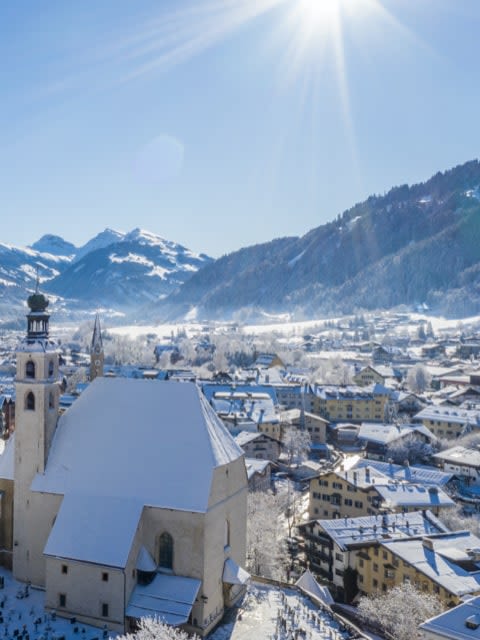
Kitzbühel is one of the great ski towns of the Alps. The medieval centre is car-free, with cobbled streets, painted facades, a 14th-century church, and a main street lined with boutiques, cafés, and restaurants. It's a town that works beautifully in the evening - after skiing, the Vorderstadt comes alive with a Tyrolean warmth that's hard to replicate in purpose-built resorts. The skiing fans out in two directions: the Hahnenkamm-Pengelstein side (where the famous World Cup downhill runs) and the Kitzbüheler Horn on the opposite side of the valley. The Hahnenkamm side has the bulk of the terrain, with long reds and blues through the trees and some of the best-groomed slopes in Austria. The town sits at just 800 m, but extensive snowmaking keeps the runs to the valley in good shape.
Kirchberg is a traditional Tyrolean village at 850 m on the western side of the KitzSki area, connected to the main Hahnenkamm-Pengelstein ski system by gondola. It has a quieter, more local feel than Kitzbühel, with family-run Gasthöfe, a weekly market, and a relaxed evening atmosphere. The skiing above links directly into the same terrain as Kitzbühel, so you get all the same runs at a gentler pace. The Gaisberg sector on the Kirchberg side has wide, well-groomed blues that are popular with families. It's a smart alternative to Kitzbühel if you want the same skiing with a calmer base.
Jochberg is a small village at 924 m between Kitzbühel and the Pass Thurn, with a gondola linking it to the Resterhöhe sector of the ski area. Resterhöhe sits at around 1,900 m and is notable for opening as early as late October - one of the first areas in Austria to start the season, thanks to heavy investment in snowmaking. The skiing is compact but well-maintained, with blues and reds linking across to the main Pengelstein area. Jochberg itself is tiny and very traditional - just a handful of guesthouses and a church. It suits skiers who want a quiet base with early-season access.
Kirchberg is the strongest base for beginners in the area. The Gaisberg sector has wide, gentle blues with a dedicated nursery area separated from faster traffic. Kitzbühel has a small learning zone at the base of the Hahnenkamm gondola, though it's more limited. The Kitzbüheler Horn side has some easy slopes near the top that are quieter and well-suited to building confidence. The grooming across the area is excellent, and Austrian ski school instruction is well-established in all three resorts.
WeSki does not currently have lessons available in the KitzSki area, but all three resorts have well-regarded local ski schools with English-speaking instructors.
WeSki tip: The Gaisberg area above Kirchberg is the best beginner zone in KitzSki - it's wide, sunny, and has a gentle gradient. It's also connected to the main ski area, so once you're linking turns on the blues, you can explore further without having to take a bus or change sectors.
KitzSki is built for intermediates. The long reds from the Pengelstein (1,938 m) back down through the trees towards Kirchberg and Kitzbühel are some of the most satisfying runs in the Tyrol - well-groomed, consistent pitch, and beautifully maintained. The Ehrenbachhöhe sector has a good mix of blues and reds, and the run from the top of the Hahnenkamm down towards Kitzbühel follows part of the famous race course before branching off onto gentler terrain. The Kitzbüheler Horn, on the opposite side of the valley, is worth a morning's visit for its panoramic views and quiet, varied blues.
WeSki tip: The 3S gondola from the Pengelstein area across to the Kitzbüheler Horn was one of the longest in the world when it was built. It gives you access to the Horn's slopes without returning to the valley - take it mid-morning for quiet runs and panoramic views across to the Wilder Kaiser range before heading back for lunch in town.
The Hahnenkamm Streif is the headline act - one of the most famous and demanding downhill courses in the world, open to the public outside race week. The course drops 860 m over 3.3 km with gradients reaching 85%, including the infamous Mausefalle (Mousetrap) jump and the Steilhang compression. It's a genuine challenge even at recreational speeds. Beyond the Streif, the blacks on the Steinbergkogel and the steeper runs off the Ehrenbachhöhe provide more sustained terrain. Off-piste is limited by the relatively low altitude and tree cover, but after fresh snow, the woods between the Pengelstein and Kirchberg can be rewarding. A guide is recommended.
WeSki tip: The Streif is skiable by confident intermediates in good conditions - it's steep, but the piste is groomed and maintained. The key section is the Steilhang: a compression at speed that catches people off guard. Take it slowly the first time, and you'll understand why the racers hit it at 140 km/h. Race week is late January - the atmosphere in town is unmissable.
The KitzSki pass covers all 170 km of piste and 57 lifts across Kitzbühel, Kirchberg, and Jochberg on a single ticket, including both the Hahnenkamm-Pengelstein side and the Kitzbüheler Horn. Passes are available from one day up to the full season, with discounted rates for children, teens, and seniors. For a broader area, the Kitzbühel Alps AllStarCard extends access to Ski Welt, SkiCircus Saalbach, and other nearby areas - worth considering for longer stays.
You can add the lift pass directly to your WeSki booking, along with ski equipment hire at Kitzbühel and Kirchberg - so everything's sorted before you arrive.
WeSki tip: If you're staying a full week, check the Kitzbühel Alps AllStarCard - it covers KitzSki plus several neighbouring areas on one pass. A day trip to SkiWelt or Saalbach makes a great change of pace, and both are within 30 minutes' drive.
Innsbruck is the closest airport, around 1 hour's drive east along the Inn Valley. Salzburg is about 1 hour 15 minutes, and Munich roughly 1 hour 45 minutes. All three airports have good UK connections. By train, Kitzbühel is on the main Innsbruck-Salzburg railway line, with regular direct services from both cities - the journey from Innsbruck takes about an hour. The train station is a short walk from Kitzbühel's centre and the Hahnenkamm gondola base. Kirchberg and Jochberg are also served by local trains and buses.
WeSki has private and shared transfers to all three resorts: Kitzbühel, Kirchberg, and Jochberg. Add them to your booking for a straightforward door-to-door trip.
The Resterhöhe sector above Jochberg often opens as early as late October, making KitzSki one of the first areas in Austria to start the season. The main area opens in late November or early December and runs through to mid-April. The relatively low altitude (800 m to 2,000 m) means the area relies heavily on snowmaking, and the investment has been substantial - coverage is comprehensive, and conditions are reliable even in lower-snow years. January to mid-March typically sees the best natural snow on the upper slopes.
The Hahnenkamm race week in late January is the busiest and most electric period - the town fills with spectators, and the atmosphere is extraordinary. If you want to see the race, book well in advance. For quieter skiing, early December (once the full area is open), January before race week, and the first half of March all work well. Late season brings spring conditions and long days on the sunny slopes above Kirchberg.
Yes, particularly from a Kirchberg base. The Gaisberg sector has wide, gentle blues with a dedicated nursery area. The Kitzbüheler Horn also has easy slopes near the top. WeSki does not currently have lessons available, but all three resorts have well-regarded local ski schools with English-speaking instructors.
KitzSki covers 170 km of marked piste served by 57 lifts, ranging from 800 m to 2,000 m. There are around 60 runs across all grades. Three resorts - Kitzbühel, Kirchberg, and Jochberg - share the KitzSki pass.
The Streif is one of the most famous downhill ski races in the world, held annually on the Hahnenkamm mountain above Kitzbühel in late January. The course is 3.3 km long with an 860 m vertical drop and gradients reaching 85%. The course is open to the public outside race week - it's steep but groomed, and skiable by confident intermediates. Race week draws tens of thousands of spectators and is one of the highlights of the alpine skiing calendar.
Kitzbühel is a medieval town with a famous main street, boutiques, restaurants, and a polished atmosphere. Kirchberg is a quieter, more traditional Tyrolean village with family-run guesthouses and a relaxed feel. Both share the same ski area - Kirchberg connects by gondola to the Hahnenkamm-Pengelstein system. Kirchberg suits families and anyone who prefers a calmer base; Kitzbühel suits those who want the full town experience.
The Resterhöhe sector above Jochberg often opens in late October, making it one of the earliest openings in Austria. The main KitzSki area opens from late November or early December and runs through to mid-April. Extensive snowmaking keeps conditions reliable throughout the season.
Fly to Innsbruck (1 hr drive), Salzburg (1 hr 15 min), or Munich (1 hr 45 min). By train, Kitzbühel is on the main Innsbruck-Salzburg line, with direct services taking about an hour from either city. The station is a short walk from the town centre and slopes. WeSki has private and shared transfers to all three resorts.
No. The lift system links all three resorts during ski hours. You can ski from Kitzbühel to Kirchberg or across to Jochberg and back. Local trains and buses also connect the villages. The Kitzbüheler Horn is on the opposite side of the valley from the main Hahnenkamm area and is reached by gondola from Kitzbühel - no car needed.
Yes. Ski equipment hire is available through WeSki at Kitzbühel and Kirchberg. WeSki does not currently have lessons available in the KitzSki area. You can add equipment hire to your booking along with your lift pass and transfers.
Start building your dream ski trip today with our one-stop ski shop - hundreds of resorts, unlimited combinations.




 4.9/5
4.9/5I usually book flights, transfers, hotel, ski rental and lift passes myself but this year used WeSki for a trip to Morzine. It was so much easier. Everything worked perfectly - transfers arrived on time and there was plenty of feedback throughout the whole process giving you confidence the holiday would go smoothly.

A really useful service that is so much easier to use than other 'all-inclusive' sites. It nicely bridges the gap between a travel agent and booking the trip yourself online. I will use WeSki every time I go skiing from now on.
We booked a late minute skiing trip to Morzine through we ski. We looked at booking the trip ourselves but could get anywhere near the price quoted by we ski. The company was excellent and we had no problems at all from start to finish. I would definitely use them to book another weekend skiing trip.
Seamless experience from start to finish. I was spending ages trying to sort out a weekend break and managed to do it with we ski in minutes and for the same price as booking it all up yourself. Flight, transfer and accommodation was all as expected and faultless.

WeSki is a trading name operated by Wetrip Weski Ltd (BR021500). All the flights and flight-inclusive holidays on this website are financially protected by the ATOL scheme. When you pay you will be supplied with an ATOL Certificate. Please ask for it and check to ensure that everything you booked (flights, hotels and other services) is listed on it. Please see our booking conditions for further information or for more information about financial protection and the ATOL Certificate go to: www.caa.co.uk.
Package holidays that do not include travel by air are financially protected via ABTOT.
For the latest travel advice from the Foreign & Commonwealth Office visit www.gov.uk/foreign-travel-advice.