
EN
EN
The Portes du Soleil spans the border between France and Switzerland, linking around 600km of pistes for one of the biggest ski areas in the Alps. On the French side, its resorts range from Avoriaz, a car-free resort built on a high ridge, to the lively mountain town of Morzine and traditional villages such as Les Gets and Châtel. Across the border, the Swiss resorts of Champéry, Les Crosets, Champoussin, and Morgins sit beneath the Dents du Midi, a row of jagged peaks.
Beyond skiing into another country, visitors come for the variety of bases and some of the best-known snowparks in the Alps. The skiing sits mostly between 1,000m and 2,300m, with Avoriaz and the Swiss resorts high on open pastures and the slopes above Morzine, Les Gets, and Châtel winding through forest. Skiers and snowboarders of every level are well catered for. Beginners have learning areas in every resort and gentle tree-lined runs to work towards, while intermediates have long blues and reds and the classic loop from France into Switzerland and back. Advanced skiers and riders have steep blacks and big mogul fields, plus off-piste from high couloirs to forest routes, best explored with a local guide.
Off the slopes, the character of the Portes du Soleil changes from one resort to the next. In Morzine, bakeries, bistros, and bars line the main street, and après-ski carries on late into the evening. Up in Avoriaz, horse-drawn sleighs pass between wooden buildings on car-free streets. In Châtel, you can visit farms where Abondance cheese is made, and it turns up in fondue and tartiflette across the area. Across the border, Champéry adds a Swiss twist, with raclette in old chalet restaurants and a curling hall where you can try the sport for the first time.
| Country | France and Switzerland |
| Region | Haute-Savoie (France) / Valais (Switzerland) |
| Total piste km | 600 km |
| Altitude | 900 m (Morzine) - 2,277 m (Pointe de Mossette) |
| Linked resorts | 10 Avoriaz Morzine Les Gets Châtel La Chapelle d'Abondance St Jean d'Aulps [France] Champéry Les Crosets Champoussin Morgins [Switzerland] |
| Lifts | 196 |
| Runs | 286 (34 green, 109 blue, 99 red, 44 black) |
| Season | Mid-December - mid-April |
| Ski pass name | Portes du Soleil ski pass |
| Nearest airports | Geneva (~1 hr 15 min) Lyon (~2 hr 45 min) |
| Glacier skiing | No |
| WeSki services | Lessons: Avoriaz, Morzine, Les Gets Transfers: all 10 resorts (private to all; shared to Avoriaz, Morzine, Les Gets; scheduled to Morzine and Les Gets) Ski equipment hire: Avoriaz, Morzine, Les Gets, Châtel, Champéry, Morgins, St Jean d'Aulps |
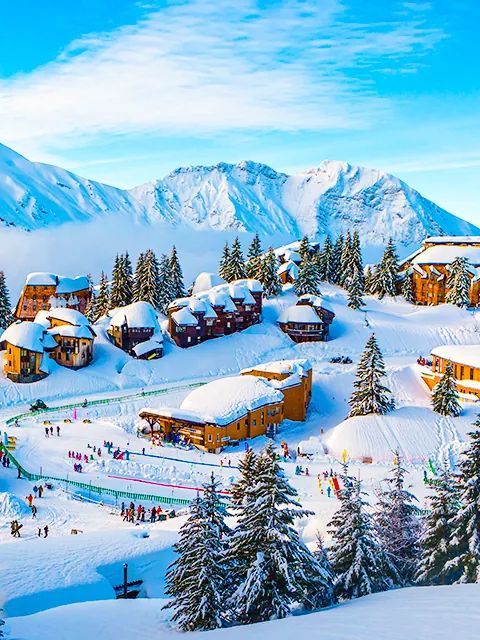
Avoriaz sits at 1,800m on a ridge, with most of its skiing on open, high slopes above the treeline and forest runs lower down. Beginners have learning areas right in the resort, and because it's ski-in, ski-out, there's no bus or gondola ride to reach them. Intermediates have rolling blues and reds above the village and long runs through the forest, while advanced skiers have steep blacks and mogul fields up high. Avoriaz also has deep freestyle roots, with four snowparks, including The Stash, a woodland park built from natural features.
Built in the 1960s, the resort's wood-clad buildings rise from the cliff edge as if they were part of the mountain. Its snowy streets are entirely car-free, so you get around on foot, on skis, or by horse-drawn sleigh. Most accommodation is in self-catering apartments, many of them ski-in, ski-out. Restaurants and bars line the streets of Avoriaz, après-ski centres on sunny terraces, and there's plenty of activity beyond the slopes, from a tropical indoor water park and igloo village, to dog sledding and snowshoeing in the surrounding forest.
Morzine's skiing starts right in town, with lifts climbing from the centre onto both sides of the valley. On the Pléney side, wide, tree-lined blues wind down through the forest, and beginners have nursery slopes and a magic carpet at the top of the gondola. Across the valley, Morzine's Nyon and Chamossière slopes are steeper and more varied, with long reds for intermediates and views from Lake Geneva to Mont Blanc on a clear day. Advanced skiers can test themselves on the mogul-covered Aigle Noir black or head into the freeride area off the Chamossière chairlift, at just over 2,000m.
A proper mountain town, Morzine is home to around 3,000 people all year and has the energy to match. Its main street is lined with bakeries, shops, and restaurants, and when the lifts close, the town's bars kick off a lively après-ski scene that carries on late into the night. Accommodation ranges from catered chalets to hotels and apartments, so there's something for every kind of group. Families are well looked after too, with the Famille Plus label recognising the town's childcare and activities for children of every age, plus an aquatic centre and an ice rink for days off the slopes.
Les Gets sits at 1,172m, with skiing rising on both sides of the village, mostly through the trees. Above the village, the Chavannes area is a gentle, open place to learn, with easy greens for first-timers. It's also home to the resort's snowpark and a boardercross named after local Olympic medallist Deborah Anthonioz. Intermediates can spend days cruising long blues and reds through the forest, while the Mont Chéry side, across the village, adds steeper runs and views all the way to Mont Blanc.
Down in the village, wooden chalets cluster around an outdoor ice rink, with restaurants, bars, and shops all a short walk apart. Most accommodation is in chalets and apartments, and après-ski is relaxed and friendly, centred on the bars around the village centre. With the Famille Plus label, Les Gets is a great pick for a family ski holiday, and there's plenty to make a day off the slopes fun. The all-season toboggan run is a hit with all ages, and the mechanical music museum holds more than 1,000 instruments, from tiny music boxes to barrel organs and automatons.
Châtel sits at 1,200m, and its skiing is split between two sectors on either side of the valley, each with its own feel. Super-Châtel, reached by gondola from the village centre, is sunny and open, with a beginner area for first-timers and the Smooth Park for freestylers. Across the valley, the Linga and Pré-la-Joux sector is shadier and steeper, with north-facing reds through the forest and mogul fields to test strong skiers. Ski buses link the two, so it's easy to switch sides from one day to the next.
A farming village at heart, Châtel has chalets and apartment buildings spread across the hillsides, and its roots show up best at the table. This is the home of Abondance cheese, and it turns up in fondue, raclette, and on cheeseboards across the village. To see where it comes from, you can visit local farms where it's made and try it at the source. Châtel also holds the Famille Plus label, making it a good fit for a family ski holiday, and days off the slopes can be spent snowshoeing through the forest or ice skating in the village.
St Jean d'Aulps has its own ski area, the Espace Roc d'Enfer, which climbs from the La Grande Terche ski base above the village to around 1,800m, beneath the rocky Roc d'Enfer peak. Its runs wind through forest and across open slopes with wide views, and the highlight is the Roc d'Enfer circuit, two 5km sections of uninterrupted red runs through a quiet valley. Beginners have a gentle nursery slope with a restaurant at the bottom, and the whole area is small enough to get to know in a day or two.
Down in the valley at 805m, St Jean d'Aulps is a working farming village with an active community all year, a handful of restaurants serving local dishes, and the ruins of a medieval abbey to explore. Accommodation is mostly chalets and apartments, either in the village or up at La Grande Terche, close to the lifts. Off the slopes, there's an ice rink at La Grande Terche, along with snowshoeing and sledging, and ski buses connect the village with the rest of the Portes du Soleil.
Champéry sits at 1,050m, right beneath the jagged Dents du Midi, and its red-and-white cable car lifts you straight from the village to the slopes. Up top, the terrain opens out into high pastures, with blues and reds to roam and learning areas for beginners. Confident skiers have some of the steepest terrain in the Portes du Soleil within reach, from mogul fields to off-piste below the ridges. In good snow, runs lead all the way back down towards the valley.
With a main street of wooden chalets, some of them centuries old, the village has a classic Swiss feel, and its chalets house shops, bars, and restaurants. Evenings are made for fondue and raclette, and accommodation is a mix of hotels and chalet apartments. The Palladium sports centre adds an ice rink, a swimming pool, and a curling hall where beginners can try the sport. Getting here is easy too, with trains running from Aigle, a stop on the main rail line through the Rhône valley, right into the village.
At 1,668m, Les Crosets is the highest of the Swiss resorts in the Portes du Soleil, set in an open bowl with ski-in, ski-out access onto wide, open slopes. Intermediates have blues and reds spread across the bowl, including a scenic red down from the Pointe des Mossettes, at 2,277m, with long views of the Dents du Midi. Freestylers have the Superpark, one of the best-regarded snowparks in Switzerland, with features for intermediate and advanced riders. For experts, the ridges above hold steep blacks, and the back of the Pointe des Mossettes and the Pointe de l'Au have powder bowls best skied with a guide.
The resort itself is small and slope-focused, a cluster of chalets and apartments with restaurants and bars right on the piste. Lunch and après-ski happen on the terraces looking across the peaks, and the evening scene is cosy and relaxed. Off the slopes, there are marked snowshoe trails and a sledging run, and regular night skiing sessions keep the slopes lit after dark.
Champoussin sits at 1,580m on a sunny shelf facing the Dents du Midi, with ski-in, ski-out access and gentle, rolling slopes right around the village. The terrain follows the natural shape of the mountain, so beginners and skiers building confidence have easy, open ground close by, and snowboarders have natural rolls to play on. Intermediates have blues and reds above the village, and confident skiers can head higher for longer, steeper descents.
For an intimate, low-key ski trip, Champoussin is a great choice. The village is a small, quiet collection of chalets and apartments, with a few restaurants close to the lifts and sunny terraces made for a long lunch. Off the slopes, there's snowshoeing, sledging, and paragliding for a bird's-eye view of the Dents du Midi.
Morgins sits at around 1,350m, and its skiing is split between two sectors facing each other across the valley, linked by a shuttle bus. Gentle, tree-lined runs rise right above the village, with nursery slopes for beginners and blues and easy reds through the forest for intermediates. On the other side, the Foilleuse chairlift climbs to a high, open bowl, with the Dents du Midi on one side and the Cornettes de Bise on the other. Freestylers have the Edge Park and a ski-cross course built to international competition standards, and if you're curious about ski touring, the Rando Parc has three marked routes for learning to skin uphill.
At heart, Morgins is still a working Swiss mountain village, with traditional wooden chalets and farming traditions that carry on alongside the ski season. Most chalets and small hotels are within a short walk of the lifts, and restaurants serve Valais specialities such as raclette, fondue, and croûte au fromage, bread baked under melted cheese. In the evening, the outdoor ice rink on the main square becomes a meeting point, with music, skate hire, and a snack bar. Beyond skiing, there's cross-country skiing around the lake, husky outings that end with fondue in a mountain pasture, and ski tours by moonlight.
La Chapelle d'Abondance sits at 1,020m, and its skiing is split between two small sectors on either side of the valley, Crêt Béni above the village and Braitaz across the way, linked by shuttle bus. The slopes are compact and unhurried, with a mix of greens, blues, and reds that make this an easy place to learn or to build confidence at your own pace. Down on the valley floor, cross-country tracks offer a change of rhythm from downhill skiing.
The village itself is a cluster of old wooden chalets in the Abondance valley, where farming still shapes daily life. Evenings revolve around hearty Savoyard cooking in the village restaurants, often made with the local Abondance cheese. On a day off the skis, snowshoe trails lead out into the quiet of the surrounding valley.
If it's your first time on skis or a snowboard, the Portes du Soleil is a reassuring place to start. Every resort has its own learning area, so there's no need to travel far while you're finding your feet. Lessons are easy to find too, with ski schools in every resort, from the ESF on the French side to the Swiss Ski School across the border.
Where you stay can make those first days easier. In Avoriaz, the learning areas are right in the resort, steps from most accommodation. Morzine's nursery slopes sit at the top of the Pléney gondola, and Les Gets has gentle slopes and easy greens in its Chavannes area, a short ride above the village. In Châtel, the Super-Châtel gondola takes you up to a sunny learning area, while on the Swiss side, Champoussin and Morgins have gentle slopes close to the village.
When you're ready to leave the nursery slopes behind, head for the tree-lined runs above Morzine, Les Gets, and Morgins. They're wide and gently pitched, and the trees along each side mark out the piste clearly and shelter it from the wind, which makes your first longer runs feel far less daunting.
If you're an intermediate, the Portes du Soleil has a fresh run to try around almost every corner. Blues and reds make up most of the area, and the terrain changes as you move around it, from open, rolling slopes above the treeline in Avoriaz and the Swiss resorts to tree-lined runs above Morzine, Les Gets, and Châtel. For long, open cruising, Avoriaz and Les Crosets are hard to beat, while Morzine, Les Gets, Châtel, and Morgins suit skiers who love skiing through the trees.
Skiing between France and Switzerland is easier than many people expect. From the Avoriaz side, a lift to the Pointe des Mossettes leads to a red run down to Les Crosets, and from Châtel, the slopes above Super-Châtel link across to Morgins. As long as you're comfortable on reds, you can cross the border without going anywhere near the Swiss Wall.
The classic day out is the Portes du Soleil circuit, a signposted loop through Avoriaz, the Swiss resorts, and Châtel. It takes most of a day, so you'll need the full area pass, a lunch stop on the Swiss side, and an eye on lift closing times for the return. Ski it once, and you'll understand why it's a favourite with intermediates who visit year after year.
If steep skiing is what you're after, Avoriaz and the Swiss resorts have the biggest choice of blacks. In Avoriaz, the Hauts Forts runs drop a long way from the top of the resort towards the valley, and on the Swiss side, a black from the Pointe des Mossettes falls around 800m to Les Crosets. Morzine adds the mogul-covered Aigle Noir, and Châtel's north-facing Linga sector has mogul fields through the forest.
The run everyone talks about is the Swiss Wall, on the border above Les Crosets. It's a 1km mogul field that drops 331m at around 37 degrees and is graded beyond black in Switzerland. Off-piste, Avoriaz has some of the most accessible terrain in the area, including the Fornet bowl. From Morzine's Nyon area, the remote Vallée de la Manche offers a long, scenic descent, and on the Swiss side, the slopes behind the Pointe des Mossettes hold powder bowls after fresh snow. Avalanche risk is real away from the marked runs, so hire a local guide who knows the terrain.
Snowboarding has deep roots in the Portes du Soleil, and Avoriaz in particular has a long freestyle history. On the mountain, the open slopes around Avoriaz and Les Crosets give you plenty of room to carve, while the tree-lined runs above Morzine, Les Gets, and Châtel are full of natural rolls and banks to play on, with soft snow tucked between the trees after a fresh fall. Before setting off across the area, check the piste map, as some links include flat sections and drag lifts that are hard work on a board.
For park riders, Avoriaz is the place to start, with four parks to choose from. The Stash, a woodland park built from logs and natural features, stands out from anything else in the area, and Arare has bigger features for intermediate and advanced riders. Across the border, the Superpark at Les Crosets has been dedicated to freestyle since 1998, with big jumps and rails. Closer to the valley resorts, Châtel's Smooth Park sits at Super-Châtel, Les Gets has a park and boardercross in its Chavannes area, and Morgins has the Edge Park, a good spot for building your skills.
Most visitors settle into one base for their trip, so a local pass is often all you'll need. Avoriaz, Châtel, La Chapelle d'Abondance, and St Jean d'Aulps each sell their own pass, Morzine and Les Gets share one, and a single pass covers the four Swiss resorts.
For skiing across several resorts or both countries, the Portes du Soleil pass covers every lift in the area. Passes are sold from a single day up to a full season, and a pass for the length of your stay usually works out cheaper per day than buying single days.
For international visitors, Geneva is the closest airport, around 65 to 125km from the resorts, with Lyon a longer transfer at about 200 to 270km. From either one, you can book a shared or private transfer, or hire a car if you'd like the freedom to explore the valleys.
If you'd rather arrive by train, the best station depends on where you're staying. For Morzine and Châtel, Thonon-les-Bains is 30 to 40km away, while Cluses, 20 to 30km away, is closer to Les Gets and Morzine. On the Swiss side, Champéry is the easiest to reach, with trains from Aigle running right into the village, and Monthey is the nearest station for Morgins.
Once you've arrived, a car isn't essential. Ski buses link the villages with their lifts, and Avoriaz is car-free, so you'll get around on foot or on skis. The lifts are also the quickest way between France and Switzerland, since crossing by road means a long drive around the mountains.
If you're looking for the most reliable snow, aim for January to mid-March, when conditions are usually at their best across the whole area. The Portes du Soleil season itself runs from mid-December to mid-April, though some lower sectors close earlier. February is the busiest month, with French, Swiss, and UK school holidays filling the slopes and lift queues, so if your dates are flexible, January and early March give you a good chance at quieter slopes.
Later in the season, spring brings longer, sunny days and softer snow to Portes du Soleil, with plenty of time for a long lunch on a terrace. Avoriaz and the high slopes around Les Crosets hold their snow best into April, while the lower runs back to the valley villages depend more on conditions, which makes Avoriaz the safest base for a late-season trip.
Yes. The signposted circuit loops through Avoriaz, the Swiss resorts, and Châtel, and a confident intermediate can ski it in a day with a lunch stop. Most visitors treat it as an occasional day out and ski locally for the rest of their trip. Check the closing times of the link lifts before you set out, as the return journey takes a while.
You'll want to be comfortable on red runs. The main crossings use blues and reds, and a full circuit covers long distances on skis. At the Chavanette crossing above Avoriaz, the Swiss Wall is the direct way down, but you can ride the chairlift down instead if you'd rather not tackle it.
There are no border checks on the slopes, but carry a passport or ID card in case you're asked for it. Switzerland uses Swiss francs, though most mountain restaurants accept cards and many take euros. Your phone may switch to a Swiss network, so check your roaming plan before you go.
You'll need a taxi or bus back, and if you're on the other side of the border, the road journey is long because it goes all the way around the mountains. Check the closing times of your return lifts on the piste map or app before you set out, and leave a good margin on the way back.
No, not if you're staying in one resort. Local passes cover your own slopes and close neighbours, such as Morzine and Les Gets together, which is plenty for most stays. Go for the full pass if you want to ski the circuit, cross into Switzerland, or move between several resorts during your trip.
Avoriaz is ski-in, ski-out, and so are the slope-side villages of Les Crosets and Champoussin. In Les Gets and Morzine, runs come back into town, though the lowest sections depend on snow. In good snow, you can also ski down towards Champéry and take a short bus or cable car to the village.
Yes, occasionally. The highest lifts on the ridges, including those at the border crossings, can close in strong wind, which may cut the links between France and Switzerland for the day. When that happens, the forest runs around Morzine, Les Gets, Châtel, and Morgins usually stay open. Check the live lift status each morning before you plan your route.
The Portes du Soleil is larger, with more resorts and the chance to ski between two countries. The Grand Massif, just to the south, is more compact and built around a high, north-facing bowl with traditional villages below. If you want variety and a cross-border day out, the Portes du Soleil is a strong choice.
Yes, especially if you stay in Morzine, Avoriaz, or Champéry. Morzine has a lively town centre, an aquatic centre, and an ice rink. In Avoriaz, you can spend a day at the Aquariaz water park or ride a horse-drawn sleigh, while Champéry's Palladium offers skating, curling, and swimming under one roof.
Morzine, Les Gets, and Châtel all hold the Famille Plus label for their childcare, ski schools, and activities for every age. Avoriaz suits families who want everything close by, with car-free streets and learning areas right in the resort. On the Swiss side, Champoussin and Morgins have gentle slopes close to the village.
Start building your dream ski trip today with our one-stop ski shop - hundreds of resorts, unlimited combinations.





 4.9/5
I usually book flights, transfers, hotel, ski rental and lift passes myself but this year used WeSki for a trip to Morzine. It was so much easier. Everything worked perfectly - transfers arrived on time and there was plenty of feedback throughout the whole process giving you confidence the holiday would go smoothly.

A really useful service that is so much easier to use than other 'all-inclusive' sites. It nicely bridges the gap between a travel agent and booking the trip yourself online. I will use WeSki every time I go skiing from now on.
We booked a late minute skiing trip to Morzine through we ski. We looked at booking the trip ourselves but could get anywhere near the price quoted by we ski. The company was excellent and we had no problems at all from start to finish. I would definitely use them to book another weekend skiing trip.
Seamless experience from start to finish. I was spending ages trying to sort out a weekend break and managed to do it with we ski in minutes and for the same price as booking it all up yourself. Flight, transfer and accommodation was all as expected and faultless.
WeSki is a trading name operated by Wetrip Weski Ltd (BR021500). All the flights and flight-inclusive holidays on this website are financially protected by the ATOL scheme. When you pay you will be supplied with an ATOL Certificate. Please ask for it and check to ensure that everything you booked (flights, hotels and other services) is listed on it. Please see our booking conditions for further information or for more information about financial protection and the ATOL Certificate go to: www.caa.co.uk.
Package holidays that do not include travel by air are financially protected via ABTOT.
For the latest travel advice from the Foreign & Commonwealth Office visit www.gov.uk/foreign-travel-advice.