
EN
EN
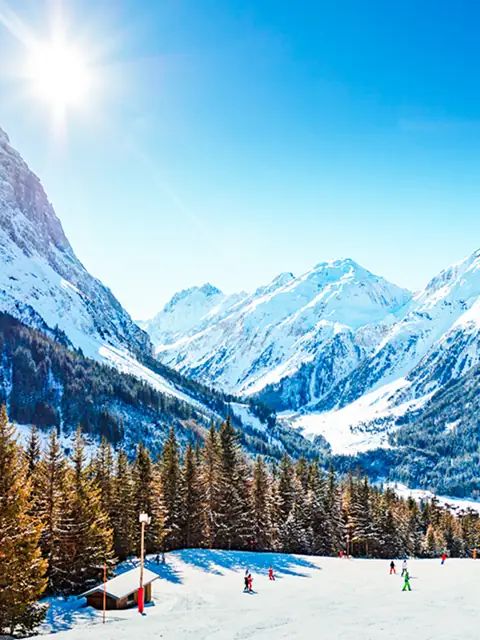
Picture two big ski resorts facing each other across a valley, with a double-decker cable car, the Vanoise Express, gliding between them high above the forest. That's Paradiski, linking around 425km of pistes in the French Alps. On one side, La Plagne's villages are scattered across a high, rolling plateau, while across the valley, Les Arcs' four villages climb one long mountainside. Two smaller resorts add a quieter side to the area, with the hamlets of Peisey-Vallandry set among the trees on the Les Arcs side and the old village of Champagny-en-Vanoise tucked away behind La Plagne.
Whether you ski or snowboard, there’s terrain here for every mood and every level. La Plagne is known for broad, rolling runs across its plateau, which make it an easy place to learn and a relaxed one to cruise, while Les Arcs has longer, steeper descents, topped by the 3,226m Aiguille Rouge. Beginners will find learning areas in every resort and wide, gentle blues to build up to throughout the area. Intermediates have open slopes above the treeline and long reds through the forest lower down. With a full Paradiski pass, intermediates can also ride the Vanoise Express across the valley and spend a day skiing the other resort, since blue runs connect both of its stations to the slopes. For advanced skiers and riders, there are steep faces and couloirs across both resorts, and the off-piste descents into the valleys are best explored with a local guide.
Paradiski mixes bold, purpose-built mountain resorts with old Savoyard villages, so you can choose between ski-in, ski-out apartments high on the slopes and wooden chalets in Peisey-Vallandry and Champagny-en-Vanoise. Off the slopes, there’s plenty to fill a well-rounded holiday, from snowshoe walks in the Vanoise National Park, right on the doorstep, to swimming, sledging, and a bobsleigh ride on an Olympic track. Après-ski in the area ranges from dancing in ski boots on mountain terraces to a quiet drink in a village bar, and dinner usually involves good wine and mountain comfort food, such as fondue, raclette, or tartiflette.
| Country | France |
| Region | Savoie / Tarentaise Valley, Northern Alps |
| Total piste km | 425 km |
| Altitude | 1,250 m (Champagny-en-Vanoise) - 3,250 m (Aiguille Rouge) |
| Linked resorts | 4 La Plagne Les Arcs Peisey-Vallandry Champagny-en-Vanoise |
| Lifts | 141 |
| Runs | 259 (11 green, 120 blue, 79 red, 49 black) |
| Season | Mid-December - late April |
| Ski pass name | Paradiski ski pass |
| Nearest airports | Chambéry (~1 hr 30 min) Lyon (~2 hr 30 min) Geneva (~2 hr 45 min) Grenoble (~2 hr 30 min) |
| Glacier skiing | Yes - Glacier de Bellecôte above La Plagne (accessible from Bellecôte run at 3,417 m) |
| WeSki services | Lessons: La Plagne, Les Arcs Transfers: all 4 resorts (private to all; shared to La Plagne and Les Arcs) Ski equipment hire: Les Arcs (1600, 1800, 1950, 2000), La Plagne (Centre, 1800, Aime 2000, Belle Plagne, Bellecôte, Soleil, Montalbert), Champagny-en-Vanoise, Peisey-Vallandry |
La Plagne is best known for its wide, forgiving pistes, but there's more variety here for skiers and snowboarders than this easy-going reputation suggests. Beginners have dedicated learning slopes right outside the high villages, with gentle blue runs across the plateau to move onto as they improve. Intermediates can spend days cruising, from rolling blues around Plagne Centre to the scenic reds that drop from the Roche de Mio, one of the resort's high points. Advanced skiers have steep black runs, some left ungroomed, and the Mont de la Guerre, a nearly 7km run down to Champagny-en-Vanoise. With a guide, the north face of Bellecôte offers one of the longest off-piste descents in the Alps, at around 2,000m of vertical.
With around ten villages to choose from, La Plagne has a base to suit every ski holiday style, and most of them put you right on the snow. The high villages, between about 1,800m and 2,100m, are ski-in, ski-out, while lower down, the traditional villages of Montchavin-Les Coches and Montalbert are set among the trees. Montchavin-Les Coches is a good fit for families, with a family-friendly setup recognised by the Famille Plus label.
La Plagne has a piece of Olympic history you can try for yourself, as the bobsleigh track built for the 1992 Winter Olympics is open to visitors. Each day, you can choose from a rich selection of winter activities, whether you want memorable thrills like the Super Tyro, a 600m zipline, or relaxing spots to unwind, like the Magic Pool at Plagne Bellecôte, a heated outdoor pool with a sauna overlooking the slopes. There's no shortage of places to eat, with restaurants throughout the villages and on the slopes serving Savoyard classics such as fondue, raclette, and tartiflette. Some mountain restaurants host evening dinners where you ski back down to the village afterwards. Après-ski is just as varied, from drinks on the mountain terraces as the lifts close to the village bars and a bowling bar in Belle Plagne for a few games after a day on the slopes.
Les Arcs has four villages, each named after its altitude, from Arc 1600 at the bottom to Arc 2000 at the top. It has a reputation for challenging terrain, but it's also a great place to learn. The ski school in Arc 2000 pioneered a method where beginners start on short skis and move to longer ones as they improve, and today every village has its own ski school and learning areas, with Arc 2000 adding a dedicated progression route for first-timers. If it's not your first time, there's plenty on the pistes to enjoy, from long reds through the forest above Arc 1600 to open, high slopes around Arc 2000. Above it all rises the Aiguille Rouge, the resort's highest peak at 3,226m. Its signature run drops 7km from the summit down into the forest, and the slopes around it hold long blacks and plenty of off-piste for strong skiers.
All four villages are car-free, and each has its own centre with shops, restaurants, and plenty to do off the slopes. The modernist buildings of Arc 1600 and Arc 1800, designed from the late 1960s, now hold France's label for 20th-century architectural heritage, while Arc 1950 is a newer village built in a traditional alpine style. Arc 1800 tends to be the hub, as the biggest village with the most shops and restaurants. It's also home to one of the area's best-known après spots, La Folie Douce, which turns into a terrace dance floor once the slopes close. For a thrill away from the pistes, Les Arcs’ Aiguille Rouge zipline is said to be the steepest in France, and Arc 2000 has a 3km sledge run that's fun for all ages. When it's time to unwind, there's a spa in Arc 1950, and evenings can be spent skating, bowling, or at the cinema in one of the villages.
Peisey-Vallandry's two ski bases, Plan Peisey and Vallandry, sit in the forest at around 1,600m. Runs wind down through larch and spruce forest, and above the treeline, the terrain opens into wide, rolling bowls with views across to Mont Blanc. Beginners have gentle slopes and ski schools close to the villages, and the forest blues are a comfortable place to build confidence. Intermediates have plenty of reds and blues to explore, many of them leading right back to the village. Advanced skiers can take on black runs such as the Aigle, with big views over the valley, and ungroomed nature runs that turn into mogul fields after fresh snow. With a guide, off-piste routes drop all the way into the Nancroix valley.
The atmosphere at Peisey-Vallandry is relaxed and family-friendly, with ski-in, ski-out apartments and residences. Restaurants throughout the villages serve Savoyard classics, and a piste-side bar with live music tends to be the hub of its low-key après-ski scene. One of the highlights of staying here is the old village of Peisey just below, reached by a quirky bucket lift that locals call the "lobster pots". Its narrow streets of old farm buildings are home to a bakery, a butcher, and a cheese shop known for its Beaufort, and torchlit guided tours bring the village's history to life. Nearby, you can watch goats being milked and taste their cheese at a local dairy, or head to Nancroix, on the edge of the Vanoise National Park, for cross-country skiing and frozen-waterfall climbing.
Set on a sunny shelf at 1,250m, Champagny-en-Vanoise is a quiet village at the gateway to the Vanoise National Park, with a gondola that whisks visitors straight from the village up to around 2,000m, where the skiing begins. The slopes here face south, with views across the valley towards Courchevel.
At the top of the gondola, there's a dedicated learning area for beginners, with chairlifts serving gentle green and blue runs. Intermediates have sunny, open blues and reds to cruise, with the rest of La Plagne's long, rolling runs within easy reach and Les Arcs across the valley. For confident skiers, the highlight is the Mont de la Guerre, a long, sustained descent of nearly 7km that runs all the way back into the village, with snowmaking that helps keep it open late into the season. The slopes above the village also hold challenging reds and blacks, and with a guide, off-piste routes from the Roche de Mio drop down into the wild valley of Champagny-le-Haut.
When Champagny voted in 1965 to link up with the new ski area above, it chose to grow without losing its traditional character. Today, old mountain houses line a village centre of shops, bars, and restaurants, and accommodation ranges from studio apartments to large chalets, most within easy reach of the gondola. Restaurants serve Savoyard specialities, and après-ski is relaxed and village-focused, with drinks on sunny terraces as the lifts close. In the village, there's a sledging area and dog sledding, and a short drive up the road, Champagny-le-Haut has 30km of cross-country trails, snowshoe routes, and a 22m ice-climbing tower.
Every village in Paradiski has its own learning area. Much of the high ground is wide and gently pitched, so there's room to practise without feeling hemmed in, and because most of the skiing sits above 2,000m, the snow on the beginner slopes tends to stay in good condition all season. Once you're ready to move on from the nursery areas, you'll find plenty of easy blues where you can travel between villages as you build your skills.
La Plagne is a strong choice for first-timers, with learning areas right outside Plagne Centre, Belle Plagne, and the other high villages, plus dedicated beginner runs, marked in purple and served by their own small lifts. In Les Arcs, the ski school in Arc 2000 pioneered a way of learning on short skis that get longer as you improve, and the village now has a progression route designed for first-timers. Peisey-Vallandry has gentle slopes close to the villages, and in Champagny-en-Vanoise, the learning area sits at the top of the gondola.
Lessons are easy to arrange, with ski schools in every resort, including branches of the ESF, France's national ski school, which offers group and private lessons for adults and children. If you're travelling during the February school holidays, it's worth booking ahead, as lessons fill up quickly.
If you're an intermediate, Paradiski gives you two very different mountains to explore on one pass. La Plagne is cruising country, with long, rolling blues and reds spread across its high plateau, while Les Arcs has longer, more varied descents, from reds through the forest above Arc 1600 to open slopes around Arc 2000.
The La Plagne side gives intermediate skiers and snowboarders more of a challenge within reach, with scenic reds that drop from the Roche de Mio and long runs above Plagne Centre. These reward you not only with a good test of stamina, but with big views too. In Les Arcs, the long forest reds above Arc 1600 have a steady pitch and clearly marked pistes, so you can find your rhythm and build confidence over long, uninterrupted descents.
For a classic, memorable Paradiski outing, intermediates can cross the valley on the Vanoise Express to ski the other side. Blue runs connect both of its stations to the slopes, so it's well within reach with a full Paradiski pass.
Advanced skiers come to Paradiski for big vertical, steep blacks, and some of the best lift-served off-piste in the Alps. Les Arcs itself hosted speed skiing at the 1992 Winter Olympics, so it's clear the area has serious pedigree. It's also where most of the steepest pistes are, with long blacks below the Aiguille Rouge. La Plagne has fewer black runs, but many are left ungroomed, including the steep Emile Allais. The resort is also home to the Mont de la Guerre, a memorable outing that mixes red and black pitches over nearly 7km down to Champagny-en-Vanoise. Over in Peisey-Vallandry, ungroomed nature runs turn into mogul fields after fresh snow.
The north face of Bellecôte, above La Plagne, is the headline off-piste descent, with around 2,000m of vertical. Other off-piste favourites include the Inversens couloir off the Roche de Mio, the bowls around the Aiguille Rouge, and the tree skiing above Montchavin and Montalbert, all best explored with a local guide.
Paradiski has a special place in snowboarding history. The Apocalypse Snow films, shot in Les Arcs in the 1980s, helped bring snowboarding to France, and riders still come for the same mix of open bowls, forest runs, and lift-served freeride.
The two sides of the valley ride very differently, which makes a longer stay spent exploring both all the more fun. La Plagne's wide, rolling pistes are a comfortable place to learn, and its open plateau has plenty of room to carve at speed. A few of the paths linking its villages are flat, though, so keep your speed up or be ready to unstrap. Les Arcs has steeper, more varied terrain, from high, open slopes and freeride around the Aiguille Rouge to tree runs above Arc 1600 and Peisey-Vallandry that hold on to fresh snow, with plenty of natural features to play on.
Both sides have plenty for park riders, so you can ride freestyle wherever you stay. In Les Arcs, the main snowpark between Arc 1600 and Arc 1800 covers 7.5 hectares, with features ranging from beginner-friendly boxes to big kickers and a quarter pipe, and Arc 1800 adds the Mille 8 zone for every level. Across the valley, La Plagne's Riders Nation park stretches for around 1km above Plagne Centre, with lines for all abilities, and Plagne Bellecôte has a halfpipe for riders who like to go vertical.
Many visitors stick to one side of the area for their stay, in which case a La Plagne or Les Arcs pass is all you'll need, at a lower price than the full area pass. A La Plagne pass covers all of La Plagne's slopes, including Champagny-en-Vanoise, while a Les Arcs pass covers the whole of that side, including Peisey-Vallandry. If you decide partway through your trip that you'd like to ski the other side, upgrade options let you add the Vanoise Express.
The Paradiski pass covers all 425km of pistes on both sides, including the Vanoise Express, on a single ticket, with passes available from one day up to a full season. If you're staying for six days or more, it's often worth buying the full pass from the start, even if you only plan to cross the valley once or twice, as upgrading later tends to cost more. Passes can be bought online in advance or at the ticket offices in each resort.
Chambéry is the closest airport for international visitors, around 105 to 135km from the resorts. Geneva and Lyon are also good options, at about 145 to 175km and 200 to 235km away respectively. From any of them, you can book a shared or private transfer or hire a car.
By train, Bourg-Saint-Maurice is the nearest station for Les Arcs, with seasonal services from Paris and London. A funicular runs from the station straight up to Arc 1600, so you can go from train to slopes without a road transfer. For La Plagne, Aime-La Plagne station is around 15 to 20km from the villages, Landry is the closest station for Peisey-Vallandry, and Moûtiers is the nearest for Champagny-en-Vanoise.
Once you're there, ski buses link the villages within La Plagne and within Les Arcs, and many accommodations are ski-in, ski-out. Getting between the two sides by road means a long drive down into the valley and back up, so the Vanoise Express is the easiest way across.
If snow is your top priority, aim for January to mid-March, when conditions are usually at their most consistent across the whole area, right down to the tree-lined runs above the villages. Much of the skiing sits above 2,000m, and the Aiguille Rouge tops out at 3,226m, so the high slopes hold up well across a season that runs from mid-December to late April.
To avoid the busiest weeks, plan around the February school holidays, when families from across Europe fill the slopes and the purpose-built villages. January and early March give you a good chance at quieter pistes, with snow that's usually still in great shape.
Prefer sunshine to powder? Late March and April bring longer days, softer spring snow, and long lunches on sunny terraces. The south-facing runs on the La Plagne side are especially enjoyable in the afternoon sun, while the high slopes around the Aiguille Rouge keep their snow best right to the end of the season.
Montchavin-Les Coches, one of La Plagne's villages, holds the Famille Plus label for its family-friendly setup. The high villages of La Plagne and Les Arcs suit families who want to step straight onto the snow, with learning areas close to the accommodation. Peisey-Vallandry and Champagny-en-Vanoise offer a quieter, more traditional village base.
Yes. Non-skiers can ride a bobsleigh down La Plagne's Olympic track, relax in the heated outdoor pool at Plagne Bellecôte, or try the Aiguille Rouge zipline in Les Arcs. Snowshoe walks in the Vanoise National Park, a spa in Arc 1950, and a pedestrian ticket for the Vanoise Express add even more options, and many mountain restaurants can be reached by lift for lunch with friends who ski.
Yes. With a full Paradiski pass, you can ride the Vanoise Express across the valley and spend the day exploring the other side. Blue runs connect both of its stations to the slopes, so it's within reach for most intermediates. Many visitors make it a highlight of their trip and spend the rest of the week skiing closer to their base.
If you're comfortable on blue runs, you can make the crossing. The Vanoise Express does the hard work over the valley, and blues link both of its stations to the wider ski area. Reaching the far ends of each side, such as Arc 2000 or Belle Plagne, involves more skiing, so confident intermediates will get the most out of a full day across the valley.
Fly to Chambéry (1 hr 30 min drive), Lyon (2 hr 30 min), Grenoble (2 hr 30 min), or Geneva (2 hr 45 min). Alternatively, take the Eurostar and TGV to Bourg-Saint-Maurice for Les Arcs (a funicular runs directly from the station to Arc 1600) or to Aime-la-Plagne for La Plagne. WeSki has private and shared transfers available.
You'll need a taxi back, and the road journey is long, as it winds down into the valley and back up the other side. The last crossing time is shown on the piste map and lift app, so check it before you set out and leave plenty of time to ski back to the station.
Not necessarily. Many visitors stick to one side, and a La Plagne or Les Arcs pass covers plenty of skiing for a week. If you'd like to ride the Vanoise Express and explore both sides, choose the full Paradiski pass, and for a six-day stay, it's often worth buying it from the start.
Most of La Plagne's high villages and all four Les Arcs villages are ski-in, ski-out, and the hamlets of Peisey-Vallandry sit right on the forest runs. In good snow, you can also ski back down to Montchavin-Les Coches, Montalbert, and Champagny-en-Vanoise, where the Mont de la Guerre runs all the way into the village.
Occasionally, yes. Like the highest lifts on both sides, the Vanoise Express can close in strong wind, which cuts the link between La Plagne and Les Arcs for the day. There's still plenty to ski on your own side when that happens, and the live lift status is posted each morning.
No. La Plagne's glacier is no longer open for skiing, but with the Aiguille Rouge at 3,226m and much of the skiing above 2,000m, the high slopes still hold their snow well through the season.
The Three Valleys, just to the south, is larger, with more resorts linked across three valleys. Paradiski is built around two big resorts facing each other across a valley, joined by the Vanoise Express, each with plenty of variety on its own. If you like the idea of exploring two very different mountains, or arriving by train and taking a funicular straight to the slopes, Paradiski is a strong choice.
Start building your dream ski trip today with our one-stop ski shop - hundreds of resorts, unlimited combinations.



 4.9/5
I usually book flights, transfers, hotel, ski rental and lift passes myself but this year used WeSki for a trip to Morzine. It was so much easier. Everything worked perfectly - transfers arrived on time and there was plenty of feedback throughout the whole process giving you confidence the holiday would go smoothly.

A really useful service that is so much easier to use than other 'all-inclusive' sites. It nicely bridges the gap between a travel agent and booking the trip yourself online. I will use WeSki every time I go skiing from now on.
We booked a late minute skiing trip to Morzine through we ski. We looked at booking the trip ourselves but could get anywhere near the price quoted by we ski. The company was excellent and we had no problems at all from start to finish. I would definitely use them to book another weekend skiing trip.
Seamless experience from start to finish. I was spending ages trying to sort out a weekend break and managed to do it with we ski in minutes and for the same price as booking it all up yourself. Flight, transfer and accommodation was all as expected and faultless.

WeSki is a trading name operated by Wetrip Weski Ltd (BR021500). All the flights and flight-inclusive holidays on this website are financially protected by the ATOL scheme. When you pay you will be supplied with an ATOL Certificate. Please ask for it and check to ensure that everything you booked (flights, hotels and other services) is listed on it. Please see our booking conditions for further information or for more information about financial protection and the ATOL Certificate go to: www.caa.co.uk.
Package holidays that do not include travel by air are financially protected via ABTOT.
For the latest travel advice from the Foreign & Commonwealth Office visit www.gov.uk/foreign-travel-advice.