
EN
EN
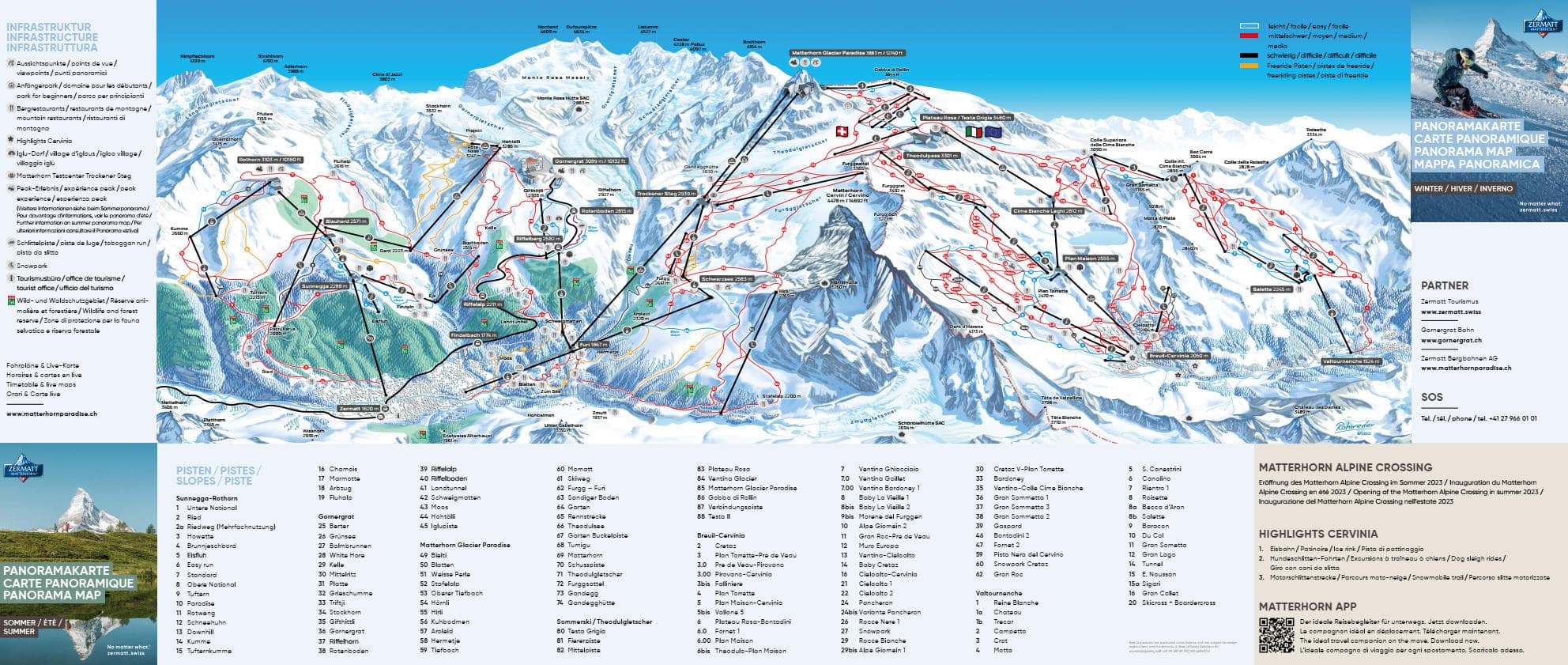
The Matterhorn Ski Paradise is a cross-border ski area linking Zermatt in Switzerland with Breuil-Cervinia in Italy, connected across the Theodul Glacier at nearly 3,900 m. It's one of the highest and most spectacular ski areas in the world, dominated by the Matterhorn - arguably the most recognisable mountain on earth. The area has year-round glacier skiing, enormous vertical drops, and a split personality: Zermatt is refined, car-free, and distinctly Swiss; Cervinia is wider, sunnier, and Italian in every sense.
The area covers 360 km of marked piste served by 52 lifts, sitting between 1,524 m and 3,883 m at the Piccolo Cervino (Klein Matterhorn) - the highest lift-served point in Europe. There are 73 runs: 7 green, 25 blue, 27 red, and 14 black. Skiing is available year-round on the Theodul Glacier, and the main season runs from late November to early May. Two resorts share the international pass.
Zermatt is one of the great mountain villages of the Alps - car-free, full of character, and with the Matterhorn visible from almost every angle. Cervinia is more straightforward: a purpose-built resort at 2,050 m with wide, sunny slopes and a relaxed Italian atmosphere. Skiing between the two countries in a single day is one of the highlights of any trip here. Browse Matterhorn Ski Paradise ski deals on WeSki to start planning your trip.
| Country | Switzerland and Italy |
| Region | Valais (Switzerland) / Aosta Valley (Italy) |
| Total piste km | 360 km |
| Altitude | 1,524 m (Breuil-Cervinia) - 3,883 m (Piccolo Cervino / Klein Matterhorn) |
| Linked resorts | 2 Zermatt [Switzerland] Breuil-Cervinia [Italy] |
| Lifts | 52 |
| Runs | 73 (7 green, 25 blue, 27 red, 14 black) |
| Season | Year-round (glacier skiing on the Theodul/Plateau Rosa) |
| Ski pass name | Matterhorn Ski Paradise / International pass |
| Nearest airports | Geneva (~3 hr to Zermatt) Milan Malpensa (~2 hr to Cervinia) Turin (~1 hr 45 min to Cervinia) Zurich (~3 hr 30 min to Zermatt via train) |
| Glacier skiing | Yes - Theodul Glacier / Plateau Rosa, reaching 3,883 m at the Piccolo Cervino (Klein Matterhorn). Year-round skiing. |
| WeSki services | Lessons: Zermatt Transfers: both resorts (private and shared to Breuil-Cervinia; private to Zermatt) Ski equipment hire: Cervinia, Valtournenche, Zermatt |
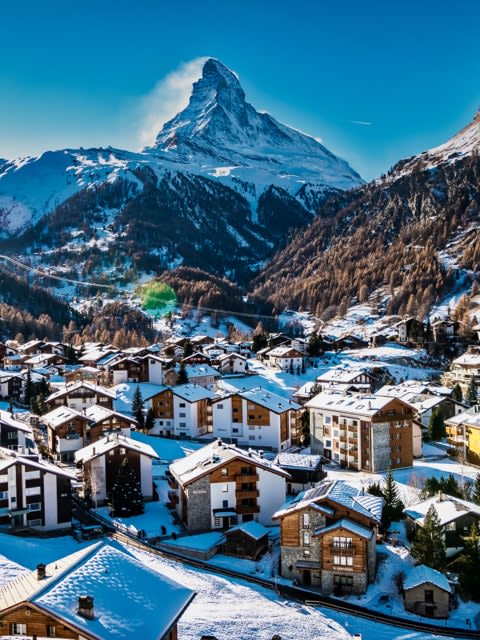
Zermatt is a car-free village at 1,620 m in the Valais, reachable only by train or helicopter. Electric taxis and horse-drawn carriages are the main transport. The village itself is a mix of traditional wooden chalets, high-end hotels, and excellent restaurants - it has more Michelin-starred dining than almost any ski resort in the world. The skiing fans out across three main areas: Sunnegga-Rothorn (sunny, family-friendly), Gornergrat (stunning views, good intermediate terrain), and the Klein Matterhorn-Schwarzsee sector which connects to Cervinia via the glacier. The vertical range is extraordinary - from the village at 1,620 m to the Klein Matterhorn at 3,883 m, you're looking at over 2,200 m of potential descent. The Matterhorn Glacier Ride cable car, completed in 2023, is the highest 3S gondola in the world and crosses directly above the glacier.
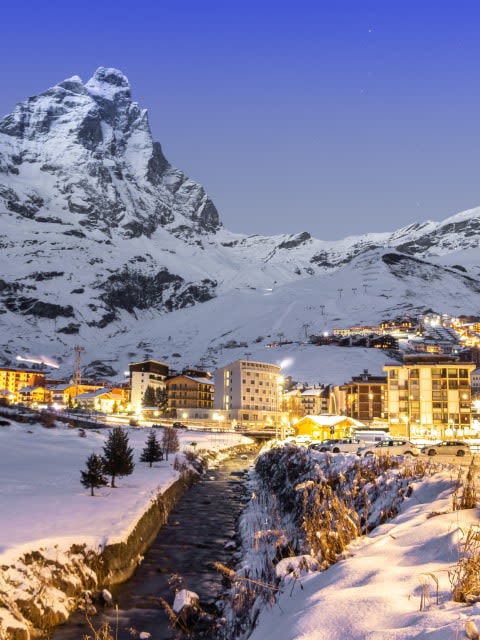
Breuil-Cervinia sits at 2,050 m in Italy's Aosta Valley, making it one of the highest resort bases in Europe. The skiing above is wide, open, and south-facing - ideal for long, sweeping intermediate runs with constant sunshine. The resort connects to Zermatt via the Plateau Rosa at around 3,480 m, and also links down to the smaller village of Valtournenche (1,524 m) below. Cervinia's character is distinctly Italian: good pizza, a relaxed pace, and a sociable atmosphere without the polish of Zermatt. The wide boulevards above the resort are some of the most forgiving intermediate slopes in the Alps, and the altitude keeps conditions reliable well into spring.
Cervinia is the better choice for beginners. The wide, gentle slopes above the resort are some of the most forgiving in the Alps - broad, well-groomed boulevards with a consistent gradient that lets you build confidence. The Plan Maison area at 2,555 m has a good nursery zone separated from faster traffic. On the Zermatt side, Sunnegga has a pleasant, sunny beginners' area with easy blues, though the terrain across the resort generally gets steeper more quickly. The high altitude means excellent snow quality, but beginners should be aware that the thin air above 3,000 m can be tiring.
Ski and snowboard lessons are available through WeSki in Zermatt, for adults and children.
WeSki tip: If you're a beginner, base yourself in Cervinia. The wide pistes above the resort are genuinely confidence-building - you'll never feel hemmed in. The altitude (2,050 m at the base) means the snow is excellent, but drink plenty of water and don't push too hard on the first day. By day two you'll have adjusted.
The 25 blues and 27 reds give intermediates an outstanding range, and the scale of the vertical is what makes it special. The long run from the Klein Matterhorn (3,883 m) all the way down to Zermatt (1,620 m) drops over 2,200 m - one of the greatest vertical descents in the world. On the Cervinia side, the wide reds from Plateau Rosa down to the resort are long, consistent, and beautifully groomed. Skiing from Zermatt over to Cervinia for lunch and back is a classic day out - you cross the border at nearly 3,500 m, drop into Italy for a pizza, and return in the afternoon sun. The Gornergrat sector above Zermatt has excellent reds with panoramic views of the Monte Rosa massif.
WeSki tip: The Italy day trip is one of the best experiences in Alpine skiing. Take the first lift from Zermatt towards Klein Matterhorn, cross the glacier into Italy, ski down the long red to Cervinia, have a leisurely Italian lunch, and head back in the early afternoon. Allow time - the return involves a climb back over the Plateau Rosa, and the last lifts close at a set time.
The 14 blacks are concentrated on the Zermatt side, particularly on the Stockhorn and Schwarzsee sectors. The Stockhorn (3,405 m) is the area's most challenging lift-served terrain - steep, north-facing, and with demanding off-piste routes that drop into the Triftji gorge. The off-piste around Zermatt is exceptional: long glacier descents, couloirs off the Breithorn (4,164 m), and classic touring routes. The Mont Rose tour - a multi-day ski mountaineering route - starts from the Zermatt area. On the Italian side, the terrain is gentler, but the open slopes above the treeline hold some worthwhile freeride lines after fresh snow. A mountain guide is essential for any backcountry skiing, particularly on glacier terrain.
WeSki tip: The Stockhorn cable car on the Zermatt side only runs when conditions allow, and it's the gateway to the steepest lift-served terrain in the area. When it's open after fresh snow, head there immediately - the north-facing bowl below holds powder well, but it tracks out quickly. Check the morning lift status at the Trockener Steg station.
The International pass covers all 360 km of piste and 52 lifts across both Zermatt and Cervinia on a single ticket, including the Klein Matterhorn glacier and year-round skiing. Passes are available from one day up to the full season, with discounted rates for children, teens, and seniors. Local Zermatt-only and Cervinia-only passes are also available at lower rates, though the international pass is strongly recommended if you want to ski both sides. The Zermatt-only pass also comes in a Sunnegga-Rothorn or Klein Matterhorn variant for half-day skiing.
You can add the lift pass directly to your WeSki booking, along with ski equipment hire at Cervinia, Valtournenche, and Zermatt - so everything's sorted before you arrive.
WeSki tip: The international pass is well worth it even if you only cross to Italy once. That one day - skiing from Switzerland into Italy over a glacier at 3,500 m and having lunch in a different country - is likely to be the highlight of your trip. The Cervinia-only pass is only worthwhile if you're certain you won't want to ski the Zermatt side at all.
The two resorts are in different countries, so the access routes differ. For Zermatt: Geneva is about 3 hours by car to Täsch (the last village you can drive to), from where a shuttle train takes you the final 12 minutes into car-free Zermatt. The Swiss rail network also runs direct trains from Zurich (about 3 hours 30 minutes) and Geneva (about 3 hours 45 minutes) to Zermatt via Visp. The train journey through the Rhône valley is scenic. For Cervinia: Turin airport is about 1 hour 45 minutes' drive, and Milan Malpensa is roughly 2 hours.
WeSki has private and shared transfers to Breuil-Cervinia, plus private transfers to Zermatt. Add them to your booking for a straightforward door-to-door trip.
The main season runs from late November to early May, but the Theodul Glacier provides year-round skiing - including summer. The altitude (most of the skiing sits above 2,000 m, with glacier terrain up to 3,883 m) means snow conditions are among the most reliable in the Alps. January to mid-March sees the deepest snowpack and the best powder conditions. The glacier keeps high-altitude runs in excellent shape from November right through to May and beyond.
Swiss school holidays in February and the Christmas-New Year period are the busiest times on the Zermatt side. Cervinia tends to be slightly quieter. If you've got flexibility, early January and the first half of March are excellent. Late season - April and May - is particularly rewarding: the lower slopes get spring conditions with warm sunshine, while the glacier remains firm and reliable. Summer glacier skiing (June to September) is limited to a handful of runs above 3,400 m but provides a unique experience.
Yes, particularly from a Cervinia base. The wide, gentle slopes above Cervinia are some of the most forgiving in the Alps. Zermatt's Sunnegga area also has pleasant beginner terrain. Ski and snowboard lessons for adults and children are available through WeSki in Zermatt. The high altitude means excellent snow quality but can be physically tiring for first-timers.
The area covers 360 km of marked piste served by 52 lifts, ranging from 1,524 m to 3,883 m at the Piccolo Cervino (Klein Matterhorn) - the highest lift-served point in Europe. There are 73 runs across all grades. Two resorts - Zermatt and Breuil-Cervinia - share the international pass.
Zermatt is a car-free Swiss village with traditional charm, high-end dining, and steeper, more varied terrain. Cervinia is a higher-altitude Italian resort with wide, sunny slopes, a relaxed atmosphere, and excellent intermediate cruising. Zermatt suits skiers who want character and challenge; Cervinia suits those who want sunshine and long, groomed runs. The two are linked by glacier lifts at around 3,500 m.
Yes. The international pass covers both countries, and the lift system connects Zermatt and Cervinia across the Theodul Glacier at around 3,480 m. You can ski from one side to the other and back in a day. The crossing point is one of the highest ski connections in the world. No passport is needed for EU and UK citizens.
Yes. The Theodul Glacier above the Klein Matterhorn (3,883 m) provides year-round skiing. Summer skiing (June to September) is limited to a handful of runs above 3,400 m but is available. The main season runs from late November to early May, with the glacier extending conditions at both ends.
The main season runs from late November to early May. January to mid-March sees the best powder conditions. Late season (April-May) is rewarding thanks to the altitude and sunshine. Summer glacier skiing is available but limited. Swiss school holidays in February are the busiest period.
For Zermatt: fly to Geneva (3 hr) or take the train from Zurich (3 hr 30 min) or Geneva (3 hr 45 min). Zermatt is car-free - you drive to Täsch and take a shuttle train. For Cervinia: fly to Turin (1 hr 45 min) or Milan Malpensa (2 hr). WeSki has private and shared transfers to Cervinia, and private transfers to Zermatt.
Yes. Ski and snowboard lessons are available through WeSki in Zermatt. Ski equipment hire is available at Cervinia, Valtournenche, and Zermatt. You can add both to your booking along with your lift pass and transfers.
The Klein Matterhorn (Piccolo Cervino) is a peak at 3,883 m between Zermatt and Cervinia, accessed by the Matterhorn Glacier Ride cable car - the highest 3S gondola in the world, completed in 2023. It's the highest lift-served point in Europe and the starting point for the glacier crossing between Switzerland and Italy. The viewing platform at the top has panoramic views of 38 four-thousanders including the Matterhorn, Monte Rosa, and the Grand Combin.
Start building your dream ski trip today with our one-stop ski shop - hundreds of resorts, unlimited combinations.


 4.9/5
4.9/5I usually book flights, transfers, hotel, ski rental and lift passes myself but this year used WeSki for a trip to Morzine. It was so much easier. Everything worked perfectly - transfers arrived on time and there was plenty of feedback throughout the whole process giving you confidence the holiday would go smoothly.

A really useful service that is so much easier to use than other 'all-inclusive' sites. It nicely bridges the gap between a travel agent and booking the trip yourself online. I will use WeSki every time I go skiing from now on.
We booked a late minute skiing trip to Morzine through we ski. We looked at booking the trip ourselves but could get anywhere near the price quoted by we ski. The company was excellent and we had no problems at all from start to finish. I would definitely use them to book another weekend skiing trip.
Seamless experience from start to finish. I was spending ages trying to sort out a weekend break and managed to do it with we ski in minutes and for the same price as booking it all up yourself. Flight, transfer and accommodation was all as expected and faultless.
WeSki is a trading name operated by Wetrip Weski Ltd (BR021500). All the flights and flight-inclusive holidays on this website are financially protected by the ATOL scheme. When you pay you will be supplied with an ATOL Certificate. Please ask for it and check to ensure that everything you booked (flights, hotels and other services) is listed on it. Please see our booking conditions for further information or for more information about financial protection and the ATOL Certificate go to: www.caa.co.uk.
Package holidays that do not include travel by air are financially protected via ABTOT.
For the latest travel advice from the Foreign & Commonwealth Office visit www.gov.uk/foreign-travel-advice.