
EN
EN
 Snow-sure resort
 Stunning views
 Off-piste skiingSnow-sure resortStunning viewsOff-piste skiingSnow-sure resortStunning viewsOff-piste skiingSnow-sure resortStunning viewsOff-piste skiing
Grand Targhee sits on the western slope of the Teton Range in Wyoming, in the United States, reached by a single mountain road up from the Teton Valley. Set on the range's storm-facing western side, it's one of the snowiest resorts in North America, its position catching Pacific storms as they pile into the peaks and delivering light, dry powder with real consistency. The base is a compact, welcoming village built in warm lodgepole pine and stone, with a handful of lodges, a few restaurants, and a friendly feel shaped by Western hospitality. The focus here is firmly on the mountain and the snow, and it's not unusual to spot wildlife grazing near the slopes.
The skiing covers around 2,600 acres and roughly 95 runs, with snowcat skiing available too for anyone chasing untracked powder beyond the lifts. Wide, gentle slopes near the base give beginners plenty of room to get comfortable, and the majority of the terrain is beautifully pitched intermediate cruising through open bowls and glades, much of it regularly topped up with fresh snow. If you're more advanced, you'll find steep glades, tree runs, and hike-to terrain to explore, and it's the deep, dependable powder that brings strong skiers back year after year. The season runs from late November to mid-April, and with over 12 metres of snowfall in an average year, conditions here stay reliable right through it.
Beyond the slopes, Grand Targhee has a laid-back Western character that's easy to settle into. The Trap Bar is the heart of après, with live music most afternoons and a warm, sociable atmosphere, and a horse-drawn sleigh ride to a dinner in a wood-fired yurt makes for a memorable evening out. There's an outdoor heated saltwater pool and hot tubs, 15km of groomed Nordic trails, snowshoeing with a naturalist, and fat biking on the snow. Down in the valley, the small towns of Driggs and Victor add relaxed, ranch-country charm, with local restaurants and bars for a change of scene.
Check out Grand Targhee ski deals to start planning your trip.
Grand Targhee sits on the western slope of the Teton Range in Wyoming, in the United States, reached by a single mountain road up from the Teton Valley. Set on the range's storm-facing western side, it's one of the snowiest resorts in North America, its position catching Pacific storms as they pile into the peaks and delivering light, dry powder with real consistency. The base is a compact, welcoming village built in warm lodgepole pine and stone, with a handful of lodges, a few restaurants, and a friendly feel shaped by Western hospitality. The focus here is firmly on the mountain and the snow, and it's not unusual to spot wildlife grazing near the slopes.
The skiing covers around 2,600 acres and roughly 95 runs, with snowcat skiing available too for anyone chasing untracked powder beyond the lifts. Wide, gentle slopes near the base give beginners plenty of room to get comfortable, and the majority of the terrain is beautifully pitched intermediate cruising through open bowls and glades, much of it regularly topped up with fresh snow. If you're more advanced, you'll find steep glades, tree runs, and hike-to terrain to explore, and it's the deep, dependable powder that brings strong skiers back year after year. The season runs from late November to mid-April, and with over 12 metres of snowfall in an average year, conditions here stay reliable right through it.
Beyond the slopes, Grand Targhee has a laid-back Western character that's easy to settle into. The Trap Bar is the heart of après, with live music most afternoons and a warm, sociable atmosphere, and a horse-drawn sleigh ride to a dinner in a wood-fired yurt makes for a memorable evening out. There's an outdoor heated saltwater pool and hot tubs, 15km of groomed Nordic trails, snowshoeing with a naturalist, and fat biking on the snow. Down in the valley, the small towns of Driggs and Victor add relaxed, ranch-country charm, with local restaurants and bars for a change of scene.
Check out Grand Targhee ski deals to start planning your trip.
The snow is part of what you’ll remember most about skiing in Grand Targhee. Sitting on the Tetons’ storm-facing side, it’s a mountain that draws in Pacific storms and turns them into some of the deepest, driest, and most reliable powder in North America. Powder days come thick and fast, and they shape the whole experience of skiing here. The terrain is built for it, with wide-open bowls and well-spaced glades that hold light snow beautifully. Most of the mountain is made up of rolling intermediate country, long cruisers and gentle bowls, with easy groomed runs near the base if you're starting out, and steep glades, chutes, and hike-to lines up high if you're chasing a challenge. It's a natural, unpretentious mountain where the pleasure is in the snow underfoot rather than the size of the trail map.
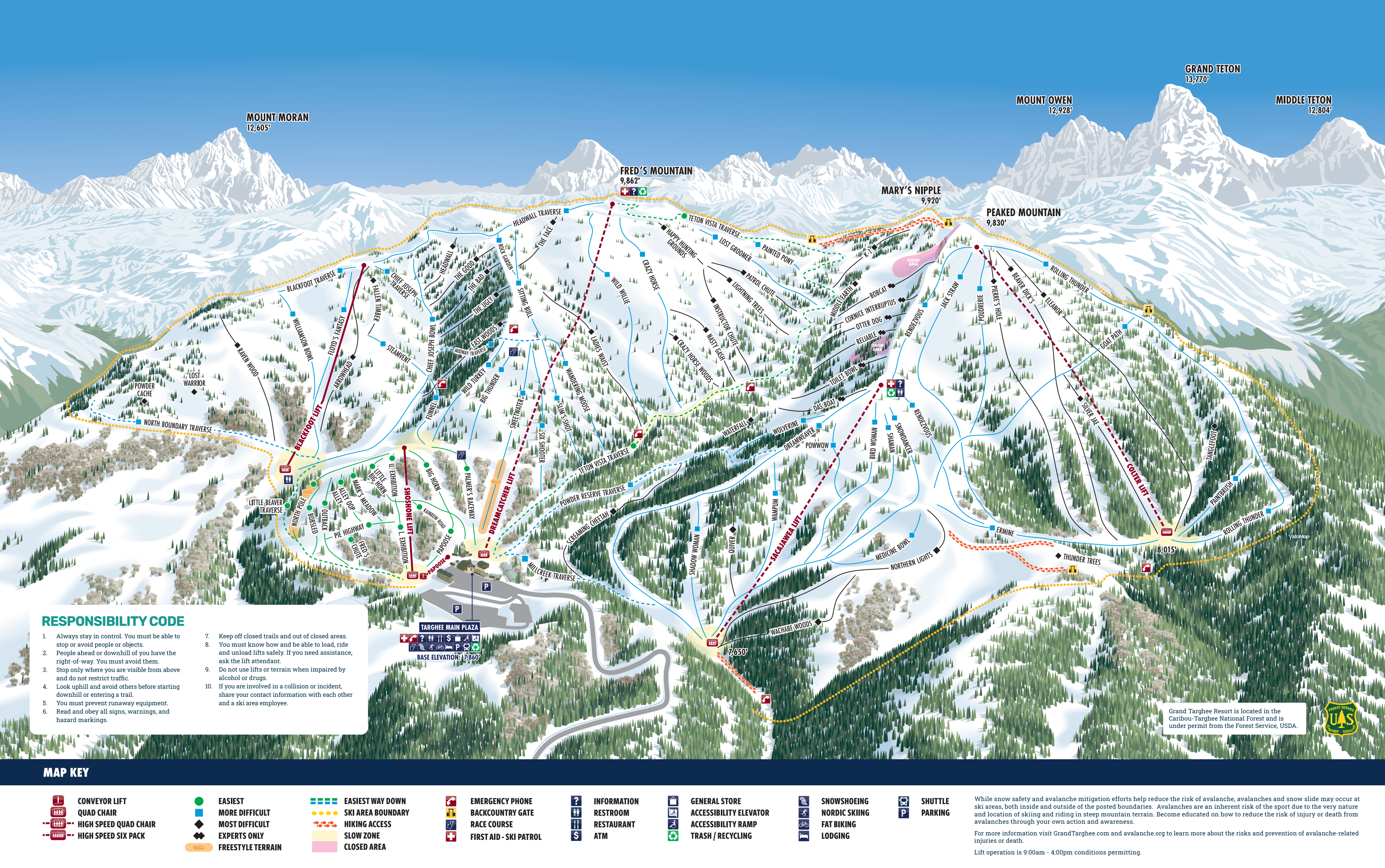
The pistes are spread over two linked mountains. Fred's Mountain, the main area, sits right above the base, alongside Peaked Mountain. Getting around is simple, with a handful of lifts covering the lot. From the base, a high-speed quad runs straight to the top of Fred’s, a fast quad and six-seater open up Peaked and the terrain between, and beginners have their own gentle lift by the village. The layout’s easy to read, and the main lifts are quick, so you can lap long, top-to-bottom runs without much fuss. And if you want to go further, Grand Targhee's snowcat operation runs trips into acres of untracked powder beyond the lift network.
Important for international visitors: Keep in mind that North America grades its runs differently from the Alps. Here you'll see green circles for the easiest slopes, blue squares for intermediate runs, and black diamonds, then double black diamonds, for advanced and expert terrain. As a rough guide, a North American blue sits close to an easy European red, and the blacks can be a good deal more demanding, so it's worth easing in for a run or two while you get a feel for how the grading compares.
First, the honest bit: Grand Targhee is first and foremost a powder mountain, so its dedicated beginner terrain is fairly modest in scale. What's here, though, is excellent for learning. All the beginner runs sit together at the base, served by the Papoose magic carpet and the Shoshone chair and set apart from the busier slopes, so you can take your first slides somewhere calm. Once you're off the carpet, wide, mellow greens like Big Horn, Outback, and The Meadows give you plenty of open space to practise long, slow turns and get comfortable on your edges. It's a gentle, well-groomed area, and with a friendly ski school on hand, an easy and unintimidating place to start.
There's room to progress as your confidence grows. The Shoshone area alone has more than a dozen green runs, ranging from very gentle to a little steeper, so you can keep stepping things up without leaving easy terrain, the run called Lower Elevation, right below the chair, is a good one to build towards, with a few steeper pitches to test yourself on. One thing worth knowing is that the jump from green to blue is a real step up here, and Targhee's blues can be demanding, especially in fresh snow, so take it steady as you move up, and a lesson or two pays off when you're ready to explore more of the mountain.
WeSki insider tip: Once you're steady linking turns, ride the Dreamcatcher lift to the top of Fred's Mountain and come down the Teton Vista Traverse. It's graded green and it's the longest run on the hill, something many beginners don't realise they can reach. It narrows in a couple of places and has a sharp turn or two, so take your time, and pull to the side when you want to soak up the view rather than skiing and gazing at once.
There's a lot for intermediates to enjoy at Grand Targhee, and most of the mountain is squarely intermediate country. The blue runs off Fred's Mountain are beautifully groomed and full of variety, so you can warm up on the mellow, view-filled Sitting Bull Ridge, let the skis run on wide cruisers like Chief Joseph, then test yourself on steeper groomers such as Crazy Horse and Wild Willie. Over on the Sacajawea side, Dreamweaver is full of banked turns and changes of pitch, while the Colter lift serves up Rolling Thunder, a sweeping run widely rated among the finest intermediate descents anywhere. Do keep in mind that North American blues cover a wide range, so expect everything from gentle confidence-builders to runs with steeper sections that ask more of your technique.
Grand Targhee is a great place for intermediates to progress. Once you're comfortable on the groomers, try out the open bowls and widely spaced glades, which are gentle and forgiving enough to explore without feeling out of depth. A good first move is Chief Joseph Bowl, easily reached off the top of the Dreamcatcher lift, which gives you a first taste of open, ungroomed terrain. From there you can venture gradually into the trees, building the confidence to handle the kind of rolling, tree-filled terrain Targhee is known for.
WeSki insider tip: Grand Targhee's high, open slopes can fog in when the weather closes, and flat light on the upper bowls makes the terrain hard to read. When that happens, do as the locals do and head for the Sacajawea lift. It sits lower down and its runs are cut through the trees, so you get far better definition and contrast underfoot on a day when the top of the mountain has whited out.
Grand Targhee rewards strong skiers, though it does so in its own way. Since its pitches are on the shorter side, this is less about long, sheer faces, and more about picking your way through exceptional natural terrain. Expect steep open bowls, tight chutes, cliff bands, and some of the best tree skiing in the Rockies. The Headwall, dropping straight off the summit ridge, is an obvious place to test your legs, with consistent pitch and several lines to pick from. From there, Blackfoot lift is usually quieter, and its glades hold fresh snow for days. The steepest, most committing terrain on the hill sits over on Peaked Mountain. Hike up from the top of the Sacajawea chair and you'll find a set of double-black chutes and cliff-dotted lines dropping down the north face.
Grand Targhee also runs a snowcat operation into a big area of untracked terrain beyond the lifts. You'll ride up by snowcat with a small group and a guide, with open bowls, chutes, and quiet tree runs to yourself for a taste of proper backcountry skiing. After fresh snow it's a superb way to find untouched powder, and it's worth booking a few days ahead, as places are limited and go quickly.
WeSki insider tip: For the best snow on the mountain, put in the short hike to Mary's Nipple, the high point of the ski area, reached by following the Teton Vista Traverse from the top of the Dreamcatcher lift. It's only ten to fifteen minutes on foot, but that bit of effort pays off, the bowls and glades just below the summit hold soft, untracked snow for days after the rest of the mountain has been skied out.
Grand Targhee has a powder-first culture that snowboarders slot straight into, with a shared focus on deep snow and good turns that makes it a welcoming place to ride. The mountain is a playground of wide-open bowls, rolling contours, and widely spaced glades, and the light, dry powder is easy to float and surf through. You can link natural drops and pillow lines, weave through the trees, and carve big turns out across the open faces, all the kind of riding a board is made for.
One practical thing to keep in mind on a board is that Targhee has a few flat traverses and catwalks linking its terrain. They can be slow going in deep snow, so carry your speed into them, especially the run-out below the Headwall, and you'll roll through without having to unstrap. If you're into freestyle, there are a couple of terrain parks on the lower mountain. They’re set up with jumps, rails, and boxes that build from small features up to medium and large hits, so there's room to progress your park riding.
Grand Targhee's frequent snowfall means the off-piste here is in good condition far more often than not, and it's a big part of the appeal. The best of it sits right inside the resort boundary. Between the marked runs you'll find glade after glade of tree skiing, with something to suit most abilities. In places the trees are widely spaced and forgiving, ideal if you're getting started off-piste, while elsewhere they tighten into steeper, more demanding lines for confident skiers.
For something bigger, the snowcat operation on Peaked Mountain opens up a large area of guided, untracked terrain beyond the lifts. Experienced skiers also have the wider Teton Range right on the doorstep, a renowned backcountry destination. Heading outside the boundary is a serious undertaking, though, so go with a guide, carry avalanche safety gear, and know how to use it.
The Grand Targhee Mountain Sports School runs group lessons and private tuition for all ages and abilities, from complete first-timers to seasoned skiers looking to sharpen up. Given the mountain, it's no surprise the school is well regarded for its powder clinics and tree-skiing sessions, which help intermediates make the step into off-piste terrain. There's also good specialist coaching on offer beyond the standard lessons, like dedicated telemark instruction and Nordic lessons on the cross-country trails. For anyone who wants tuition in a specific discipline, or just to get more out of Targhee's terrain, it's a strong, personable school to book with.
Grand Targhee has two terrain parks, set up so you can progress from one to the next. Beginners and anyone finding their feet on features start at the North Pole park off the Shoshone lift, with small boxes, rails, and rollers to get the hang of. When you're ready for more, the main Sweetwater park, off the Dreamcatcher chair, steps things up with medium and large jumps, rails, and boxes. Both are shaped and reshaped through the winter, so the features change as the season goes on. They tend to take shape once the snow builds up, so there's more to ride from midwinter onward than in the early weeks.
Grand Targhee is a welcoming place to bring a family. Everything centres on a small base village, where the lodges, restaurants, rental shop, and ski-school meeting point all sit within a couple of minutes' walk of the snow and of each other. That keeps the daily juggle of a family trip simple. You can get everyone booted up, dropped at lessons, and out on the slopes without much fuss, then regroup easily at lunch. It's a friendly, down-to-earth mountain with a relaxed Western feel and no glitz, which makes for a calm, unhurried family holiday.
A gentle beginner area sits right by the village, where children’s lessons from age three upwards. There's also a licensed on-mountain nursery for little ones from age one, so even pre-skiers are catered for while parents get out for a few runs. Themed adventure zones are dotted through the trees for young skiers, helping them enjoy the mountain as they progress. More experienced kids who are comfortable on blue runs will have a great time exploring here. The wide, open glades and soft snow make Targhee a perfect place to try skiing off-piste for the first time, and there's a terrain park for anyone keen to try jumps and rails.
Off the slopes, there are so many activities for the family that suit the area's remote and outdoorsy character. You can head out snowshoeing, try a dog-sled ride, or go snowmobiling down in the Teton Valley, and there's snow tubing right at the base for an easy afternoon with the kids. The small towns of Driggs and Victor, just down the hill, have a handful of family-friendly restaurants and shops, and the west entrance to Yellowstone is close enough for a memorable day out among the winter wildlife. Dining at the mountain is simple and hearty, with cafeteria-style lunches and casual spots around the base, and the Trap Bar is a friendly place to wind down together at the end of the day.
Grand Targhee sits in a spectacular corner of the American West, on the quiet, western side of the Tetons above Idaho's Teton Valley, with two of the country's great national parks, Yellowstone and Grand Teton, within reach. It's a wild, open landscape of snow-covered ranchland, forest, and soaring peaks, and the things to do here make the most of it, big scenery, small Western towns, and plenty of ways to get out into the mountains. Here's what's worth seeking out on a day off the slopes.
Dining at Grand Targhee is relaxed and unfussy, in keeping with the mountain itself. The base village keeps things simple with a handful of spots covering breakfast, lunch, and a proper sit-down dinner, and for more choice you can drop down into the Teton Valley towns of Driggs and Victor, about 20 minutes away, where a lively little scene of independent restaurants, breweries, and cafes has grown up. The cooking leans into its Western roots, so expect hearty, ingredient-led food built on the things this corner of the Rockies does well, ranch-raised beef and bison, local trout, Idaho potatoes, and wild huckleberries, cooked without fuss and served in generous portions.
WeSki insider tip: Look out for huckleberries, the small, tart, blueberry-like fruit that's the state fruit of Idaho and grows wild across these mountains. They turn up all over the valley through the season, in jams, pies, sauces, and even beers and spirits, but the one to seek out is a huckleberry milkshake, an old-fashioned local treat that's worth going out of your way for.
Après at Grand Targhee is low-key and friendly, centred on one lively bar at the base. When the lifts stop, the Trap Bar is where everyone heads, skiers, boarders, families, and cat-ski groups all piling in for a cold beer, a plate of the famous nachos, and live music on many afternoons. It's warm and easy-going, the natural place to sit back and talk over the day's snow. If you fancy a change of scene, the Teton Valley towns of Driggs and Victor, a short drive down the hill, have a handful of pubs, breweries, and taprooms pouring local craft beer in a relaxed, small-town setting.
Après-ski spots to know:
Grand Targhee's base village has a small cluster of slopeside lodges right at the foot of the slopes, the Targhee, Teewinot, and Sioux lodges. Between them they cover everything from simple, comfortable hotel rooms to roomier suites and condo-style units with kitchens and fireplaces, so there's something to suit couples, families, and groups alike. The style is warm and low-key, wood-built mountain lodging that's cosy and easy to settle into, and the real draw is how close you are to the snow. You can be clipped in and riding within a couple of minutes of your door, and back just as quickly when you want a break.
For a wider choice, the Teton Valley towns of Driggs and Victor, around 20 minutes down the hill, have more hotels, lodges, and rental cabins in a broader range of styles and sizes. Staying in the valley puts you closer to the area's restaurants, bars, and shops, with the trade-off of a daily trip up to the mountain. The road climbs from the valley floor up Ski Hill Road to the base and is well maintained through the winter, though it's worth carrying chains in a storm. A car makes a valley stay easiest, but Grand Targhee also runs a free daily shuttle from stops around Driggs and Victor if you'd rather not drive.
A Grand Targhee lift ticket covers all the lifts across both Fred's Mountain and Peaked Mountain, giving you the run of the resort's full marked trail network. The snowcat skiing on Peaked is a separate, guided experience, booked and paid for in addition to your lift ticket. Grand Targhee is also part of the Mountain Collective, a pass shared by a group of independent resorts around the world, so if you happen to hold one it includes a couple of days here, though for a week's stay a standard lift ticket is all you need.
Check for multi-day pass options when booking your Grand Targhee ski holiday through WeSki to find the best fit for your trip.
You'll find a well-stocked rental shop right in the base village, with ski and snowboard packages for all ages and abilities, plus high-performance and demo gear if you fancy trying something a bit sharper. It's worth asking about fat powder skis, given how much snow falls here, they make a real difference on a deep day, and the team will happily set you up with a pair. They know the mountain well, so they're a good source of advice on what to ride for the day's conditions. Booking online ahead of your trip is a good idea, especially over the busier holiday weeks.
Grand Targhee sits in Alta, Wyoming, on the western slope of the Teton Range. Three airports serve the area. The closest is Jackson Hole Airport (around 70km to the east), which takes seasonal direct flights from a number of US cities and offers the most scenic approach, though the route crosses Teton Pass, which can be slow or closed in winter storms. Idaho Falls Regional Airport (around 135km to the west) is the easier winter drive, with no mountain pass to cross. For most international travellers, the main gateway is Salt Lake City International Airport (around 450km to the south), which has the widest choice of long-haul connections and a straightforward drive north through Idaho into the Teton Valley.
Getting up to the resort from the Teton Valley is easiest by car, on Ski Hill Road, which climbs from Driggs to the base in about 20 minutes. It's well maintained through the winter but can be slow going in heavy snowfall. If you'd rather not drive, Grand Targhee runs a free daily shuttle from stops around Driggs and Victor, and there's also a paid shuttle service over from Jackson if you're staying that side. Parking at the base is free in most lots, with a small charge in the closest lot on weekends and holidays. One thing to plan around: a day trip to Jackson means crossing Teton Pass, which can close in storms and needs winter tyres or chains, so keep an eye on the road reports.
Grand Targhee sits in Alta, Wyoming, on the western slope of the Teton Range. Three airports serve the area. The closest is Jackson Hole Airport (around 70km to the east), which takes seasonal direct flights from a number of US cities and offers the most scenic approach, though the route crosses Teton Pass, which can be slow or closed in winter storms. Idaho Falls Regional Airport (around 135km to the west) is the easier winter drive, with no mountain pass to cross. For most international travellers, the main gateway is Salt Lake City International Airport (around 450km to the south), which has the widest choice of long-haul connections and a straightforward drive north through Idaho into the Teton Valley.
WeSki can arrange car hire from the airport or a private transfer to Grand Targhee, ready to add to your holiday package when you book.
Grand Targhee advertises over 12 metres (roughly 500 inches) of snowfall a year, which puts it among the snowiest lift-served resorts in North America. Its position on the western, storm-facing side of the Teton Range means it catches Pacific storms as they arrive, and the snow that falls is typically light and dry, classic Rocky Mountain powder. That reliable snow is the resort's defining feature and the main reason skiers make the trip out to this quiet corner of Wyoming.
They sit on opposite sides of the same mountain range but feel quite different. Jackson Hole is larger and steeper, with a lively resort town and plenty of dining and nightlife. Grand Targhee is smaller, quieter, and more laid-back, and it tends to get even more snow. Plenty of powder skiers love it for the consistency of the conditions and the relaxed feel, and because the two are about an hour apart over Teton Pass, some visitors ski both in a single trip.
It's one of Grand Targhee's highlights. A snowcat takes small groups up to a large area of untracked terrain on Peaked Mountain, open bowls, steep chutes, and quiet tree runs that your group has to itself. It's booked separately from a standard lift ticket, usually runs to ten or twelve runs across the day, and comes with a guide. Think of it as a step towards backcountry skiing without the climbing, and given Targhee's snowfall, the powder is reliably deep. Spaces are limited, so book ahead.
Yes, with one thing to keep in mind. There's a well-designed beginner area at the base, with gentle green runs and a friendly ski school, and the soft, forgiving snow makes it a lovely place to learn. That said, the mountain is best known for its powder and its intermediate and advanced terrain, so the beginner run selection is fairly modest. For a first-timer staying a full week, it works well as part of a wider trip, or as a few days of learning before moving onto the excellent intermediate terrain.
North American resorts grade runs a little differently from Europe. Green circles are beginner runs (much like European greens and easy blues). Blue squares are intermediate, but they cover a wide span, some are gentle cruisers, others are a good deal more testing. Black diamonds are advanced and steep, and double black diamonds are expert-only, often with very steep pitches, moguls, or cliffs. There's no exact equivalent to the European red, so confident intermediates should expect some blues here to feel quite demanding.
Yes, with a bit of planning. Yellowstone's west entrance, at West Yellowstone in Montana, is roughly two hours' drive from the Teton Valley. In winter the roads inside the park are open only to snowcoaches and guided snowmobile trips, which are a wonderful way to see the geysers, hot springs, and wildlife in the snow. Grand Teton National Park is closer and open year-round, with beautiful winter scenery and good wildlife watching. Either one makes for a memorable day off the slopes.
Yes, and that's a big part of its appeal. The resort sits at the end of a single road up from Driggs, Idaho, on the quiet western side of the Tetons. The nearest airports are Idaho Falls (about 90 minutes away) and Jackson Hole (about an hour, over Teton Pass), while Salt Lake City, roughly four and a half hours south, is the main international gateway. The remoteness keeps the mountain feeling peaceful and unspoilt, though it does mean a car is useful and travel days take a little more planning. The reward is some of the most consistent deep powder in North America.
 4.9/5
4.9/5I usually book flights, transfers, hotel, ski rental and lift passes myself but this year used WeSki for a trip to Morzine. It was so much easier. Everything worked perfectly - transfers arrived on time and there was plenty of feedback throughout the whole process giving you confidence the holiday would go smoothly.

A really useful service that is so much easier to use than other 'all-inclusive' sites. It nicely bridges the gap between a travel agent and booking the trip yourself online. I will use WeSki every time I go skiing from now on.
We booked a late minute skiing trip to Morzine through we ski. We looked at booking the trip ourselves but could get anywhere near the price quoted by we ski. The company was excellent and we had no problems at all from start to finish. I would definitely use them to book another weekend skiing trip.
Seamless experience from start to finish. I was spending ages trying to sort out a weekend break and managed to do it with we ski in minutes and for the same price as booking it all up yourself. Flight, transfer and accommodation was all as expected and faultless.

WeSki is a trading name operated by WeTrip Ltd. All the flights and flight-inclusive holidays on this website are financially protected by the ATOL scheme. When you pay you will be supplied with an ATOL Certificate. Please ask for it and check to ensure that everything you booked (flights, hotels and other services) is listed on it. Please see our booking conditions for further information or for more information about financial protection and the ATOL Certificate go to: www.caa.co.uk.
Package holidays that do not include travel by air are financially protected via ABTOT.
For the latest travel advice from the Foreign & Commonwealth Office visit www.gov.uk/foreign-travel-advice.