
EN
EN
 Hidden gem
 Snow-sure resort
 Stunning viewsHidden gemSnow-sure resortStunning viewsHidden gemSnow-sure resortStunning viewsHidden gemSnow-sure resortStunning views
June Mountain sits high in the Eastern Sierra, in one of the United States' most scenic mountain regions, above the small lakeside village of June Lake and a little north of Mammoth. It looks out over a chain of alpine lakes ringed by granite peaks, with the great bulk of Carson Peak rising straight above the village. It's a small, friendly mountain with an unhurried feel, where regulars come back year after year and families settle in with ease. June opened in 1961 and has held on to that welcoming character ever since, offering wide, open slopes and long Sierra views at a gentle pace.
The skiing spreads across around 1,500 acres, and though the mountain isn't a giant, there's a satisfying spread of terrain to work through at every level. Beginners have gentle, wide runs to learn on, including some easy terrain high up. Intermediates get the run of the place, with long, well-groomed blue cruisers making up the heart of the mountain. Strong skiers have more to get their teeth into than the mountain’s family reputation suggests, with open bowls, steep chutes, and plenty of gladed tree runs off the higher lifts. The longest run, Silverado, carries you a full 3.2km from the summit at just over 3,080m down to the base. The season generally runs from around December into April, fed by Sierra storms and held together by a high, cold snowpack that keeps the spring skiing going.
Down in the village, June Lake makes a relaxed and characterful base for a ski holiday. It's a small community strung along the lakeshore, with a handful of restaurants and bars, a well-stocked general store, and June Lake Brewing, a much-loved local brewery that has become the heart of the social scene. Beyond the slopes there's a quiet winter holiday to be had, with snowshoeing and cross-country skiing on the trails around the lakes, snowmobiling further afield, and frozen lakes and aspen groves to wander among. It's an easy-going, outdoorsy place, best for anyone who likes their mountain holiday wrapped in scenery and fresh air.
Check out June Mountain ski deals to start planning your trip.
June Mountain sits high in the Eastern Sierra, in one of the United States' most scenic mountain regions, above the small lakeside village of June Lake and a little north of Mammoth. It looks out over a chain of alpine lakes ringed by granite peaks, with the great bulk of Carson Peak rising straight above the village. It's a small, friendly mountain with an unhurried feel, where regulars come back year after year and families settle in with ease. June opened in 1961 and has held on to that welcoming character ever since, offering wide, open slopes and long Sierra views at a gentle pace.
The skiing spreads across around 1,500 acres, and though the mountain isn't a giant, there's a satisfying spread of terrain to work through at every level. Beginners have gentle, wide runs to learn on, including some easy terrain high up. Intermediates get the run of the place, with long, well-groomed blue cruisers making up the heart of the mountain. Strong skiers have more to get their teeth into than the mountain’s family reputation suggests, with open bowls, steep chutes, and plenty of gladed tree runs off the higher lifts. The longest run, Silverado, carries you a full 3.2km from the summit at just over 3,080m down to the base. The season generally runs from around December into April, fed by Sierra storms and held together by a high, cold snowpack that keeps the spring skiing going.
Down in the village, June Lake makes a relaxed and characterful base for a ski holiday. It's a small community strung along the lakeshore, with a handful of restaurants and bars, a well-stocked general store, and June Lake Brewing, a much-loved local brewery that has become the heart of the social scene. Beyond the slopes there's a quiet winter holiday to be had, with snowshoeing and cross-country skiing on the trails around the lakes, snowmobiling further afield, and frozen lakes and aspen groves to wander among. It's an easy-going, outdoorsy place, best for anyone who likes their mountain holiday wrapped in scenery and fresh air.
Check out June Mountain ski deals to start planning your trip.
June is a mountain with two distinct sides, and getting to know both is part of the fun. The front side holds the bulk of the groomed terrain, with long, rolling blue cruisers that suit intermediates especially well, and a gentle, confidence-building space for beginners to progress alongside. The back side faces away from the sun, so it keeps its snow for longer, and this is where the steeper skiing lives, with runs dropping through dense pine forest and opening into wide bowls up top. There's more here for advanced skiers than June's family reputation suggests, with steep pitches, proper tree runs, and open upper terrain to test yourself on. And because much of June's 1,500 acres is open, skiable ground between the marked trails, there's room to explore and pick your own line down, particularly through the trees.
It helps to understand the layout and what it’s like getting around June before you set off. The lifts are known by number rather than name, running from J1 up to J7. Your day starts on J1, a slow double chair that climbs from the base up to the June Meadows Chalet at mid-mountain. But from the chalet, things speed up. The two high-speed quads, J6 and J7, are the workhorses of the upper mountain, carrying you up to the summit terrain quickly so you can lap the best runs, while the Rainbow Chair (J4) serves cruising on the front side and J2 covers the beginner slopes and terrain parks by the chalet.
Important for international visitors: For anyone used to the European system, North American trail ratings work a little differently. Green circles are beginner runs, much like European greens and easy blues. Blue squares are intermediate but cover a wider range than European blues, so some will feel closer to a European red. Black diamonds are advanced, and double black diamonds are expert-only, steep and often left ungroomed. There's no direct equivalent to the European red here, so as an intermediate, expect the blue squares to vary a fair bit in pitch, and start on the gentler ones to get a feel for how June grades its terrain.
One of the nicest things about learning to ski here is that the beginner terrain sits high up the mountain rather than down at the base. You’ll start the day riding the J1 chair up to the June Meadows Chalet, where you can take your first turns at altitude with the peaks and lakes spread out around you. The dedicated beginner area has a magic carpet for your very first slides and a gentle, fenced-off space to practise in, set apart from the main runs with faster skiers. When you're ready for a little more, the J2 chair is right there serving mellow green runs like River Run and Desperado, so you can build up at your own pace without straying far from familiar ground.
As your confidence grows, the progression feels nicely gradual. Gentle greens like Bucky's give you room to open up, and from there, easy blue runs on the sunny front side are a natural next step. Since the mountain is compact and clearly signed, you're never far from the Chalet or a run you already know, and it's easy to push yourself a little and loop back to comfortable ground.
WeSki insider tip: Don't let the beginner label keep you down on the lower slopes. Once you can link your turns with confidence, ride the J6 quad up towards the summit and take Silverado, a long, gentle green that winds a full 3.2km from high on the mountain all the way back down.
Intermediates get the best of June, especially on the front side of the mountain where you’ll find excellent carving ground. The Rainbow Summit terrain, served by the J4 chair, gives you flowing cruisers with swathes of trees between them. One of the best is Gunsmoke, a wide angled groomer made for laying down big turns, while Silverthorne gives you a long, gentler cruise off the same summit. Over on the main J6 pod there's a good stock of both easygoing blues and more challenging runs, like the long, satisfying Schatzi dropping down from June Mountain Summit. The two high-speed quads, J6 and J7, keep the lapping quick, so you can put in plenty of vertical.
When you're ready to progress, move up to June Mountain Summit. As an intermediate, the Matterhorn is an excellent route to take down from the top. This is the single blue line through terrain that's otherwise steeper, so you can enjoy skiing from the summit without committing to a black. Taking on your first black is an easy step to make from here, because many of June's summit blacks are short. You can drop into a steeper pitch like The Wall knowing it won't last too long if it gets away from you, then ease back onto a cruiser afterwards.
WeSki insider tip: J6 is a great lift to lap as the main intermediate pod, but its runs have a flat section through the middle that leaves you poling and shuffling to keep your speed up. The runs off the Rainbow chair (J4) give you the same kind of cruising without that flat spot, so if you find yourself scooting along the flats, move your laps over to J4 and enjoy the carving uninterrupted.
June's best challenges for strong skiers are up on June Mountain Summit and down on the steep pitches near the base. Ride the J7 quad to the top and you'll reach the most reliable expert skiing on the hill, with steep and largely ungroomed runs like Davos Drop and Sunset falling away down the fall line, and tight tree skiing tucked between them. A few of these are rated double black, and while they're on the short side, they pack in some seriously steep pitches and the odd technical section. Lower down off the J1 base chair, you’ll find The Face, which is the steepest sustained run on the mountain and a proper leg-burner when it's well covered. But since it sits at a lower elevation, it needs a good snowpack to open, so it's worth checking whether it's in before you build a day around it.
Away from the marked runs, there's a lot of open, skiable ground to poke around in. You can often find fresh snow tucked away a good while after a storm, particularly in the trees and the sheltered pockets below the summit. For anyone with the right training and kit, a backcountry gate at the top of J7 opens onto a whole expanse of Sierra terrain beyond the boundary, though it doesn't feed back into the ski area. Wherever you point your skis up here, the near-790m of vertical from summit to base gives you long, sustained descents rather than stop-start ones.
WeSki insider tip: Make J7 your base for the day. It's the one lift with sustained and uninterrupted vertical, and because the runs fan out without crossing one another, you get a long, clean line to yourself on each lap. Many of the single-blacks here are groomed, so you can open up and carve at speed on steep, black-diamond pitches, then drop into the short double-blacks off the top when you want to test yourself.
Snowboarding is popular at June, which has long been a favourite with boarders as much as skiers. It's a freerider's mountain rather than a hardcore park scene, and that shapes what riding here is like. June’s terrain suits a board well, with wide, well-groomed cruisers on the front side that are made for carving clean turns, and the backside opens into natural bowls, gullies, and tree runs full of rollers and powder pockets. Because so much of the mountain is open, you have room to link creative lines of your own rather than sticking to the marked runs. One thing to plan for is June's flat spots. Some of the runs between the lifts, and the odd catwalk, can leave you unstrapping if you lose speed, so keep your momentum up through the flat sections.
For a mountain its size, June gives you plenty of scope to get off the groomers. Most of the in-bounds off-piste is over on the backside, where natural lines weave between marked runs through the Sierra pine forest. Above the treeline, open bowls and gullies give confident skiers more room to explore and pick a line of their own. All of this sits within the patrolled boundary, so it's a friendly place to build your off-piste confidence, though the usual caution applies once you leave the groomed runs: conditions vary from one aspect to the next, so keep your wits about you and your speed in check.
If you're properly equipped and want to go further, a backcountry gate at the top of J7 opens onto the wider Sierra, with a serious landscape of ridges, bowls, and glades that experienced ski tourers rate highly. This is true backcountry, so it isn't somewhere to head out on a whim. It's unpatrolled, there's no avalanche control, and it doesn't lead back into the ski area. The best way in is with a qualified local guide, and Sierra Mountain Guides run tours from a short hike off the summit, bringing the know-how and the safety kit.
June's ski and snowboard school is a small, personal operation. Group sizes stay low, the instructors know every corner of the mountain, and lessons have an attentive feel. For adults, there are first-timer lessons to get you going from scratch, and workshops for anyone past the basics who wants to sharpen their technique or work on a particular kind of terrain. If you'd rather have focused one-to-one time, private lessons can be built entirely around your goals, whether that's your first taste of off-piste, getting to grips with terrain park riding, or ironing out a stubborn habit, and you can bring up to four friends or family of a similar standard along on the same private at no extra cost.
June's terrain parks are all about progression, which makes them a welcoming place to get into freestyle whatever your level. They sit conveniently around the J2 lift, so you can lap them quickly and put in plenty of repetitions as you build up. The Playground is a great place to start, mixing shaped natural terrain with small jumps, rails, and boxes so beginners can get the hang of the basics one step at a time. From there, the Fun Zone is a boardercross-style run of rollers, banked turns, and small snow spines, which is good for working on your flow and carrying speed through the features rather than just hitting them one by one.
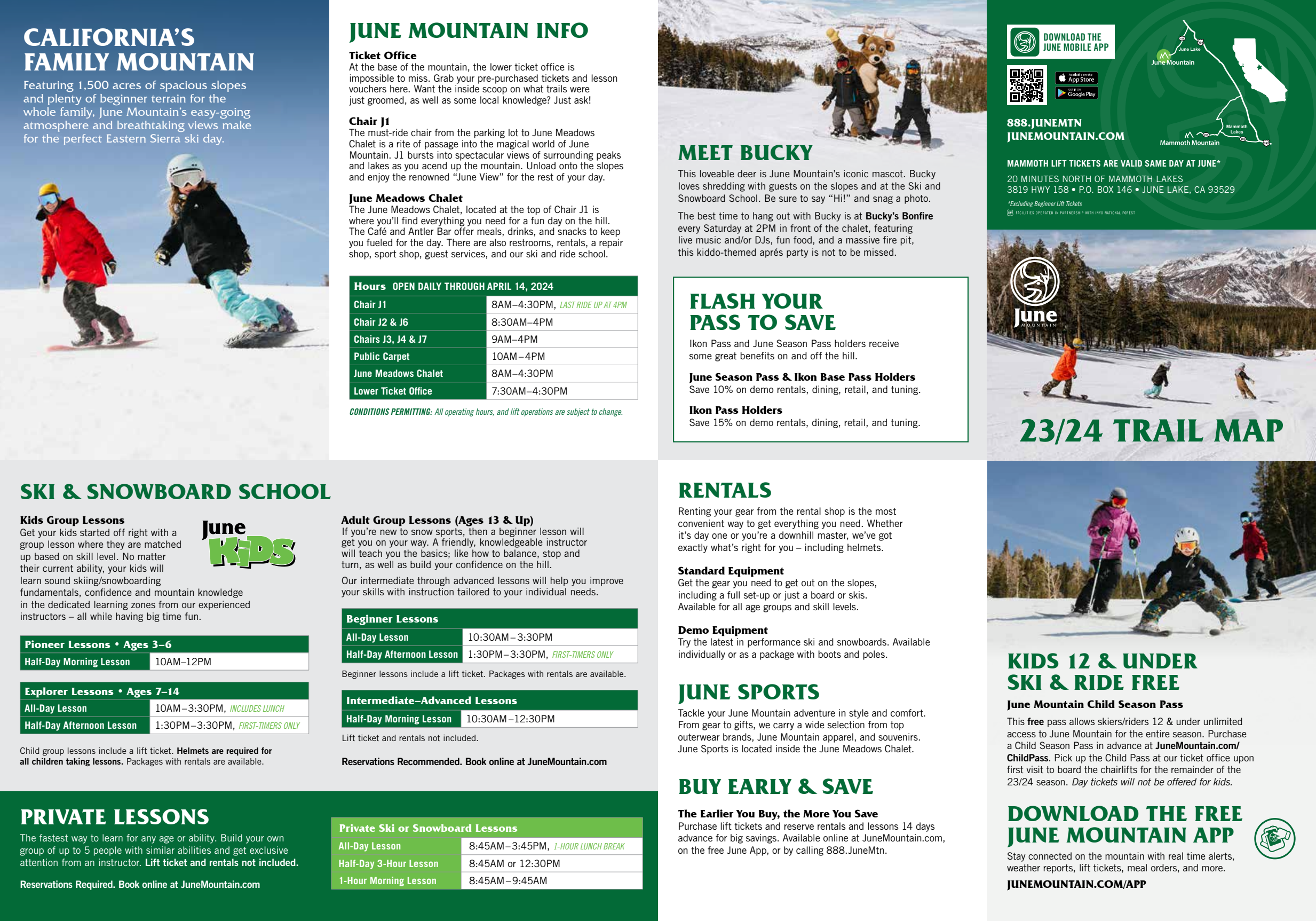
June Mountain has built a strong identity around families. It's a small, friendly mountain where children settle in quickly and parents can relax. Everything runs from a single mid-mountain lodge, so once you're up the hill you can let more confident kids lap runs on their own while keeping easy tabs on everyone. There's enough terrain and off-slope activity to keep children busy day to day without ever feeling overwhelming.
Younger children and first-timers start at the June Meadows Chalet, where a dedicated learning area and magic carpet give them a gentle space to begin. The ski school runs group lessons from age three, half-days for the youngest and full days with lunch for ages five and up. Everyone rides the J1 chair up to the Chalet for lessons, rentals and the learning slopes, and as it's one of the slower lifts, it's worth allowing an hour or more before a lesson starts. Children who already ski or ride will find plenty to grow into, from June's wide blues and steeper blacks to the terrain parks and the backside tree runs, which make a good family adventure once everyone's ready to explore them together.
Off the slopes, June Lake is small and easy-going, with restaurants and cafés strung along the lakeshore at the heart of village life. It's an outdoorsy base rather than a spot for shopping or big attractions, which suits a family holiday well. There's snowshoeing and cross-country skiing on the trails around the frozen lakes, plus gentle winter walks along the June Lake Loop. Eating out is relaxed, with casual places serving American food, wood-fired pizza and Hawaiian poke.
June Mountain sits in the Eastern Sierra, one of California's great outdoor corners, so the days you spend off the slopes are as memorable as the skiing. Activities here are built around the landscape, with frozen lakes, pine forests, and huge Sierra skies, and there's more than enough to fill a rest day or keep non-skiers happily occupied. It's an outdoorsy, unhurried sort of place, best for anyone who likes fresh air and open space on their days off the mountain.
On the mountain, dining is simple. June Meadows Chalet, the mid-mountain lodge, does canteen-style food and hot drinks, with a smaller outpost for a quick lunch stop. The real food scene happens down in June Lake, where the choice is characterful and eclectic. This is laid-back, family-run mountain-town food, so think classic American steakhouse dinners, an old-school bar and grill, New York-style pizza and, (less expectedly) excellent Hawaiian poke, with craft beer running through the whole scene. For a wider choice and a smarter night out, Mammoth Lakes lies about 30 minutes south.
WeSki insider tip: The fun of eating in a village this small and remote is how far it punches above its weight. Skip the idea that you'll only find basic mountain fare and seek out the local specialities that feel out of place this high in the Sierra, fresh Hawaiian poke and proper New York-style pizza are the two most worth tracking down.
Après-ski at June Mountain is full of easygoing vibes, in keeping with the mountain itself. It starts up at the June Meadows Chalet, whose sunny deck is a fine spot to see out the afternoon with a cold beer and a view over the snow-covered peaks. Down in the village, June Lake Brewing is the natural gathering point for visitors and locals alike, with craft beer and a warm taproom, while the Tiger Bar adds a dose of old-school roadside character. It's a relaxed, sociable scene, and if you're after a livelier evening, Mammoth Lakes has a wider choice of bars about half an hour south.
Après-ski spots to know:
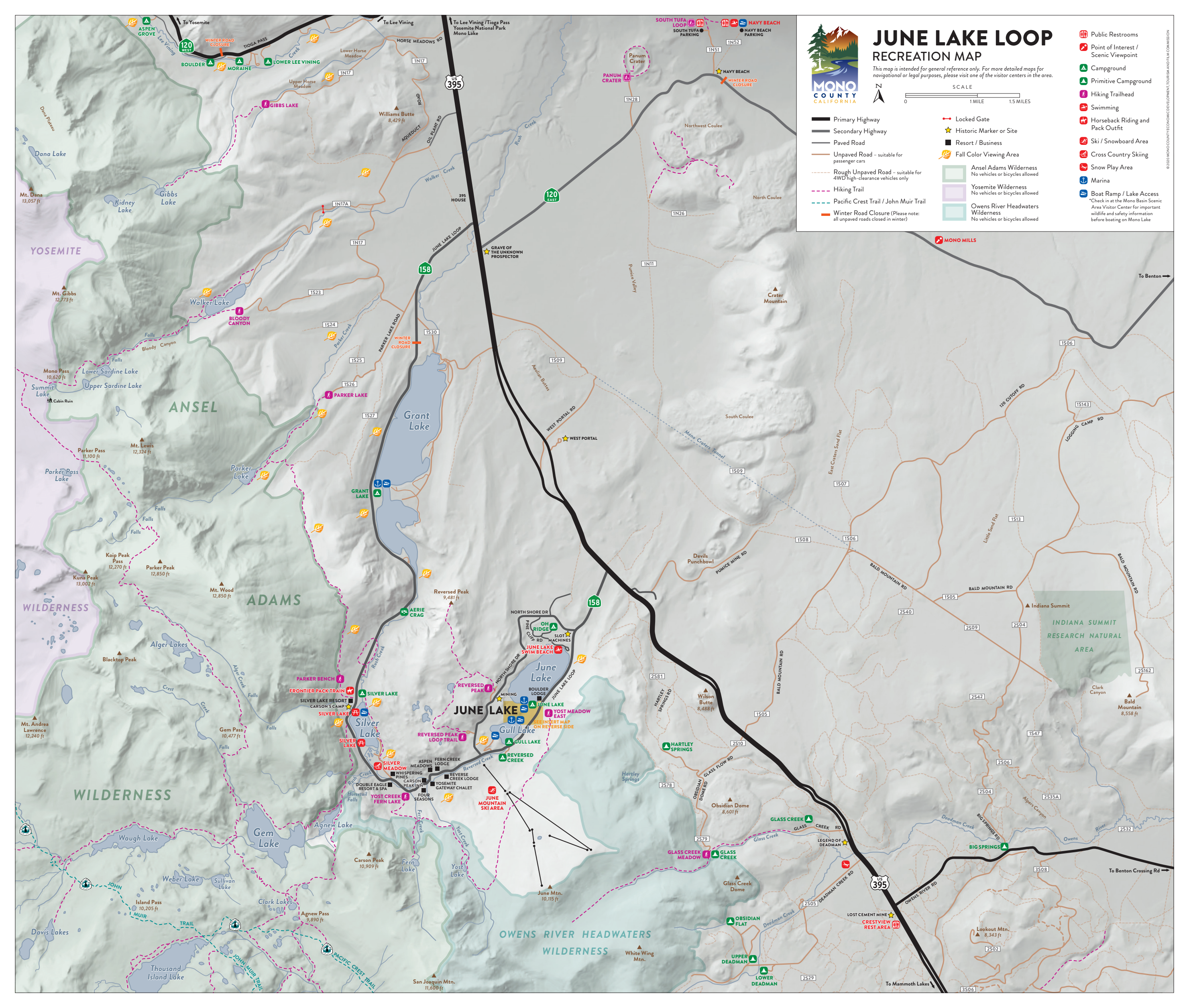
Accommodation is centred on June Lake village, where lodges, cabins, motels and vacation rentals line the lakeshore and the Loop road. The choice is small but varied, from simple motels to characterful cabins and lodges and a lakeside resort and spa at the higher end, many of them with lake or mountain views.
The village is small, with the general store, restaurants and bars grouped along the main street, and most accommodation sits within a five to ten minute drive of the mountain. A seasonal shuttle runs to June Mountain, though a car is useful for reaching the slopes on your own schedule and for exploring the wider Eastern Sierra. The roads through the village and up to the mountain are kept clear through winter, but it's worth driving with care during and after storms.
June Mountain has its own lift pass, and for a trip based here it's all you need, giving full access to the mountain and its terrain. The resort is owned by Alterra Mountain Company and is also on the Ikon Pass, which covers a network of resorts across North America. If you already hold an Ikon Pass or want to purchase one, it's valid here, but for a stay focused on June, the mountain's own pass is the simplest choice.
Check for multi-day pass options when booking your June Mountain ski holiday through WeSki to find the best fit for your trip.
June Mountain's rental shop sits on the first floor of the June Meadows Chalet, at the top of Chair J1, so you ride the chair up to collect your gear before your first run. It has ski and snowboard packages for all ages and abilities, from standard sets for beginners to higher-performance demo gear that more experienced skiers can swap between through the day. It's best to book online ahead of your trip, since the shop is set up around advance reservations, and to allow some extra time on your first morning to pick up your lift pass and ride up to the Chalet. If you're skiing more than one day, the Chalet offers overnight gear check, so there's no need to carry everything back and forth.
Getting around June Mountain couldn't be much simpler. At the base you park, pick up your lift ticket and step straight onto Chair J1, which takes you up to the Chalet, where the lodge, rentals and lessons are all based. Everything runs from that one hub, so the whole mountain opens up from a single point. There are no shuttle buses or separate base areas to work out, which means more time skiing and less time getting organised.
Off the mountain, you'll want a car. June Lake village is about a five-minute drive from the slopes, and Mammoth Lakes roughly thirty minutes south on Highway 395. A limited seasonal shuttle links Mammoth Lakes with June Lake, and some lodges run their own service to the mountain, but there are no local taxis or ride-hailing apps, so a hire car is comfortably the most practical way to get around, both for reaching the slopes on your own schedule and for anything beyond the village. The roads are kept clear through winter, though it's worth carrying chains or snow tyres, which can be legally required during storms.
June Mountain sits near June Lake in Mono County, on the eastern side of California's Sierra Nevada. For international visitors, the two main gateways are Los Angeles and Reno. Los Angeles International (LAX) offers the widest choice of international flights and is about a 520 km drive north, following Highway 395 up into the Eastern Sierra. Reno-Tahoe International in Nevada is the closer choice at around 250 km north, with good domestic connections. The nearest airport is Mammoth Yosemite, about 40 km south, which has seasonal flights from a handful of US cities, useful if the schedule suits, though most visitors arrive through LA or Reno.
WeSki can arrange car hire from the airport or a private transfer to June Mountain, both of which can be added to your June Mountain holiday package for a smooth door-to-door journey.
They're owned by the same company and sit about 30 minutes apart, but they're quite different mountains. Mammoth is one of California's largest resorts, with more than 3,500 acres, a big lift network and extensive facilities, a full-scale, high-energy destination. June is much smaller at around 1,500 acres, and more low-key and family-focused in feel. Both draw on the same Sierra Nevada storms, so the snow is broadly similar. The two share the Ikon Pass and are close enough that you can ski both on one trip, but June stands perfectly well on its own for anyone who prefers a small, relaxed mountain to the scale of a big resort.
Very much so, it's one of the mountain's real strengths. Its compact size, gentle beginner area and friendly ski school make it an easy place to bring children, and because everything runs from a single lodge, parents can give kids some freedom while keeping easy tabs on them. The terrain parks and intermediate runs give older or more experienced children plenty to enjoy, and June Lake village has a small, welcoming community feel. For rest days, the town of Mammoth Lakes, about 30 minutes away, adds a wider choice of activities and dining.
June sits under the same Sierra Nevada storm track as the wider region and picks up a good amount of snow, around 640cm in an average year. Its summit reaches about 3,080m, and much of the best terrain on the backside faces north, which helps keep the snow in good condition after a fall. The season usually runs from mid-December to mid-April, though, as anywhere, conditions vary through the winter with the weather.
June has 41 trails across 1,500 acres, with nearly 800m of vertical, and there's more skiing than the trail count suggests once you include the open terrain and tree runs between the marked pistes. For beginners, intermediates and families, that's plenty for a week, especially alongside lessons, the terrain parks and the off-slope activities around June Lake. Strong, advanced skiers chasing big, varied terrain may work through the marked runs in a few days, and can extend their range on the Ikon Pass, which also covers Mammoth half an hour away. But for most visitors, June comfortably fills a relaxed week on its own.
North American resorts grade runs differently from Europe. Green circles are the easiest beginner runs. Blue squares are intermediate, though they cover a wide range, from gentle cruisers to noticeably tougher pitches. Black diamonds are advanced and steep, and double black diamonds are expert-only, with the steepest slopes, moguls or drops. There's no direct equivalent to the European red, so confident intermediates should expect some blue runs to feel quite testing.
The June Lake Loop is a 26km stretch of road (Highway 158) that branches off Highway 395 and links four alpine lakes, June, Gull, Silver and Grant, beneath the surrounding Sierra peaks. It's the setting for the village of June Lake and much of the accommodation near the resort. In winter the northern end of the loop closes, so you reach the village and the mountain from the southern entrance off Highway 395. The frozen lakes and snow-dusted granite make it a striking arrival.
Yes. Mono Lake is about 25 minutes north of June Lake, reached via Lee Vining. This ancient saline lake is known for the tufa towers that rise from its surface, and it's a striking sight in the winter light. The South Tufa area can be visited in winter, though the final access road isn't cleared of snow, so it's worth checking conditions first. It makes an easy half-day trip that feels a world away from the ski slopes.
 4.9/5
4.9/5I usually book flights, transfers, hotel, ski rental and lift passes myself but this year used WeSki for a trip to Morzine. It was so much easier. Everything worked perfectly - transfers arrived on time and there was plenty of feedback throughout the whole process giving you confidence the holiday would go smoothly.

A really useful service that is so much easier to use than other 'all-inclusive' sites. It nicely bridges the gap between a travel agent and booking the trip yourself online. I will use WeSki every time I go skiing from now on.
We booked a late minute skiing trip to Morzine through we ski. We looked at booking the trip ourselves but could get anywhere near the price quoted by we ski. The company was excellent and we had no problems at all from start to finish. I would definitely use them to book another weekend skiing trip.
Seamless experience from start to finish. I was spending ages trying to sort out a weekend break and managed to do it with we ski in minutes and for the same price as booking it all up yourself. Flight, transfer and accommodation was all as expected and faultless.

WeSki is a trading name operated by WeTrip Ltd. All the flights and flight-inclusive holidays on this website are financially protected by the ATOL scheme. When you pay you will be supplied with an ATOL Certificate. Please ask for it and check to ensure that everything you booked (flights, hotels and other services) is listed on it. Please see our booking conditions for further information or for more information about financial protection and the ATOL Certificate go to: www.caa.co.uk.
Package holidays that do not include travel by air are financially protected via ABTOT.
For the latest travel advice from the Foreign & Commonwealth Office visit www.gov.uk/foreign-travel-advice.